

Why is Thermal Management Critical in a Small Size 8W Constant Current TRIAC Dimmable LED Driver
2026-05-29
When designing compact lighting solutions such as recessed downlights, puck lights, or under-cabinet fixtures, the Small Size 8W Constant Current Triac Dimmable LED Driver is a popular choice. However, its miniature enclosure presents a significant engineering challenge: heat dissipation. At STARWELL, we prioritize thermal management because it directly dictates driver lifespan, dimming performance, and safety. Poor heat control can lead to flickering, reduced output current stability, and premature driver failure.
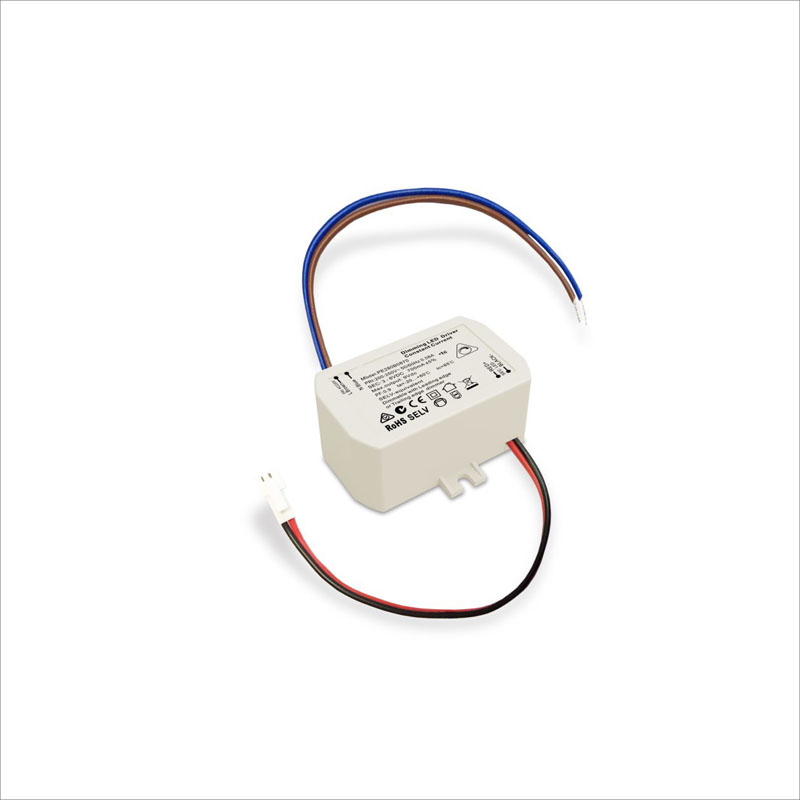
The Physics Behind Heat in a Compact Driver
A Small Size 8W Constant Current Triac Dimmable LED Driver contains multiple heat-generating components: the rectifier bridge, TRIAC dimming interface circuit, transformer, and output regulation IC. Unlike a standard driver, TRIAC dimming adds extra switching losses. In a small form factor, there is minimal surface area for natural convection, so heat accumulates quickly.
| Thermal Factor | Consequence in a Small 8W TRIAC Driver |
|---|---|
| Junction temperature rise above 85°C | Accelerated electrolytic capacitor aging (lifespan drops from 50,000h to 10,000h) |
| Hotspot on dimmer interface | TRIAC misfiring → step dimming or flicker |
| Enclosure temperature >60°C | Reduced safety margin for UL/CE compliance |
| Poor PCB copper heat spread | Current regulation drift ±15% instead of ±3% |
Quantifying the Impact on Dimming and Lifetime
Using infrared thermography, STARWELL engineers observed that a Small Size 8W Constant Current Triac Dimmable LED Driver without a thermal pad or aluminum substrate can reach 95°C internally at full load. This temperature level does two things:
-
Shifts output current – MOSFETs and sense resistors have positive temperature coefficients. At high heat, constant current can rise beyond 350mA (for a 24V 8W design), overdriving the LED array.
-
Destroys dimming linearity – TRIAC dimmers rely on holding current. Excess heat increases leakage current in the dimmer snubber, causing the driver to misinterpret the phase-cut signal.
STARWELL’s Thermal Design Approach
We embed thermal management into the electrical design from the beginning. Our Small Size 8W Constant Current Triac Dimmable LED Driver uses a double-layer PCB with 2 oz copper pour beneath the power components, plus a thermally conductive silicone potting compound. Below is a real comparison between standard and STARWELL thermal-optimized drivers under identical 8W TRIAC dimming load.
| Parameter | Standard Driver | STARWELL Thermal-Optimized Driver |
|---|---|---|
| Case temperature at 8W (Ta=40°C) | 82°C | 64°C |
| Output current drift (10 min warm-up) | +14% | +2.1% |
| Dimming range smoothness (1-100%) | 20-100% with visible step at low end | 1-100% continuous |
| Estimated lifetime (Tc=60°C) | 25,000 hours | 55,000 hours |
Small Size 8W Constant Current Triac Dimmable LED Driver FAQ
What happens if a Small Size 8W Constant Current Triac Dimmable LED Driver overheats during normal operation?
Overheating triggers a cumulative failure process. First, the internal electrolytic capacitors lose capacitance due to electrolyte evaporation, causing high output ripple (visible as LED flicker at 100/120Hz). Second, the TRIAC dimming control IC may enter thermal shutdown, leading to random on/off cycling. Finally, the constant current regulation fails, and the driver may deliver up to 400mA instead of the rated 333mA (for 24V output), permanently damaging the LED load. In extreme cases, the potting material can melt and expose live components. STARWELL drivers include a self-resetting thermal foldback circuit that reduces output current by 15% when internal temperature exceeds 85°C, preventing catastrophic failure.
Can I install a Small Size 8W Constant Current Triac Dimmable LED Driver inside a fully enclosed metal fixture without ventilation?
Yes, but only if the driver is specifically rated for “enclosed fixture” use. A standard open-frame driver inside a metal enclosure will see a temperature rise of 25-30°C above ambient. For example, at 25°C room temperature, the driver’s internal ambient becomes 55°C, and its case can reach 85°C. STARWELL offers a dedicated enclosed-fixture version of our Small Size 8W Constant Current Triac Dimmable LED Driver with a wider gap potting and an aluminum baseplate that conducts heat to the fixture body. Without such design, we recommend derating to 6W or adding a 5mm ventilation gap. Always verify the Tc (case temperature) max rating on the datasheet.
How does TRIAC dimming create additional heat compared to a non-dimmable constant current driver?
TRIAC dimming adds two thermal burdens. First, the dimmer itself chops the AC sine wave, creating high dV/dt (voltage change over time) transitions. The driver must absorb this energy through a damping circuit (usually a resistor and capacitor snubber), which dissipates heat with every half-cycle. At 8W output and 120V AC input, the snubber alone generates 0.6-0.8W of extra heat. Second, to maintain TRIAC holding current at low dimming levels (e.g., 5-10% light output), the driver draws a small “bleeder” current internally – another 0.3-0.5W loss. In a standard 8W driver, these additional losses raise total power dissipation from ~2W to ~3.2W, a 60% increase inside the same small volume. STARWELL uses a low-loss active bleeder and a silicon carbide snubber resistor to reduce these losses by 40%.
Conclusion
Thermal management is not an afterthought for a Small Size 8W Constant Current Triac Dimmable LED Driver – it is the foundation of reliability, flicker-free dimming, and safety. STARWELL builds every driver with high thermal conductivity materials, precise current foldback, and real-world testing at elevated temperatures.
Contact us today to request thermal test reports or engineering samples of our Small Size 8W Constant Current Triac Dimmable LED Driver family. Let STARWELL help you cool down your next LED lighting project with confidence.