

Why Does Terminal Count Matter in Aluminum Neutral Bars?
2026-09-21
When a panel builder specifies an Aluminum Neutral Bar, the first question is usually about ampacity. The second question is about terminal count. The second question is often more important for the long-term success of the project. A neutral bar with insufficient terminals forces the builder to double up wires under a single screw, which violates code in most jurisdictions and creates a maintenance hazard. A neutral bar with too many terminals wastes space and money. The correct terminal count depends on the number of circuits, the wire sizes, and the expected future expansion. This guide explains how to calculate the right terminal count and why it matters for code compliance, installation speed, and serviceability.
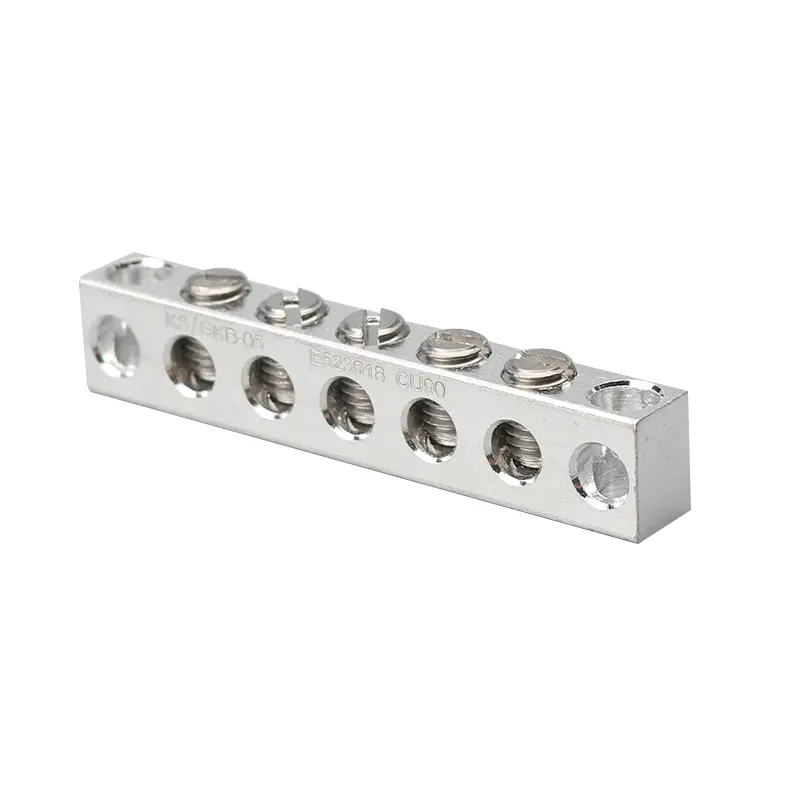
1. How Do You Calculate the Required Terminal Count for a Panel?
The required terminal count is determined by the number of circuits that will be connected to the neutral bar. In a typical electrical distribution panel, every branch circuit that supplies a 120V load requires a neutral connection. In a three-phase panel, the neutral bar must accommodate the neutral of every single-phase circuit and the neutral of any three-phase four-wire circuit. The National Electrical Code (NEC) requires that each neutral conductor be terminated in its own terminal. Two neutrals cannot be placed under the same terminal unless the terminal is specifically listed for that purpose. In our factory, we recommend adding 20 percent spare terminals to the calculated count to accommodate future circuits. The table below shows the relationship between circuit count and required terminals for common panel configurations.
| Panel type | Typical circuit count | Minimum terminals required | Recommended with 20% spare |
| Residential load center (120/240V) | 20 – 30 | 20 – 30 | 24 – 36 |
| Commercial panel (208Y/120V) | 42 – 60 | 42 – 60 | 50 – 72 |
| Industrial panel (480Y/277V) | 30 – 48 | 30 – 48 | 36 – 58 |
| Service entrance (1200A) | 60 – 100 | 60 – 100 | 72 – 120 |
Wenzhou Kangshuai Electronic Co., Ltd. manufactures Aluminum Neutral Bars with terminal counts ranging from 6 to 120. Our factory can also produce custom terminal counts for specific panel designs. The terminals are spaced on 0.625-inch or 0.750-inch centers, depending on the bar size.
2. What Happens When Terminal Count Is Insufficient?
An insufficient terminal count creates three problems. The first is code violation. The NEC and most local codes prohibit more than one neutral conductor per terminal unless the terminal is listed for multiple conductors. A panel that is wired with two neutrals under one screw will fail inspection. The second problem is loose connections. When two wires are forced under one screw, the screw may not tighten evenly on both wires. One wire may be loose, which creates a high-resistance connection. This can cause overheating, arcing, and eventually a fire. The third problem is maintenance difficulty. When a circuit needs to be removed or replaced, the electrician must disconnect the neutral. If two circuits share a terminal, the electrician must disconnect both, which interrupts power to a circuit that should remain energized. The table below shows the risk level associated with different terminal configurations.
| Terminal configuration | Code compliance | Connection reliability | Maintenance access |
| One wire per terminal | Compliant | High | Easy |
| Two wires per terminal (listed) | Compliant if terminal is listed | Moderate | Moderate |
| Two wires per terminal (not listed) | Violation | Low | Difficult |
| Three wires per terminal | Violation in all cases | Very low | Very difficult |
In our factory, we test every Aluminum Neutral Bars for terminal torque and pull-out strength. The terminals are made from extruded aluminum with a set screw that is designed to accept a single conductor. We also offer a dual-rated terminal that is listed for two conductors of the same size. This option is useful for panels where space is limited and the circuit count is high.
3. How Does Wire Size Affect Terminal Selection?
The terminal count is not the only consideration. The terminal must also be sized to accept the wire gauge that will be connected. A neutral bar with 20 terminals is useless if the terminals are too small for the 4 AWG wire that is used on the larger circuits. The terminal size is determined by the set screw diameter and the wire range marked on the bar. Most standard neutral bars accept wire from 14 AWG to 4 AWG. For larger wire, a separate terminal or a larger bar is required. The table below shows the wire range for our standard terminal sizes.
| Terminal size | Wire range (AWG) | Typical circuit ampacity | Set screw size |
| Small | 14 – 10 | 15 – 30A | 10-32 |
| Medium | 10 – 6 | 30 – 60A | 1/4-20 |
| Large | 6 – 2 | 60 – 125A | 5/16-18 |
| Extra large | 2 – 4/0 | 125 – 250A | 3/8-16 |
Wenzhou Kangshuai Electronic Co., Ltd. manufactures Aluminum Neutral Bars with all four terminal sizes. Our factory can also combine different terminal sizes on the same bar to accommodate a mix of large and small circuits. This is common in industrial panels where a few large feeders and many small branch circuits are present.
4. How Should Future Expansion Be Planned Into Terminal Count?
Future expansion is the most overlooked factor in terminal count selection. A panel that is specified with exactly the number of terminals needed for the initial circuits will require a new neutral bar when a circuit is added. This is costly and disruptive. The recommended practice is to add 20 percent spare terminals at the time of installation. For a panel with 30 circuits, this means specifying a bar with 36 terminals. The additional cost is minimal compared to the cost of replacing the bar later. In our factory, we also recommend leaving the last few terminals on the bar unused and clearly marked as spare. This makes it easy for the electrician to identify available terminals during future work.
Field tip: When installing an Aluminum Neutral Bars, label each terminal with the circuit number it serves. This simple practice saves hours of troubleshooting during maintenance and makes future expansion easier.
Frequently Asked Questions About Terminal Count in Aluminum Neutral Bars
Summary for Panel Builders and Electrical Contractors
Terminal count is a critical specification for Aluminum Neutral Bars. It determines code compliance, connection reliability, and future expansion capacity. The correct terminal count is based on the number of circuits, plus a 20 percent spare allowance. The terminal size must be matched to the wire gauge. By planning the terminal count carefully, panel builders can avoid code violations, reduce maintenance costs, and provide a panel that is ready for future growth. Wenzhou Kangshuai Electronic Co., Ltd. has been manufacturing Aluminum Neutral Bars for over 15 years and supplies to panel builders worldwide.
Wenzhou Kangshuai Electronic Co., Ltd. manufactures Aluminum Neutral Bars with terminal counts from 6 to 120, in a range of terminal sizes. We provide custom configurations and full test reports for all of our products.