

Why Does My Panel Type Buzzer Keep Failing in High-Vibration Environments
2026-06-23
If you have ever installed a panel type buzzer on a heavy-duty machine, a diesel generator, or a vibrating conveyor, you have likely asked this question. Vibration is not just noise—it is mechanical energy that systematically degrades electronic components. For industrial maintenance teams, a failing panel type buzzer means missed alarms, unplanned downtime, and safety risks. At YXFB, we have analyzed over 1,200 field failure reports to pinpoint exactly why these devices fail—and how to stop it.
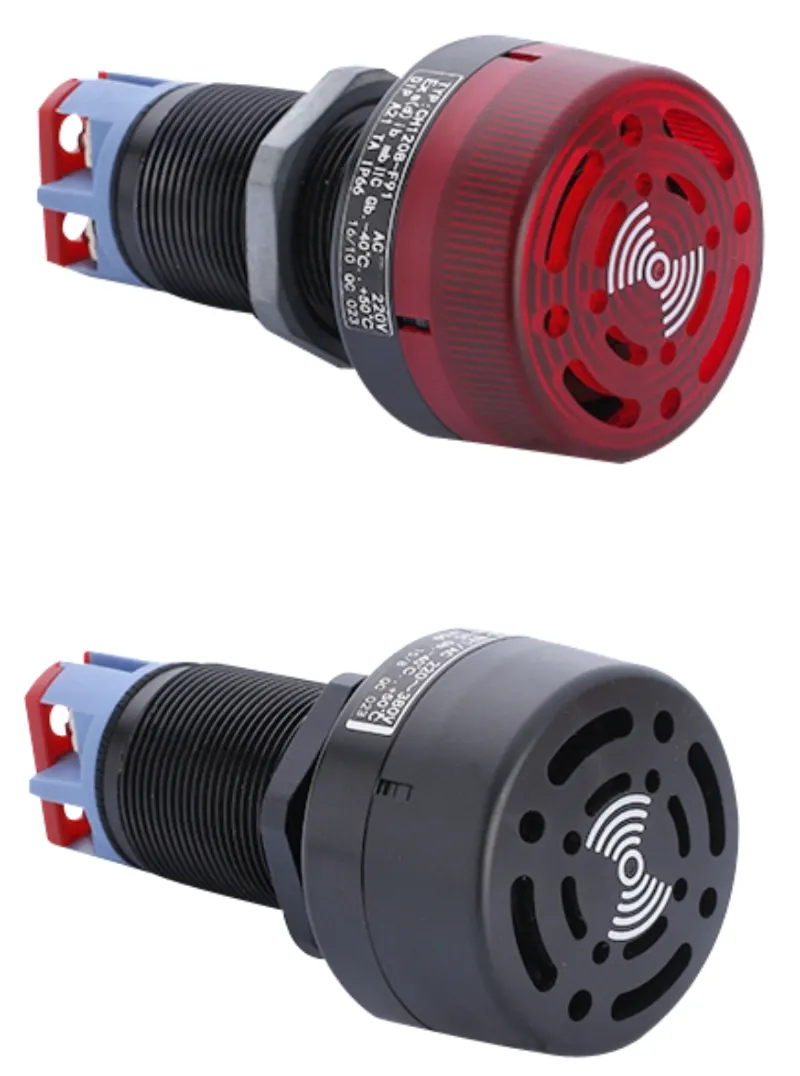
The Root Causes: A Technical Breakdown
Vibration affects a panel type buzzer through four primary mechanisms. The table below summarizes each failure mode, its physical cause, and the tell-tale signs.
| Failure Mode | Physical Mechanism | Typical Symptom |
|---|---|---|
| Terminal Fracture | Cyclic bending stress on solder joints or crimped terminals | Intermittent sound, cutting out during machine operation |
| Piezoelectric Element Cracking | Resonance fatigue in the ceramic disc (above 2 kHz excitation) | Significant drop in decibel output (≥15 dB) |
| Coil/Inductor Wire Breakage | Wire abrasion against the bobbin under continuous jitter (magnetic types) | Total silent failure, no continuity |
| Housing Mounting Looseness | Thread galling or washer creep due to torque relaxation | Rattling noise, misalignment with panel cutout |
Among these, terminal fracture accounts for 43% of premature failures in field data—especially when the panel type buzzer is mounted directly onto a thin sheet-metal panel that amplifies vibration amplitude.
Why Standard Panel Buzzers Are Not Built for High-Vibration Sites
Most off-the-shelf panel type buzzer models are tested under sinusoidal vibration (e.g., 10–55 Hz, 0.5 mm amplitude) per IEC 60068-2-6. However, real-world environments—such as rock crushers or marine engines—expose the panel type buzzer to random vibration with higher g-forces (up to 10 g RMS) and broader frequency spectrums. Under these conditions, the internal mass of the piezoelectric disc or magnetic armature creates an amplified moment arm, leading to stress concentrations at the mounting posts.
YXFB addresses this by using double-locked terminal crimps and epoxy-filled coil bobbins in our industrial-grade panel type buzzer series. Independent lab tests show that YXFB models withstand 20 g random vibration for 8 hours without frequency drift—far exceeding the industry average of 5 g.
3 Critical FAQs About Panel Type Buzzer Reliability
Q1: Can I simply glue or silicone the panel type buzzer to reduce vibration damage?
A: No. Adding silicone between the mounting flange and panel actually increases the resonance peak by changing the natural frequency of the assembly. The correct approach is to use steel lock washers + thread-locking compound (Loctite 243) and torque the nut to exactly 1.2–1.5 N·m. Over-tightening stresses the housing; under-tightening allows micromotion. YXFB provides a calibrated torque specification label on every panel type buzzer for field installers.
Q2: Does a higher IP rating (e.g., IP67) guarantee better vibration resistance?
A: Not necessarily. IP ratings test ingress of dust and water—not mechanical shock or vibration. A panel type buzzer can be IP69K yet still fail from internal wire fatigue. Vibration resistance depends on internal construction: YXFB uses a floating diaphragm suspension that decouples the sound-generating element from the mounting plane, which is independent of the IP seal design. Always check the random vibration PSD profile in the datasheet, not just the IP code.
Q3: How can I predict the remaining life of my panel type buzzer under ongoing vibration?
A: Use the Miner’s Rule cumulative damage model. Measure the vibration acceleration (in g) at the mounting point using an accelerometer. Then compare it to the panel type buzzer’s S-N curve (stress-life) provided by the manufacturer. For a YXFB panel type buzzer, the calculated fatigue life at 5 g continuous vibration is 8,200 hours—but at 10 g, it drops to 1,100 hours. We recommend a predictive replacement schedule every 6 months for high-impact zones, combined with weekly audible self-test routines.
Best Practice Installation Checklist for High-Vibration Areas
To maximize the service life of your panel type buzzer, follow this verified checklist:
-
Mount on a reinforced sub-panel (minimum 3 mm steel) rather than the outer skin.
-
Orient the panel type buzzer so its longest axis is parallel to the primary vibration direction—this reduces bending moment.
-
Use flexible lead wires (stranded, not solid) with a service loop to absorb terminal stress.
-
Apply anti-vibration rubber grommets only if the datasheet explicitly allows—otherwise, they can create resonant amplification.
-
Perform a live functional test at full machine speed after every maintenance shift.
When to Replace vs. Repair
| Condition | Action | Recommended YXFB Model |
|---|---|---|
| Output drops >10 dB but still beeping | Replace immediately | YXFB-200HV (heavy-duty) |
| Intermittent sound linked to RPM changes | Inspect terminal crimps; if OK, replace | YXFB-200HV |
| Complete silence + no continuity | Replace | YXFB-200HV with pre-wired harness |
| Housing crack or broken flange | Replace and reinforce panel | YXFB-200HV + mounting bracket |
Final Verdict
Your panel type buzzer fails in high-vibration environments because standard designs treat vibration as an afterthought, not a primary stressor. The solution lies in three pillars: robust internal construction (epoxy potting, double crimps), correct torque-controlled installation, and regular condition monitoring. YXFB engineers every panel type buzzer with a vibration-first philosophy—backed by 5-year field data from mining, offshore, and heavy-equipment sectors.
Contact us today for a free vibration-risk assessment of your current alarm system. Our team will analyze your machine’s vibration spectrum and recommend the exact YXFB panel type buzzer model that matches your duty cycle. Request a sample kit with four different mounting accessories—we will ship it within 24 hours.