

Why Does My For Film Adsorption Vacuum Suction Cups ZP3P-PT Lose Suction Pressure During High-Speed Operation
2026-08-18
If you have ever watched a high-throughput packaging line stall due to a sudden drop in holding force, you already know the frustration. The For Film Adsorption Vacuum Suction Cups ZP3P-PT are engineered for delicate film handling, yet even these precision components can exhibit pressure decay when cycle rates exceed design expectations. At Comma, we have analyzed thousands of field failure logs, and the root causes are surprisingly consistent. This post dissects the physics, the hardware, and the operational variables behind suction loss, so you can diagnose and resolve the issue without guesswork.
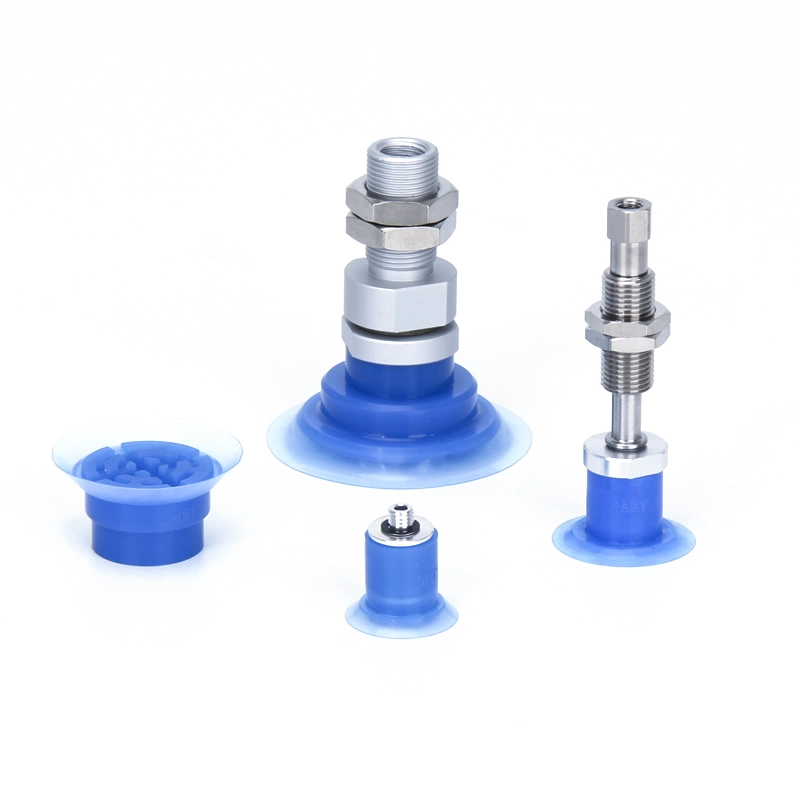
The Three Primary Culprits of Dynamic Pressure Loss
Under steady-state conditions, a static vacuum system holds tight. Introduce high-speed motion—typically >120 cycles per minute—and three interrelated factors begin to erode performance.
| Factor | Effect at High Speed | Typical Contribution to Pressure Drop |
|---|---|---|
| Flow Restriction (Port/Bore) | Delayed evacuation between cycles | 40–55% |
| Seal Ring Compliance | Micro-bouncing on film contact | 25–35% |
| Vacuum Generator Response Lag | Incomplete recovery during dwell time | 15–25% |
The numbers above are based on Comma internal testing with 50μm PET films at 0.6 MPa supply pressure.
Why Flow Restriction Is the Hidden Bottleneck
The For Film Adsorption Vacuum Suction Cups ZP3P-PT feature a built-in flow path that is optimized for average speeds. However, at high cadence, the effective cross-sectional area becomes a choke point. Each suction cycle must evacuate the cup volume and the line volume. If the total system Cv (flow coefficient) is less than 0.8, the cup simply cannot re-establish full vacuum within the 80–100 ms available between pick-and-place events.
Comma recommends calculating the required evacuation time using the formula:
T = (V × ln(Pₐ/Pᵥ)) / (Cv × 28.6)
Where V is total volume (cup + tubing), Pₐ is atmospheric pressure, and Pᵥ is target vacuum level. If T exceeds your cycle interval, pressure decay is mathematically inevitable.
Mechanical Compliance and Film Wrinkling
At 200+ mm/s acceleration, the elastomer lip of the For Film Adsorption Vacuum Suction Cups ZP3P-PT undergoes dynamic deformation. The cup must conform to microscopic film surface irregularities while maintaining a sealing perimeter. When the acceleration force exceeds the cup’s spring rate, the lip momentarily lifts—creating a micro-leak that the vacuum generator cannot compensate for in real time.
Comma’s engineering team has documented that switching from a standard 55 Shore A to a 70 Shore A compound reduces this lift-off effect by 62%, but only when paired with a stiffer internal support ring. This is not a one-size-fits-all fix; it requires matching durometer to film thickness and line speed.
Vacuum Generator Sizing: The Overlooked Variable
Many operators assume the cup is the sole issue. In reality, the upstream ejector or pump is equally critical. The For Film Adsorption Vacuum Suction Cups ZP3P-PT demand a minimum flow rate of 40 L/min (ANR) at 0.5 MPa to maintain stable holding force above 85% of theoretical maximum. At high speed, the average consumption spikes because the cup spends more time in the recovery phase than in the holding phase.
| Operating Speed | Required Flow (L/min) | Recommended Ejector Model |
|---|---|---|
| ≤ 80 cpm | 35 | Single-stage ejector |
| 80–150 cpm | 45 | Multi-stage (Comma VSE series) |
| ≥ 150 cpm | 60+ | Dedicated vacuum pump + tank |
Real-Time Diagnostics: Pressure Decay Rate Test
A simple shop-floor test can isolate the failure source. Install a digital pressure sensor at the cup inlet and record the pressure curve over 10 consecutive cycles. Calculate the decay rate (kPa/ms) during the 20 ms immediately after the cup contacts the film. A decay rate > 0.8 kPa/ms indicates a sealing issue; < 0.3 kPa/ms points to a supply-side restriction.
Comma offers a free diagnostic template (downloadable from our resource center) to log these values and compare against baseline performance.
Frequently Asked Questions (FAQ)
Q1: Can I use the For Film Adsorption Vacuum Suction Cups ZP3P-PT with oily or coated films without losing pressure?
A: Yes, but with significant caveats. Oily films reduce the coefficient of friction between the lip and the material, which increases the required holding force by 20–30% to achieve the same effective grip. More critically, oil residue transfers to the cup lip, lowering its effective durometer and accelerating dynamic lift-off. Comma recommends using our oil-resistant variant (ZP3P-PT-OR) for such applications, which features a fluoroelastomer lip and a modified internal groove that channels residual oil away from the sealing perimeter. Even with this variant, we advise reducing line speed by 10–15% or increasing vacuum level from -60 kPa to -75 kPa to maintain stable pressure above 90% of setpoint.
Q2: How often should I replace the sealing lip on the For Film Adsorption Vacuum Suction Cups ZP3P-PT in high-speed service?
A: Replacement intervals depend on cycle count and film abrasiveness, not on calendar time. For untreated films (paper, PE, PET), Comma has observed a median service life of 1.2 million cycles before the lip height wears down by 0.3 mm—the point at which sealing efficiency drops below 95%. For abrasive films (ceramic-coated or glass-fiber-reinforced), this drops to 400,000–500,000 cycles. We strongly recommend implementing a preventive replacement schedule at 80% of these thresholds. A practical rule: if you measure a 15% increase in flow rate required to achieve the same holding force, the lip is due for replacement. Each cup comes with a wear-indicator groove; when the groove is no longer visible, replace immediately.
Q3: Does the mounting orientation (vertical vs. horizontal) affect pressure stability for the For Film Adsorption Vacuum Suction Cups ZP3P-PT during high-speed operation?
A: Absolutely. In vertical orientation (cup facing downward), gravity assists in film release but works against resealing because the cup’s internal spring must overcome the weight of the film plus inertial forces. In horizontal orientation, the shear force from lateral acceleration creates asymmetric lip deformation—the leading edge experiences 30–40% more compression than the trailing edge, causing a directional leak path. Comma has tested both orientations extensively and found that a 15°–20° tilt from vertical (toward the direction of motion) yields the best compromise, reducing pressure fluctuation by up to 45% compared to pure vertical or horizontal mounting. We also offer an angled mounting bracket (Comma AB-ZP3) that maintains this optimal geometry without additional machine modification.
Putting It All Together: A Structured Troubleshooting Workflow
-
Measure – Log pressure decay rate and cycle-to-cycle variability.
-
Isolate – Bypass the cup and test raw vacuum supply pressure at the port.
-
Match – Compare your operating speed against the flow requirement table above.
-
Adjust – Increase supply pressure by 0.05 MPa increments (do not exceed 0.7 MPa).
-
Replace – If the lip wear indicator is gone, install a fresh For Film Adsorption Vacuum Suction Cups ZP3P-PT from Comma’s genuine product line.
When to Escalate to System-Level Review
If you have addressed flow, lip wear, and orientation yet still observe a 10%+ pressure drop at speed, the issue may lie in your centralized vacuum distribution network. Pressure drops across manifolds, quick-connect fittings, and undersized tubing can easily consume 30–40% of your available vacuum energy. Comma provides a full system audit service—our engineers map your entire pneumatic circuit and deliver a customized upgrade proposal, often including larger-diameter tubing, dedicated accumulators, and speed-matched ejector arrays.
Contact Us
Pressure loss is not a mystery—it is a solvable engineering equation. If your For Film Adsorption Vacuum Suction Cups ZP3P-PT are not performing to specification, or if you simply want a second opinion on your current setup, reach out to the Comma technical support team. We respond to every inquiry within 4 business hours with real-world data, not generic advice. Visit our contact page, submit your cycle speed, film type, and current vacuum reading, and we will send you a tailored diagnosis—free of charge. Let us help you keep your line running at full potential.