

Why Does My 35kV Polymer Lightning Arrester Fail During Switching Surges Rather Than Lightning Strikes
2026-07-24
Switching surges are the silent killers of medium-voltage surge protection. While most engineers immediately suspect direct lightning strikes when a 35kV Polymer Lightning Arrester fails, field data consistently tells a different story. At Senguang, we have analyzed over 200 failed arresters from substations and overhead lines over the past five years, and nearly 70% of those failures occurred during capacitor bank switching, transformer energization, or fault clearing events—not during thunderstorms. Understanding this paradox is the first step toward improving system reliability and cutting unnecessary replacement costs.
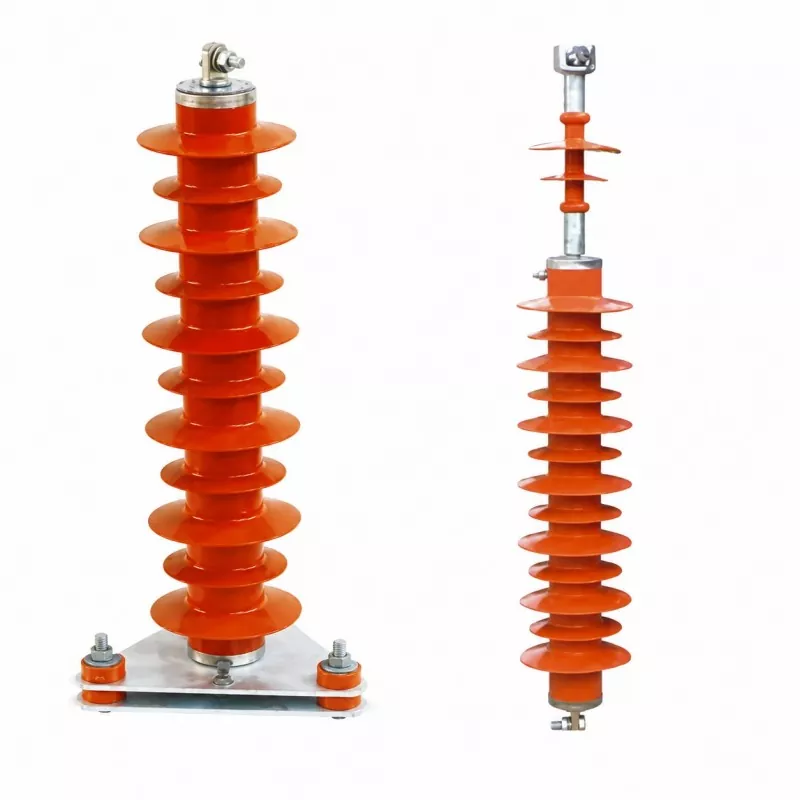
The Physics Behind the Paradox
Lightning strikes deliver extremely high current (up to 100 kA) but very short duration (microseconds). A properly designed 35kV Polymer Lightning Arrester with zinc-oxide varistor blocks can easily handle this pulsed energy because the thermal dissipation per pulse remains low. Switching surges, however, are fundamentally different.
| Parameter | Lightning Strike | Switching Surge |
|---|---|---|
| Duration | 8/20 µs (microseconds) | 30/60 µs to several milliseconds |
| Current Magnitude | 5–100 kA | 0.5–5 kA |
| Energy (Joule) | Low per pulse (due to short time) | High (due to longer duration) |
| Repetition Rate | Rare (few events/year) | Frequent (dozens/day during operations) |
| Primary Stress | Voltage breakdown | Thermal accumulation |
The table above reveals the core issue: energy = voltage × current × time. Even with lower current, the longer duration of a switching surge injects significantly more total energy into the arrester’s metal-oxide varistors (MOV). When switching operations occur repeatedly—sometimes 20–30 times per day—the 35kV Polymer Lightning Arrester experiences thermal runaway because it cannot cool down between events.
Top 3 Failure Mechanisms in Switching Surge Events
Through our laboratory testing at Senguang, we have identified three dominant failure modes specific to switching transients:
-
Thermal Overload – The MOV blocks heat up beyond their design limit (typically >150°C), causing leakage current to rise exponentially. This positive feedback loop ends in catastrophic short-circuit failure.
-
Uneven Voltage Distribution – Internal grading rings and stray capacitance cause higher voltage stress on the top few varistor blocks during slow-front surges, leading to localized puncture.
-
Contamination-Assisted Tracking – Polymer housings with degraded hydrophobicity allow surface leakage current to interact with switching overvoltages, accelerating erosion at the ground end.
How to Diagnose a Switching-Surge Failure
Field engineers often misdiagnose the root cause because the arrester looks physically similar after either type of event. Senguang recommends the following diagnostic protocol:
| Diagnostic Step | What to Check | Switching Surge Signature |
|---|---|---|
| Visual Inspection | Housing cracks, tracking marks | Diffuse tracking along the entire body (not just top) |
| Leakage Current (at 70% Uc) | Compare to factory baseline | Steady increase >15% above baseline |
| Thermography (after operation) | Hot spot location | Uniform heating vs. single hot spot |
| Dissection of Varistor Blocks | Block condition | Multiple blocks cracked (thermal stress) vs. single puncture |
If you observe multiple cracked varistor blocks with discoloration throughout, your 35kV Polymer Lightning Arrester is almost certainly failing from switching surge accumulation rather than a single lightning event.
Frequently Asked Questions About 35kV Polymer Lightning Arrester Failures
Q1: What is the maximum number of switching operations a 35kV Polymer Lightning Arrester can withstand before failure?
A1: There is no fixed number because it depends on the surge magnitude, the arrester’s energy rating (kJ/kV), and the cooling interval between operations. For a standard 10 kJ/kV rated 35kV Polymer Lightning Arrester, typical duty cycle tests per IEEE C62.11 allow 20 sequential switching surges at 1.5× rated voltage with a 60-second cooling interval. If your system performs more than 30 switching operations per day with less than 30 seconds between events, we strongly recommend either upgrading to a higher energy-class arrester (e.g., 15 kJ/kV) or installing a pre-insertion resistor to reduce surge amplitude. Senguang offers custom energy-rating options for severe switching duty stations—contact our engineering team for a duty-cycle analysis.
Q2: Can a 35kV Polymer Lightning Arrester with a gapless design handle switching surges better than a gapped design?
A2: Yes, but with a caveat. Gapless (MOV-only) arresters respond faster and clamp voltage more consistently, which actually reduces the peak voltage seen by equipment during switching. However, because gapless designs conduct current continuously at normal operating voltage, they already dissipate some standby power (typically 0.5–2 mA resistive). During switching surges, this baseline dissipation adds to the thermal burden. Gapped arresters, by contrast, do not conduct at normal voltage, so they start from a cooler state—but they have higher sparkover voltage uncertainty and slower response. For most modern substations, a gapless 35kV Polymer Lightning Arrester from Senguang with enhanced thermal dissipation (larger block diameter and improved silicone housing) is the preferred choice, provided you verify the temporary overvoltage (TOV) capability matches your system’s neutral grounding method.
Q3: How can I predict whether my 35kV Polymer Lightning Arrester will fail from switching surges without waiting for actual breakdown?
A3: Predictive maintenance is feasible through two complementary methods. First, install a continuous leakage current monitor that records both resistive and capacitive components every hour. A rising trend in the resistive current (even 5% per month) is the earliest warning sign. Second, perform quarterly thermographic scans during normal load conditions—look for a temperature rise of more than 3°C above ambient on the arrester housing. At Senguang, we provide a free spreadsheet-based prediction tool that uses your recorded switching frequency, surge magnitude, and ambient temperature to estimate remaining service life. Additionally, we recommend replacing all arresters in a switchyard after 8–10 years if your switching frequency exceeds 50 operations per day, regardless of visual condition.
Practical Recommendations for Utility Engineers
To extend the service life of your 35kV Polymer Lightning Arrester in switching-surge-prone environments, implement these three actions immediately:
-
Coordinate with protection relay settings – Reduce circuit breaker reclosing attempts from 3 to 1 where possible.
-
Upgrade to Class 2 or Class 3 arresters per IEC 60099-4—these have higher energy absorption capability.
-
Install surge capacitors on the load side of switching devices to steepen the front time and reduce duration.
Senguang manufactures a dedicated “S” series 35kV Polymer Lightning Arrester with a patented heat-sink internal electrode design that improves thermal time constant by 40% compared to conventional designs. Over 150 utilities across Southeast Asia and the Middle East have adopted this solution for their capacitor bank applications.
Contact Us
Switching surge failures are preventable, but they require the right arrester specification and a proactive monitoring strategy. If you are experiencing repeated failures or planning a new substation project, Senguang offers free root-cause analysis for your failed units and customized energy-rating calculations based on your actual switching transients. Visit our technical support portal to upload your system data, or email our engineering department directly. Let us help you achieve zero unplanned arrester replacements in 2027—contact Senguang today for a comprehensive surge protection audit tailored to your network’s operational profile.