

Why does a LiFePO4 Battery require a battery management system to operate safely
2026-04-27
A LiFePO4 Battery is widely recognized for its thermal stability and long cycle life. However, even the most advanced lithium iron phosphate chemistry cannot operate safely without a dedicated Battery Management System (BMS). At VCELL POWER, we emphasize that the BMS is not an accessory but a core component that ensures every LiFePO4 Battery delivers reliable, hazard-free performance across its lifespan.
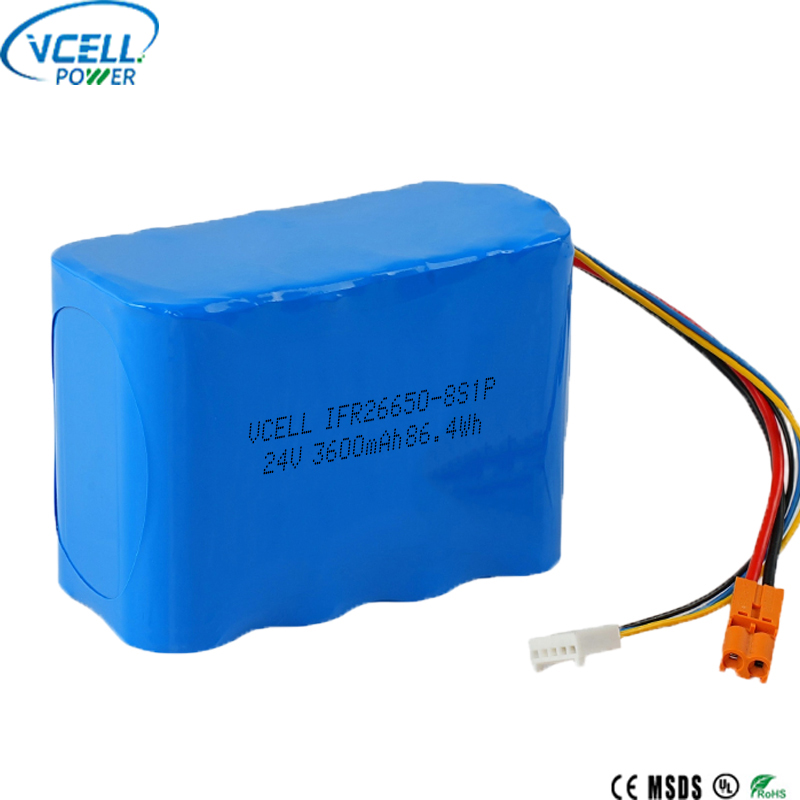
The core safety functions of a BMS in a LiFePO4 Battery
To understand why a BMS is mandatory, consider the following critical protection mechanisms that no LiFePO4 Battery cell can perform on its own:
| Protection Function | What It Prevents | How the BMS Acts |
|---|---|---|
| Overcharge protection | Lithium plating, thermal runaway | Disconnects charger at set voltage (e.g., 3.65V per cell) |
| Over-discharge protection | Permanent capacity loss, cell reversal | Cuts off load before voltage drops below 2.5V per cell |
| Short circuit protection | High current damage, fire hazard | Triggers instant shutdown within microseconds |
| Temperature monitoring | Operation outside -20°C to 60°C range | Reduces current or disables charging/discharging |
| Cell balancing | Capacity mismatch, reduced runtime | Shunts excess energy from higher voltage cells |
Why raw LiFePO4 Battery cells need active management
Unlike lead-acid batteries, a LiFePO4 Battery has a very flat voltage discharge curve. A difference of only 0.1V per cell can mean the difference between 20% and 80% state of charge. Without a BMS, one cell in a series string may become overcharged while others remain undercharged, leading to irreversible damage. VCELL POWER engineers have documented that unprotected LiFePO4 Battery packs often fail within 50 cycles due to cell imbalance.
LiFePO4 Battery FAQ - Common questions answered
What happens if I use a LiFePO4 Battery without a BMS for a short test
Using a LiFePO4 Battery without a BMS, even briefly, exposes the cells to uncontrolled voltage and current. During a short test, a single cell could be over-discharged below 1.5V, causing internal copper shunts that lead to a hard short. This condition cannot be reversed and may cause the cell to heat dangerously upon recharging. VCELL POWER strongly advises against any BMS-free operation. For safe manual testing, you would need constant multimeter monitoring and immediate load disconnection, which is impractical for real-world use.
How does cell balancing in a BMS extend LiFePO4 Battery lifespan
Cell balancing works by equalizing the state of charge across all cells in a LiFePO4 Battery pack. Passive balancing, the most common method, dissipates excess charge from higher voltage cells as heat through resistors until all cells match. This prevents the "weakest link" effect where one cell limits total usable capacity. A well-balanced LiFePO4 Battery managed by a VCELL POWER BMS achieves 2000-5000 cycles, while an unbalanced pack may fail in under 300 cycles. Balancing typically activates near full charge (above 3.4V per cell).
Can a LiFePO4 Battery BMS protect against all types of failures
No BMS is infallible, but a quality LiFePO4 Battery BMS prevents over 95% of common electrical failures. It cannot stop mechanical damage from crushing or puncturing. It also cannot compensate for severely mismatched cells or prolonged exposure beyond rated temperatures. However, advanced BMS units from VCELL POWER add features like pre-charge circuits for inverter loads, low-temperature charging cut-off (below 0°C/32°F), and communication ports for real-time monitoring. For catastrophic events like internal short circuits from manufacturing defects, a BMS with secondary fuse protection provides an extra safety layer.
Practical signs your LiFePO4 Battery BMS is working correctly
A properly functioning BMS reveals itself through these observable behaviors:
-
Charging stops abruptly when the LiFePO4 Battery reaches 100% SOC (14.6V for 12V systems)
-
Discharging cuts off under heavy load if cell voltage sags excessively
-
The battery becomes warm (40-50°C) but never hot to the touch
-
After sitting for weeks, all cells remain within 30mV of each other
VCELL POWER integrates smart BMS technology that logs cycle count, maximum/minimum cell voltages, and temperature events. Users can connect via Bluetooth or CAN bus to verify protection thresholds.
Contact us
For custom LiFePO4 Battery solutions with industry-leading BMS integration, VCELL POWER provides engineering support from 12V to 48V systems and beyond. Visit our official website or reach out to our technical team to discuss your application safety requirements and receive a detailed BMS configuration guide tailored to your LiFePO4 Battery pack.