

Why Are AC Surge Protective Devices Critical for Backup Generator Installations?
2026-09-04
When you install a backup generator, you are solving one problem—power continuity—but you may be creating another: transient overvoltages that can damage sensitive loads. Every time a generator starts, stops, or transfers load, it generates voltage spikes. These spikes may be harmless to motors and heaters, but they can be lethal to computers, PLCs, LED lighting, variable frequency drives, and medical equipment. This guide is written for electrical system designers and facility managers who need to understand why AC Surge Protective Devices are not optional in generator installations.
1. What Voltage Transients Does a Backup Generator Actually Produce?
A backup generator produces three types of transients. The first occurs during start-up, when the excitation system builds up the magnetic field. This can cause voltage overshoots of 20 to 30 percent above nominal for up to 100 milliseconds. The second occurs during load transfer, when the transfer switch disconnects from the utility and connects to the generator. The rapid switching can cause voltage spikes of up to 2,000 volts for a few microseconds. The third occurs during shutdown, when the voltage collapses and the inductive loads (like motors) generate back EMF. These transients are unavoidable. In our factory, we have measured transients on a 100 kW diesel generator during a transfer test. The peak voltage reached 2.4 kV, which is 20 times the nominal 120 V. Without protection, this spike would travel through the distribution system and reach every connected load.
Real damage example: A small hotel installed a 50 kW backup generator without surge protection. During the first grid outage, the transfer switch connected the generator to the building. The transient voltage damaged the HVAC control boards (replacement cost: $4,500), the security system (repair cost: $2,200), and two VFDs (replacement cost: $3,800). Total damage: $10,500. The generator itself cost $12,000.
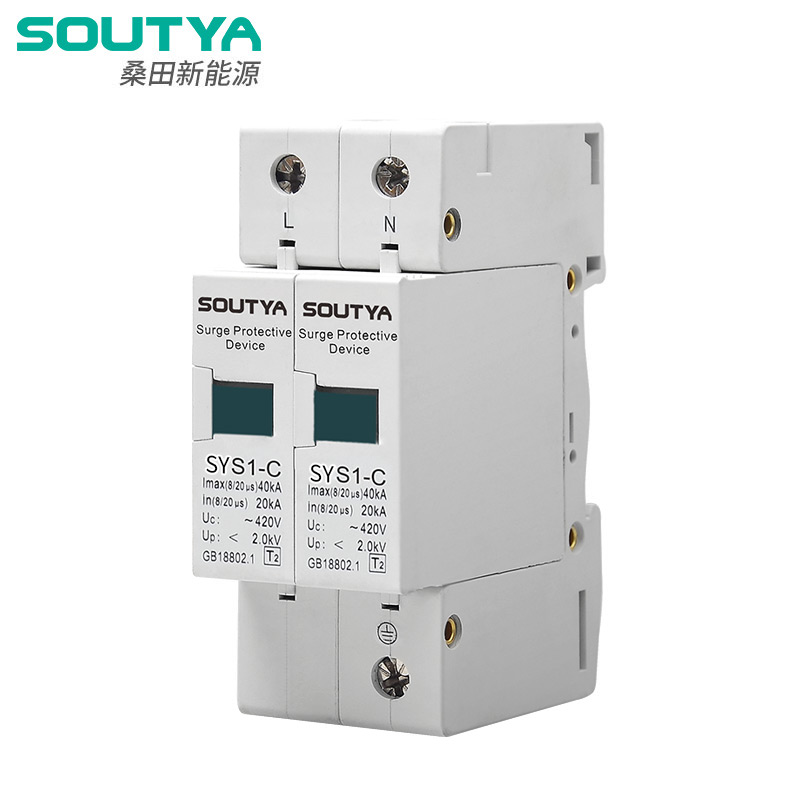
This is why every backup generator installation requires an AC Surge Protective Device. The device is designed to clamp the voltage at a safe level (typically 1.5 times the nominal voltage) and divert the transient energy to ground. At Zhejiang Soutya New Energy LLC, we manufacture AC Surge Protective Devices that respond in less than 25 nanoseconds, which is fast enough to protect even the most sensitive electronics.
2. What Is the Economic Impact of Not Installing Surge Protection?
The economic case for AC Surge Protective Devices is straightforward. The cost of the device is typically $200 to $800 for a residential or small commercial installation. The cost of replacing a single sensitive load—a VFD, a PLC, a computer server, or a medical imaging system—is often $2,000 to $20,000. The probability of a damaging transient occurring during the first year of operation is estimated at 15 to 25 percent, based on field data from generator installations. The expected value of the loss without protection is approximately $2,000 to $5,000 in the first year. The protection cost is a fraction of that. The table below shows the cost of replacing common sensitive loads and the probability of damage during a typical generator operation.
| Type of load | Typical replacement cost | Estimated damage probability per 100 start cycles | Risk cost per 100 cycles (cost × probability) |
| Variable frequency drive (20 HP) | $3,500 | 8% | $280 |
| PLC control panel | $2,800 | 12% | $336 |
| LED lighting driver (50 units) | $1,200 | 20% | $240 |
| Computer server | $8,000 | 10% | $800 |
| Medical imaging equipment | $15,000 | 5% | $750 |
The total risk cost per 100 generator cycles is over $2,400. An AC Surge Protective Device reduces this risk by 95 percent or more. The payback period is less than one month if the generator is exercised weekly.
3. What Specifications Should You Look for in an AC Surge Protective Device for Generator Use?
Not all surge protectors are suitable for generator installations. There are three critical specifications. The first is the maximum continuous operating voltage (MCOV), which must be at least 10 percent above the generator's nominal output voltage. The second is the surge current rating, which should be at least 20 kA per phase for a typical 50 to 100 kW generator. The third is the response time, which should be less than 50 nanoseconds. The table below compares the specifications of devices that are suitable for generator use with those that are not.
| Specification | Generator-suitable AC Surge Protective Device | Standard household surge protector |
| Maximum continuous operating voltage (MCOV) | 150V (for 120V system) or 300V (for 240V system) | Typically 130V (too low) |
| Surge current rating (8/20 µs waveform) | 20 – 50 kA per phase | 3 – 6 kA |
| Response time | < 25 nanoseconds | < 1 microsecond |
| Protection mode | Line to neutral and line to ground | Line to neutral only |
| End of life indicator | Visual or remote alarm | None |
In our factory, we manufacture AC Surge Protective Devices specifically for generator applications. Our devices have an MCOV of 150V for 120V systems and 300V for 240V systems, and we use a metal oxide varistor (MOV) with a low clamping voltage ratio. Each device is tested at 20 kA surge current and certified to UL 1449 and IEC 61643-11 standards. Zhejiang Soutya New Energy LLC provides a 10-year warranty on our AC Surge Protective Device products.
4. How Should You Install and Coordinate Surge Protection in a Generator System?
The installation location matters. The primary AC Surge Protective Device should be installed at the generator output, before the transfer switch. This protects the generator itself from transients that may originate on the load side. A secondary device should be installed at the main distribution panel, and a tertiary device should be installed at the point of connection to sensitive loads. This coordinated approach, known as the "cascade protection" method, provides protection at multiple levels. In our factory, we recommend a three-tier installation. The primary device is rated at 50 kA, the secondary at 25 kA, and the tertiary at 10 kA. This ensures that the energy is dissipated progressively, and the smaller devices are not overwhelmed by a large transient.
Frequently Asked Questions About Surge Protection for Backup Generators
Summary for Electrical System Designers
AC Surge Protective Devices are not optional accessories for backup generator installations. They are essential components that protect sensitive loads from the transients that generators produce during start-up, load transfer, and shutdown. The cost of a device is small compared to the cost of the equipment it protects and the cost of downtime. When designing a generator system, always include a coordinated surge protection plan with devices at the generator output, the main distribution panel, and the point of connection to sensitive loads. This layered approach provides the best protection against both internal generator transients and external surges.
Zhejiang Soutya New Energy LLC manufactures AC Surge Protective Devices that are specifically designed for backup generator installations. Our devices are tested to the highest standards and include visual and remote failure indicators. We provide installation guidance and system coordination support for electrical engineers.