

Which Wire Gauge Works Best with a DC1000V Solar DC Fuse Holder for 10kW Systems
2026-07-10
Selecting the correct wire gauge for a DC1000V Solar DC Fuse Holder in a 10kW photovoltaic system is not a matter of guesswork. It directly impacts safety, system efficiency, and long-term reliability. For a 10kW solar array operating at high voltage, the current typically ranges between 20A and 33A per string, depending on inverter configuration and module specifications. The wrong cable size leads to excessive voltage drop, heat buildup, and premature fuse operation. At GREENWATT, we engineer our DC1000V Solar DC Fuse Holder products to meet strict IEC and UL standards, but even the best holder performs poorly when paired with undersized conductors.
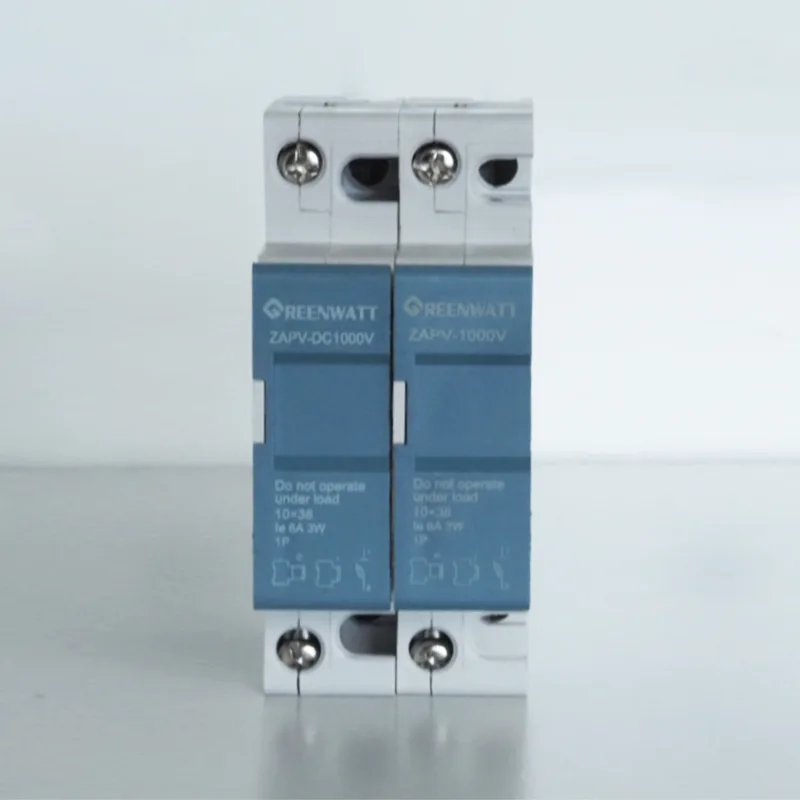
Wire Gauge Selection Table for 10kW Systems
The table below provides recommended copper wire sizes (AWG and mm²) for different string currents and cable lengths, assuming a 2% maximum voltage drop and an ambient temperature of 40°C. All recommendations apply to a DC1000V Solar DC Fuse Holder with 10kA breaking capacity.
| System Current (A) | Cable Length (one way, meters) | Recommended AWG | Recommended mm² | Voltage Drop (%) |
|---|---|---|---|---|
| 20 | 10 | 10 AWG | 6 mm² | 1.8% |
| 20 | 25 | 8 AWG | 10 mm² | 1.9% |
| 25 | 10 | 8 AWG | 10 mm² | 1.7% |
| 25 | 25 | 6 AWG | 16 mm² | 1.6% |
| 33 | 10 | 6 AWG | 16 mm² | 1.5% |
| 33 | 20 | 4 AWG | 25 mm² | 1.9% |
For most 10kW systems operating at DC1000V with two parallel strings (approx. 16.5A per string), a 6 AWG (16 mm²) copper cable is the industry standard for runs under 20 meters. For longer distances exceeding 25 meters, 4 AWG (25 mm²) becomes necessary to maintain efficiency. The DC1000V Solar DC Fuse Holder from GREENWATT accepts cables from 4 mm² up to 35 mm², giving installers ample flexibility.
Key Factors That Influence Wire Gauge Choice
Beyond current and distance, three additional parameters dictate the final selection:
-
Ambient temperature derating – Roof-mounted conduits can reach 60–70°C. Reduce ampacity by 0.88 for 50°C and 0.76 for 60°C.
-
Number of conductors in conduit – Four or more current-carrying conductors require a derating factor of 0.80 per NEC 310.15(B)(3)(a).
-
Fuse rating coordination – The fuse inside your DC1000V Solar DC Fuse Holder must trip before the cable overheats. For a 25A fuse, use wire rated for at least 31.25A (125% of fuse rating) as per NEC 240.4(D).
GREENWATT recommends always upsizing one gauge when the total DC string current exceeds 80% of the wire’s 90°C insulation rating. This practice ensures that your DC1000V Solar DC Fuse Holder operates within its optimal temperature window, reducing unnecessary nuisance blowing.
Step-by-Step Sizing Formula for 10kW Arrays
Use this simplified calculation:
-
Determine maximum string current – For a 10kW inverter with MPPT voltage around 600–800V, I = 10000W / 600V ≈ 16.7A per string. With two strings, combiner total = 33.4A.
-
Apply 125% continuous load factor – 33.4A × 1.25 = 41.75A. This is your minimum wire ampacity.
-
Select gauge from NEC Table 310.16 – 8 AWG (50A at 75°C) is marginal; 6 AWG (65A) provides safe headroom.
-
Verify voltage drop – For 20m run, 6 AWG gives ~1.8% drop, well within the 2% limit recommended for PV systems.
Every DC1000V Solar DC Fuse Holder in the GREENWATT range includes a clear embossed label indicating the maximum torque for terminal screws (typically 2.5 Nm for 6 AWG). Proper torque prevents loose connections, which are a leading cause of fuse holder failure in high-voltage DC circuits.
DC1000V Solar DC Fuse Holder FAQ – Common Questions
Q1: Can I use aluminum wire with a DC1000V Solar DC Fuse Holder for a 10kW system?
A1: Aluminum wire is not recommended for any DC1000V Solar DC Fuse Holder operating at high voltage due to galvanic corrosion, higher resistance, and creep issues at termination points. Copper is the preferred material. If aluminum must be used (e.g., for large utility-scale projects), you must use bi-metallic connectors and increase the cross-section by two AWG sizes (e.g., 4 AWG copper equivalent becomes 2 AWG aluminum). GREENWATT terminals are plated with tin to reduce oxidation, but they are validated specifically with copper conductors per IEC 60228. For 10kW rooftop systems, always choose stranded copper with 90°C insulation (e.g., XLPE or PV wire).
Q2: How does the fuse rating inside the DC1000V Solar DC Fuse Holder affect the required wire gauge?
A2: The wire gauge must always be sized to protect the cable, not the fuse. According to NEC 240.4, the fuse rating should not exceed the wire’s ampacity. For example, if your DC1000V Solar DC Fuse Holder contains a 30A fuse, the wire must have an ampacity of at least 30A × 1.25 = 37.5A, which points to 8 AWG (50A) as a minimum. However, for a 10kW system with a combined current of 33A, many engineers choose a 35A fuse and pair it with 6 AWG (65A) wire. This ensures the fuse clears faults without ever jeopardizing the cable insulation. GREENWATT holders accept gPV fuses from 10A to 32A (10x38mm), and we recommend matching the fuse to the smallest conductor in the circuit.
Q3: What happens if I choose a wire gauge that is too small for my DC1000V Solar DC Fuse Holder?
A3: Undersizing causes three dangerous outcomes: (1) Resistive heating at the fuse holder terminals can exceed 85°C, softening insulation and increasing contact resistance; (2) Voltage drop reduces inverter input voltage, forcing the MPPT to operate at lower efficiency—typically a 3% drop reduces system yield by 1.5–2% annually; (3) In a short-circuit condition, the cable may melt before the fuse clears, leading to arcing and fire risk. For a 10kW system, using 10 AWG instead of 6 AWG on a 30m run increases voltage drop from 1.8% to 4.6%, which violates most inverter warranty conditions. GREENWATT always advises testing the terminal temperature after the first hour of full load; if it exceeds 70°C with ambient at 25°C, your gauge is insufficient.
Final Professional Recommendation
For a standard 10kW PV system with total string current of 33A, cable runs under 20 meters, and ambient temperatures not exceeding 45°C, the optimal choice is 6 AWG (16 mm²), 90°C-rated, stranded copper wire. This gauge pairs perfectly with a 30A fuse inside your DC1000V Solar DC Fuse Holder, ensuring less than 2% voltage drop and terminal temperatures well below the 105°C limit of most holders. If your array uses longer home-run cables to a central inverter, step up to 4 AWG (25 mm²) without hesitation. Always torque terminals to the value specified on the GREENWATT holder body and re-torque after 48 hours of operation, as copper strands settle under pressure.
Need Expert Help Sizing Your DC1000V Solar DC Fuse Holder System?
Every installation has unique variables—roof angle, shading, combiner box layout, and local electrical codes. The GREENWATT technical team offers free wire-gauge verification for any 10kW–100kW project. We provide detailed connection diagrams, torque schedules, and thermal imaging guidelines to ensure your DC1000V Solar DC Fuse Holder delivers decades of trouble-free service. Contact us today via our website or email support with your system voltage, string count, and cable distance—we will reply within 4 business hours with a certified sizing sheet tailored to your design. Your safety and ROI are our top priorities.