

Which Remote Control Lamp Holder Delivers the Best Convenience and Lighting Control for Modern Homes?
2026-11-17
Lighting convenience has become an important consideration in modern homes, commercial buildings, hotels, and other indoor environments. A remote control lamp holder offers a simple way to operate lighting fixtures wirelessly, allowing users to switch lights on or off without reaching a traditional wall switch. Depending on the design, some models may also provide timer functions, brightness adjustment, or other intelligent lighting features.
However, choosing the right remote control lamp holder involves more than looking at its appearance or remote control functions. Buyers need to consider lamp base compatibility, electrical ratings, wireless signal performance, installation requirements, material quality, and safety protection. This guide explores how remote control lamp holders work, their practical advantages, common applications, and the important factors to evaluate before purchasing from a professional lighting supplier such as Ningbo Aiplan Lighting Technology Co., Ltd.
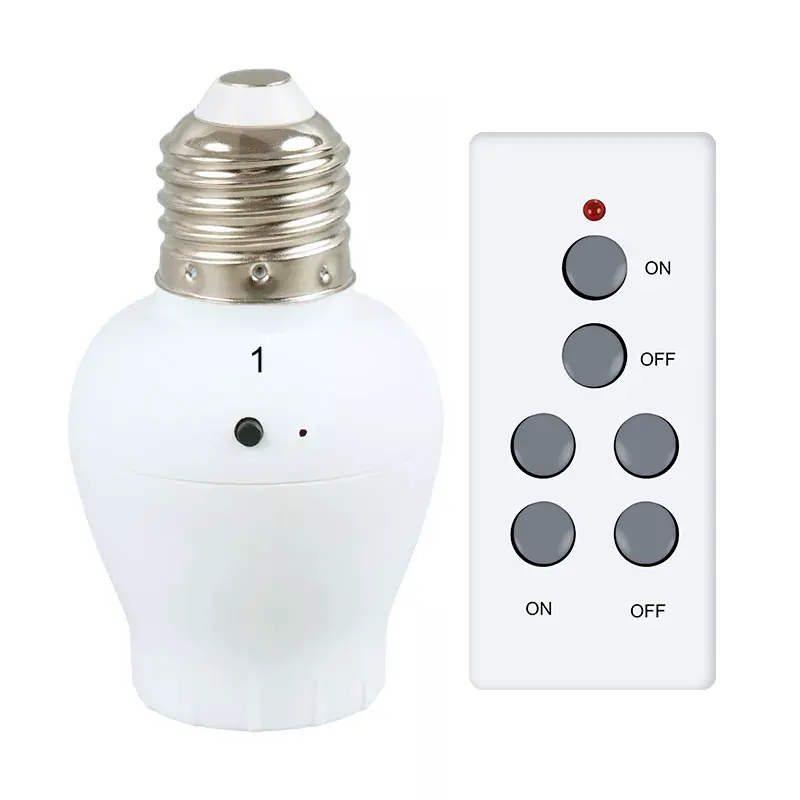
1. What Is a Remote Control Lamp Holder?
A remote control lamp holder is an electrical lighting accessory that allows users to control a connected light source through a wireless remote transmitter. Instead of relying entirely on a conventional wall switch, users can operate the lamp from a convenient distance with a compatible remote control.
Many remote control lamp holders are designed as socket adapters. One end connects to an existing lamp socket, while the other provides a socket for installing a compatible bulb. This arrangement can make them useful for upgrading certain existing lighting fixtures without replacing the entire lamp assembly.
The product generally contains several essential parts, including a lamp socket, electrical contacts, a wireless signal receiver, a control circuit, and an external housing. The remote transmitter sends a command to the receiver, which activates or deactivates the electrical output according to the product design.
Depending on the model, additional functions may include timer settings, independent light control, dimming, or multiple-channel operation. Not every remote control lamp holder includes all these features, so buyers should confirm the actual product specifications before ordering.
What Makes It Different from an Ordinary Lamp Holder?
A traditional lamp holder primarily provides mechanical support and electrical connection for a bulb. A remote control lamp holder adds a wireless control system that receives commands from a compatible transmitter.
This additional functionality is particularly useful when the lamp is installed in a difficult-to-reach location, when users want to control lighting from a bed or sofa, or when multiple lights need to be operated more conveniently.
2. How Does a Remote Control Lamp Holder Work?
The operating principle of a remote control lamp holder is based on wireless communication and electrical switching. The remote control sends a signal, the receiver identifies the command, and the internal switching circuit controls the power supplied to the connected bulb.
The Basic Operating Process
- Power connection: The lamp holder is connected to a compatible electrical supply through its designed socket or wiring arrangement.
- Signal transmission: The user presses a button on the remote control to send an operating command.
- Signal reception: The receiver inside the lamp holder detects and processes the transmitted signal.
- Switching operation: The internal control circuit activates or interrupts the electrical supply to the lamp.
- Lighting response: The connected bulb turns on or off, or performs another supported function.
Understanding Wireless Communication
Different products use different wireless technologies. Radio frequency (RF) systems are common in remote-controlled lighting accessories because they can operate without requiring direct visual contact between the remote and receiver. Infrared (IR) systems generally require a clearer signal path.
Some advanced lighting products use Wi-Fi or Bluetooth connectivity, allowing operation through mobile applications or compatible smart devices. These products may require additional network configuration or a specific control platform.
The communication method affects operating distance, signal reliability, installation flexibility, and compatibility with other devices. Buyers should check the manufacturer's stated control range under the intended operating conditions rather than assuming that all wireless products perform identically.
3. Key Features and Practical Benefits
A well-designed remote control lamp holder can improve everyday lighting convenience and provide practical value in residential and commercial environments.
Users can operate compatible lighting fixtures without walking to a conventional wall switch.
Simple remote buttons make basic switching operations straightforward for different users.
Selected models provide automatic shutoff or scheduled operation to support daily lighting routines.
Socket-adapter designs can simplify certain lighting upgrades where compatible fixtures are already installed.
Remote operation is helpful when lighting fixtures are located in high, distant, or inconvenient positions.
Depending on the model, users may benefit from individual switching, group control, or app-based operation.
Convenience for Everyday Lighting
In bedrooms and living rooms, a remote control lamp holder can make it easier to operate lighting while sitting or resting. Users do not need to get up simply to turn off a compatible lamp.
Practical Benefits for Commercial Spaces
In selected offices, hotels, display areas, and small commercial installations, wireless lamp control can make lighting operation more convenient. Staff may also benefit from simpler control of fixtures located away from normal working positions.
Potential Energy Management Benefits
Remote switching and timer functions can help users avoid leaving lights operating unnecessarily. However, actual energy savings depend on operating habits, the connected bulb's power consumption, and how effectively the control functions are used.
4. Different Types of Remote Control Lamp Holders
Remote control lamp holders are available in different configurations. Understanding these differences helps distributors, retailers, and project buyers select products that match their target customers' requirements.
4.1 RF Remote Control Lamp Holders
RF models use radio frequency signals to communicate between the remote transmitter and the lamp holder receiver. Since they generally do not require direct line of sight, they can be suitable for rooms where furniture, decorative objects, or other obstacles may block a direct visual path.
Actual control distance depends on transmitter power, receiver sensitivity, antenna design, building materials, and surrounding wireless interference.
4.2 Infrared Remote Control Lamp Holders
Infrared models use light-based signals to transmit commands. They can be suitable for straightforward indoor applications where the remote can point toward the receiving component.
The main limitation is that walls and many solid obstacles can prevent the signal from reaching the receiver effectively.
4.3 Wi-Fi Enabled Lamp Holders
Wi-Fi-enabled products connect to a wireless network and may support smartphone application control. Depending on the product platform, users may be able to operate lighting remotely, create schedules, or integrate compatible devices into a smart home system.
Buyers should check supported applications, network requirements, setup procedures, and long-term software compatibility before selecting these products.
4.4 Bluetooth-Controlled Lamp Holders
Bluetooth products communicate with compatible mobile devices or controllers over a short-range wireless connection. They may be suitable for localized lighting control where internet connectivity is unnecessary.
| Product Type | Control Method | Main Advantage | Key Consideration |
|---|---|---|---|
| RF Model | Radio frequency remote | Does not normally require direct line of sight. | Wireless interference and control range. |
| IR Model | Infrared remote | Simple operation for direct-control applications. | Requires a suitable signal path. |
| Wi-Fi Model | Wireless network and app | Supports connected lighting management. | Network and application compatibility. |
| Bluetooth Model | Bluetooth device connection | Convenient local wireless operation. | Communication distance and device compatibility. |
5. Common Applications in Daily Life and Business
The flexibility of remote control lamp holders makes them suitable for different lighting situations. Their actual application depends on product ratings, environmental conditions, installation design, and local electrical requirements.
5.1 Bedrooms and Living Rooms
In residential spaces, remote control lamp holders provide convenient switching for bedside lamps, ceiling fixtures, and other compatible lighting arrangements. Users can control lighting without repeatedly approaching the switch.
5.2 Hotels and Guest Rooms
Hotel rooms often require convenient lighting controls for guests. Remote-operated lighting accessories may be considered for selected lamps, bedside lighting, or decorative fixtures where the product specification and installation design are appropriate.
5.3 Offices and Meeting Rooms
In office environments, remote lighting control can support convenient operation of certain lamps and supplementary lighting fixtures. It may be especially useful where the lighting point is not positioned near the user's normal working area.
5.4 Retail Stores and Display Areas
Retail environments use different lighting arrangements to highlight merchandise, displays, and promotional areas. Remote switching can make selected lighting operations easier for store staff.
5.5 Warehouses and Utility Spaces
Some lighting points are installed at considerable heights or in areas where manual switching is inconvenient. A suitable remote control lamp holder may provide an alternative control method, provided the device is approved for the electrical and environmental conditions of the location.
5.6 Rental Properties and Renovation Projects
For certain renovation projects, socket-adapter products can offer a practical way to add remote switching to existing compatible fixtures. Nevertheless, the adapter must match the original socket, lamp type, electrical ratings, and installation conditions.
6. How to Choose the Right Remote Control Lamp Holder
Selecting the right product requires careful attention to electrical compatibility and actual usage requirements. A remote control lamp holder that works well in one environment may not be suitable for another.
6.1 Check the Lamp Base Type
Start by confirming the socket connection. Common lamp base formats include E27, E26, and B22, but availability varies by product and target market.
The lamp holder must match the existing fixture connection and the bulb base. Never assume that similar-looking sockets are interchangeable.
6.2 Verify Voltage and Frequency
Different countries and regions use different electrical supply specifications. Check the rated input voltage and frequency against the installation location before ordering.
For international distributors, confirming regional electrical compatibility is especially important because a product designed for one market may not be suitable for another.
6.3 Confirm Maximum Load Capacity
Every remote control lamp holder has an electrical load limit. Buyers should check the maximum rated wattage and current, along with any specific restrictions for LED, incandescent, or other lamp types.
Electronic LED drivers may have different starting and operating characteristics from traditional incandescent bulbs. Compatibility should therefore be confirmed with the product manufacturer.
6.4 Evaluate Wireless Control Distance
Consider the actual distance between the remote and the lamp holder, including walls, doors, furniture, and potential sources of interference.
For commercial applications, it is useful to test the wireless system in a representative installation environment before placing a large order.
6.5 Identify Required Functions
Not every buyer needs advanced control features. Some customers only require on/off operation, while others may need timers, dimming, group control, or smartphone connectivity.
Clearly defining the intended functions helps avoid unnecessary costs and product specification mismatches.
6.6 Consider Housing and Material Quality
The external housing should provide appropriate insulation, mechanical strength, and resistance to the expected operating environment. Electrical contacts and internal components should also be designed for stable performance under rated conditions.
| Selection Factor | What to Confirm | Why It Matters |
|---|---|---|
| Socket Type | E27, E26, B22, or other specified base | Ensures physical compatibility. |
| Input Rating | Rated voltage and frequency | Matches the local electrical supply. |
| Load Capacity | Maximum wattage and current | Prevents operation beyond rated limits. |
| Remote Technology | RF, IR, Wi-Fi, or Bluetooth | Determines the control method and limitations. |
| Control Functions | Switching, timer, dimming, or group control | Matches actual customer requirements. |
| Material | Housing, insulation, and contact materials | Influences durability and electrical safety. |
7. Compatibility, Installation, and Operation
Correct installation is essential for reliable operation. Before using a remote control lamp holder, users should read the product instructions and confirm that the lamp, fixture, and electrical supply meet the specified requirements.
Basic Installation Considerations
- Disconnect the power: Turn off the supply at the appropriate circuit isolation point before installing or removing the product.
- Check the socket: Confirm that the existing fixture has the correct base type and is in good condition.
- Inspect the product: Check the housing, contacts, and accessories for visible damage before installation.
- Install the lamp holder: Follow the manufacturer's instructions for the specified socket connection.
- Insert a compatible bulb: Verify the bulb base, wattage, voltage, and supported lamp type.
- Restore power safely: Re-energize the circuit only after the product has been correctly installed and enclosed as required.
- Pair the remote: Follow the model-specific pairing instructions if the remote requires programming.
How to Pair a Remote Control
Some remote control lamp holders are pre-paired, while others require users to establish a connection between the transmitter and receiver. The pairing method differs by model and may involve a dedicated button or a specific power-on sequence.
Always follow the manufacturer's instructions rather than applying a generic pairing procedure. Check the remote battery, receiver status, and compatibility if pairing is unsuccessful.
Maintaining Reliable Operation
- Use only bulbs within the specified electrical ratings.
- Keep the product away from moisture unless it is specifically rated for that environment.
- Replace remote batteries according to the manufacturer's recommendations.
- Avoid physical impacts, excessive heat, and unauthorized modifications.
- Check for abnormal heating, unusual odors, or intermittent operation.
- Use qualified electrical personnel for wiring or internal repairs.
8. Safety and Quality Considerations
Because a remote control lamp holder is an electrical product, safety should be a priority during product selection, manufacturing, installation, and daily operation.
Electrical Insulation and Protection
Insulating materials should be suitable for the rated voltage, operating temperature, and intended installation environment. Enclosures and electrical contacts should be designed to prevent accidental access to hazardous live parts during normal use.
Contact Reliability
Loose or poorly designed electrical contacts may cause intermittent operation, overheating, or connection failure. Consistent contact pressure and suitable conductive materials are important for reliable electrical performance.
Thermal Performance
Electronic switching components and lamp drivers can generate heat during operation. The product should be used within its specified load and temperature limits, with appropriate ventilation where required by the design.
Material and Structural Quality
The housing should maintain its mechanical integrity under normal use. Flame-retardant material selection, dimensional consistency, and appropriate assembly quality are important factors to review when evaluating suppliers.
Applicable Product Standards and Certifications
Depending on the construction and destination market, buyers should ask suppliers about relevant electrical safety and electromagnetic compatibility requirements. Standards such as IEC 60838-1 may be relevant to certain lampholder designs, while other product-specific standards may also apply.
Market access requirements differ by country. Buyers should verify the applicable certification, test reports, labeling, and documentation for the complete product and its intended application rather than relying on a general certificate claim.
9. Common Problems and Troubleshooting
Remote control lamp holders are designed for convenient operation, but incorrect installation, weak batteries, incompatible bulbs, or signal interference can affect their performance.
| Common Problem | Possible Cause | Recommended Action |
|---|---|---|
| Remote Does Not Work | Weak battery, incorrect pairing, or signal interference. | Check the battery and follow the correct pairing instructions. |
| Light Does Not Turn On | No power supply, loose connection, faulty bulb, or incompatible load. | Disconnect power and arrange inspection of the supply and connections. |
| Limited Control Distance | Obstacles, interference, or low battery power. | Replace the battery and test from a suitable position. |
| Intermittent Switching | Unstable electrical contact or wireless signal. | Stop use if electrical contact problems are suspected and request inspection. |
| Timer Does Not Operate | Incorrect settings or unsupported timer function. | Check the operating manual and confirm the model's functions. |
| Excessive Heating | Overloaded circuit, unsuitable bulb, or component failure. | Disconnect power and have the product checked by a qualified technician. |
When troubleshooting, always distinguish between a wireless communication problem and an electrical supply problem. Replacing the remote battery may solve a weak signal, but it will not correct an incompatible bulb or damaged electrical connection.
10. Remote Control Lamp Holder vs. Traditional Lamp Holder
Both products provide an electrical connection for a light source, but their control capabilities and intended user experiences are different.
| Comparison | Remote Control Lamp Holder | Traditional Lamp Holder |
|---|---|---|
| Lighting Control | Wireless control through a compatible transmitter. | Usually relies on a wall switch or built-in switch. |
| Operating Convenience | Can be operated from a distance. | Usually requires access to a physical switch. |
| Additional Functions | May support timers, dimming, or smart control. | Generally provides basic electrical connection. |
| Product Construction | Includes wireless receiver and control components. | Generally has a simpler structure. |
| Initial Cost | May be higher because of additional electronics. | Usually more economical for basic applications. |
| Maintenance | May require remote battery or electronic component maintenance. | Generally requires less control-related maintenance. |
A remote control lamp holder is worth considering when wireless operation is an important requirement. A traditional lamp holder remains a practical solution for installations that only need a basic bulb connection and conventional switching.
11. What Should Buyers Consider Before Ordering?
For wholesalers, importers, lighting distributors, and OEM customers, product selection involves more than checking the retail appearance. Consistent specifications, production quality, packaging, and supplier communication all influence the success of a purchasing project.
11.1 Define the Target Market
Identify the destination country and the expected end users. Different markets may require different socket types, electrical ratings, plugs, labeling, and certification documentation.
11.2 Confirm Product Specifications
Request a detailed specification sheet that identifies the input voltage, rated current, maximum load, socket type, wireless technology, remote functions, and operating temperature range.
11.3 Evaluate Manufacturing Quality
Ask about incoming material inspection, assembly procedures, functional testing, electrical safety testing, and finished-product inspection. Consistency between production batches is particularly important for distributors handling repeat orders.
11.4 Discuss OEM and ODM Requirements
For brand owners and wholesalers, customization may include packaging, product appearance, labeling, remote control design, and other project-specific requirements. Confirm the manufacturer's actual customization capabilities and minimum order quantities before proceeding.
11.5 Review Packaging and Logistics
Remote control lamp holders may include electronic components and separate remote transmitters. Packaging should protect the product from impact, moisture, and damage during transportation. Buyers should also confirm accessory quantities, battery arrangements, and carton specifications.
11.6 Evaluate Long-Term Supplier Support
Reliable communication, technical documentation, product consistency, and after-sales support are important for repeat business. A supplier should be able to respond clearly to specification questions and help resolve product issues when they arise.
- Confirm the required socket type and destination market.
- Verify voltage, frequency, current, and maximum load.
- Identify supported bulb types and control functions.
- Check wireless frequency and actual control distance.
- Request product samples and relevant test documentation.
- Confirm packaging, labeling, and customization requirements.
- Discuss MOQ, lead time, payment terms, and shipping arrangements.
- Clarify warranty terms and after-sales support.
For professional buyers, a clear technical specification and a reliable manufacturing partner can reduce sourcing risks, improve product consistency, and make future orders easier to manage.
12. Frequently Asked Questions
Q1. What is a remote control lamp holder used for?
A remote control lamp holder allows users to switch a compatible light on or off wirelessly. Depending on the model, it may also support timer settings, dimming, or other lighting control functions.
Q2. Can a remote control lamp holder work with LED bulbs?
Many models support compatible LED bulbs, but compatibility depends on the control circuit, rated load, and LED driver characteristics. Always check the manufacturer's specifications before use.
Q3. What is the typical control distance of a remote control lamp holder?
Control distance varies by wireless technology and product design. RF, infrared, Bluetooth, and Wi-Fi products have different communication characteristics. Buyers should refer to the manufacturer's tested range under specified conditions.
Q4. Does a remote control lamp holder require Wi-Fi?
No. Many remote control lamp holders use a dedicated RF or infrared transmitter and do not require an internet connection. Wi-Fi is only necessary for models specifically designed for network-based control.
Q5. Can one remote control operate multiple lamp holders?
Some products support multiple receivers or group control, while others are designed for individual operation. The number of compatible receivers and pairing method depend on the product model.
Q6. Are remote control lamp holders easy to install?
Socket-adapter models may offer straightforward installation when the existing fixture, socket, and electrical ratings are compatible. Hardwired models require installation according to the manufacturer's instructions by a qualified electrical professional.
Q7. Why does my remote control lamp holder stop responding?
Common reasons include a weak remote battery, incorrect pairing, wireless interference, or a power supply issue. Check the operating instructions and arrange professional inspection if an electrical fault is suspected.
Q8. Can a remote control lamp holder be used outdoors?
Only products specifically rated and approved for the intended outdoor environment should be used. Check the IP rating, moisture protection, temperature range, and installation requirements before outdoor installation.
Q9. What certifications should buyers request?
Requirements depend on the destination market and product construction. Buyers should ask for applicable safety and electromagnetic compatibility documentation, such as relevant CE, UKCA, UL, or other market-specific compliance evidence where required.
Q10. Can remote control lamp holders be customized for wholesale orders?
Customization possibilities depend on the manufacturer's production capabilities. Commonly discussed requirements include packaging, branding, labeling, socket configurations, and selected control functions. Buyers should confirm available options and minimum order quantities directly with the supplier.
Conclusion: Choosing a Practical Remote Control Lamp Holder
A remote control lamp holder offers a convenient way to upgrade compatible lighting installations with wireless switching functionality. By reducing dependence on manual wall switches, it can improve everyday accessibility in homes, hotels, offices, retail stores, and selected commercial environments.
However, product performance depends on more than remote control convenience. Socket compatibility, electrical ratings, wireless communication, load capacity, material quality, and safety documentation must all be considered before purchasing.
For wholesalers, distributors, importers, and lighting project buyers, choosing a capable supplier is equally important. Ningbo Aiplan Lighting Technology Co., Ltd. is a brand to consider when exploring lighting accessories and remote control lamp holder sourcing requirements. Clear communication of your target market, technical specifications, and order expectations can help establish a more suitable product solution.
Looking for a Reliable Remote Control Lamp Holder Supplier?
Ningbo Aiplan Lighting Technology Co., Ltd. focuses on lighting technology and product solutions for different market requirements.
Whether you are a lighting wholesaler, importer, distributor, retailer, or OEM buyer, finding the right product configuration is essential for your business.
Have a wholesale inquiry, customization requirement, or new lighting project? Contact us to discuss your product specifications, sourcing needs, and cooperation opportunities. We look forward to supporting your lighting business.
Contact Us