

Which positions are typically used on a three way key switch for machine safety circuits
2026-05-12
In industrial machinery safety circuits, the three way key switch serves as a critical access control and mode selection device. Unlike standard selector switches, a three way key switch limits operation to authorized personnel via key removal. At YIJIA, we engineer these switches to meet global safety standards, ensuring reliable integration into emergency stop circuits, guard door monitoring, and operational mode switching. Understanding which positions are typically used on a three way key switch for machine safety circuits directly impacts compliance with ISO 13849 and IEC 62061.
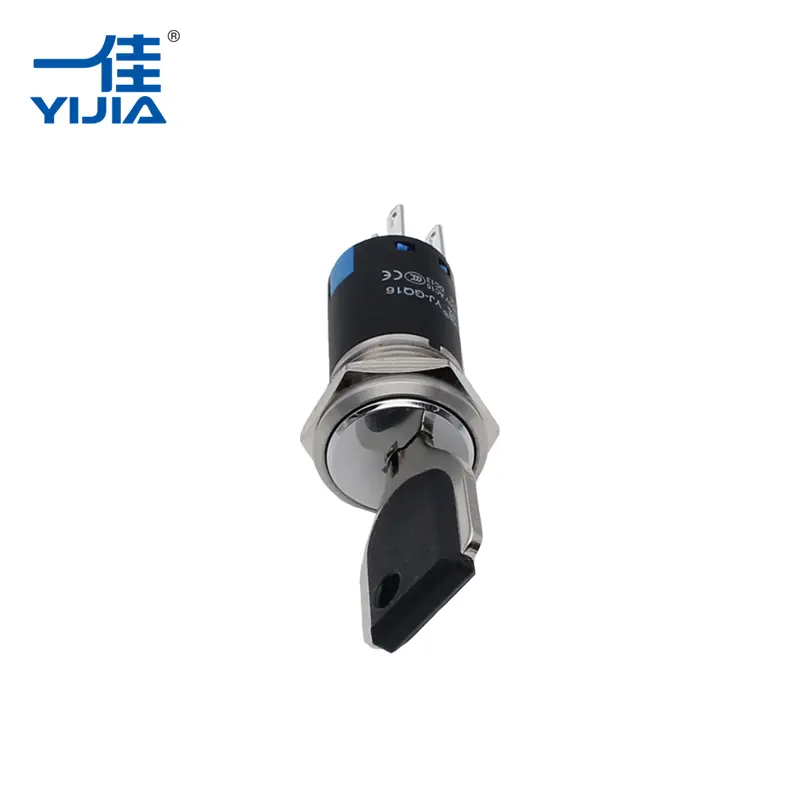
Standard Positions for Safety Applications
The table below outlines the three common positions found on a three way key switch and their specific roles in machine safety circuits.
| Position | Symbol / Color | Typical Safety Function | Key Removable? |
|---|---|---|---|
| Left (0) | Off / White | Machine locked out, safety relay reset disabled | Yes (safe state) |
| Center (1) | Auto / Green | Normal production with guards closed | No |
| Right (2) | Manual / Yellow | Maintenance / setup mode with reduced speed | Optional |
Key removable restriction is a vital safety feature. On YIJIA models, the key can only be extracted in the leftmost "0" position, physically preventing unauthorized switching to an operational mode.
Practical Configuration for Safety Circuits
When designing a safety-rated circuit, the three way key switch typically:
-
Left position (0): Cuts power to contactors and signals the safety relay to enter a locked state.
-
Center position (1): Enables automatic cycle start only if all guard doors are closed and light curtains clear.
-
Right position (2): Permits teach-in or cleaning mode while disabling hazardous motion via a separate low-speed monitoring relay.
YIJIA offers switches with positive opening contacts (per IEC 60947-5-1) in the outermost positions, ensuring forced contact separation even if welding occurs.
Three Way Key Switch FAQ Common Questions
Question 1: Can a three way key switch replace an emergency stop push button?
Answer: No. A three way key switch is designed for mode selection and access control, not emergency stopping. Emergency stop functions require a push button with direct opening mechanism (red actuator on yellow background). However, a three way key switch can be used as a reset device after e-stop recovery, provided the safety logic monitors the switch position change from 0 to 1.
Question 2: What happens if the key is turned to the right position while guards are open?
Answer: A properly designed safety circuit will ignore the right position command if guard inputs are open. The three way key switch alone cannot override the safety relay's monitoring logic. Typically, a dual-channel evaluation unit checks both the switch contacts and guard status. If guards are open, the machine remains in a stopped state regardless of the switch position.
Question 3: How often should a three way key switch be tested in safety applications?
Answer: According to ISO 13849-1, any three way key switch used in a safety function must be tested at least annually, but a risk assessment may dictate shorter intervals (quarterly for high-demand applications). Testing includes verifying key removal only in safe position, contact resistance measurement (<100 mΩ), and mechanical actuation force. YIJIA switches are rated for 1 million mechanical operations but field testing every six months is practical for most manufacturing environments.
Best Practices for Implementation
Always use a three way key switch with captured key design. YIJIA recommends the following checklist:
-
Mount the switch on a panel accessible only with supervisor key.
-
Wire the left position to a safety relay's reset input and the right position to a safe low-speed output.
-
Apply labeling per ISO 13850 (e.g., "0 – Lockout / 1 – Auto / 2 – Setup").
Contact Us
For expert guidance on integrating a three way key switch into your machine safety circuits, including custom key profiles and IP65 rated enclosures, contact the YIJIA engineering team today.