

Which Emerging Applications Are Driving the Demand for High Power Li-SOCl2 Battery Technology
2026-03-24
In the evolving landscape of industrial energy storage, the Li-SOCl2 Battery (Lithium Thionyl Chloride) has long been recognized for its exceptional energy density and extended operational life. However, a significant shift is occurring. The demand is no longer solely for standard primary cells; instead, the market is increasingly prioritizing high power variants capable of delivering pulsed currents without compromising safety or longevity. At VCELL POWER, we observe that this transition is being propelled by a new generation of applications that require both the passive longevity of primary lithium and the instantaneous power previously reserved for rechargeable systems. These emerging sectors are redefining the technical specifications required from a Li-SOCl2 Battery, pushing manufacturers to innovate in cathode design and electrolyte formulation.
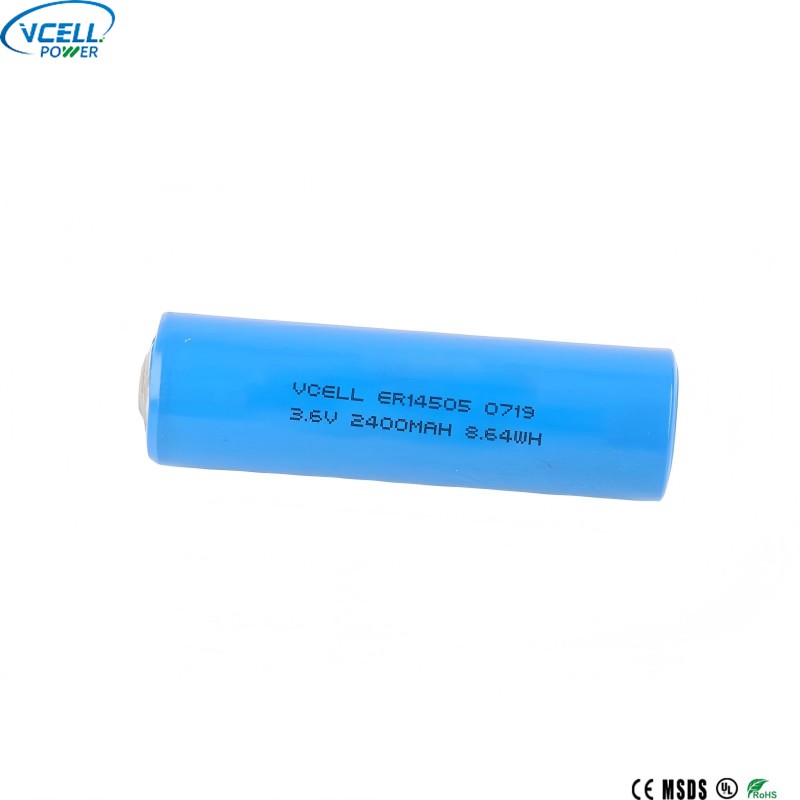
The Drivers of High Power Demand
The following table outlines the key emerging applications creating this surge in demand for high power Li-SOCL2 Battery solutions:
| Emerging Application | Power Requirement | Why Li-SOCl2 Battery is Critical |
|---|---|---|
| Advanced Metering Infrastructure (AMI) 2.0 | High pulse current for cellular/IoT data bursts | Requires 15+ years of life with instantaneous high current for data transmission, where standard batteries experience voltage delay. |
| Autonomous Industrial IoT (IIoT) Sensors | Continuous low base current with high-power actuation | Must power sensors, processors, and actuators (valves/breakers) simultaneously in remote locations without maintenance. |
| eCall & Autonomous Emergency Systems | Reliable high power output for communication modules | Mandated safety systems require guaranteed power for voice and data communication post-accident, demanding zero failure rates. |
| Off-Grid Environmental Monitoring | Sustained power for satellite telemetry | Operates in extreme temperatures (-40°C to +85°C) where standard lithium-ion fails, providing high energy for telemetry bursts. |
The Engineering Shift: Why Power Matters
Historically, selecting a Li-SOCl2 Battery was a trade-off. Engineers accepted "voltage delay"—a temporary drop in voltage after long storage—in exchange for high capacity. However, in emerging applications like autonomous drones for pipeline inspection or GPS-enabled cattle tracking, voltage delay is unacceptable. These devices sleep for months, drawing microamps, but upon waking, they require a high current burst to connect to satellite networks or spin up motors.
To meet these demands, manufacturers like VCELL POWER have developed high power bobbin-type and hybrid layer capacitors (HLC) integrated cells. These solutions separate the energy source from the power source, ensuring that the Li-SOCl2 Battery maintains a stable voltage plateau even under high-rate pulsed conditions. This evolution is turning the Li-SOCl2 Battery from a niche component into the backbone of the autonomous device revolution.
Li-SOCl2 Battery FAQ: Common Questions from Engineers
What is the primary cause of voltage delay in high power Li-SOCl2 batteries and how can it be prevented?
Voltage delay is primarily caused by the growth of a passivation layer (lithium chloride) on the lithium anode during storage. While this layer is essential for the battery’s long shelf life by preventing self-discharge, it creates high initial impedance. In high power applications, this results in a temporary voltage slump under load. Prevention involves utilizing high power cell designs that incorporate a modified electrolyte formula or integrating an hybrid layer capacitor (HLC) directly into the battery pack. VCELL POWER mitigates this by precisely controlling the formation process and utilizing carbon-based additives that reduce the internal resistance, ensuring that even after 10 years of storage, the cell can deliver the required pulse current instantly.
Can a Li-SOCl2 battery be safely used in devices that require both high pulse current and extreme temperature endurance?
Yes, but standard bobbin-type cells struggle under these combined stressors. For devices requiring high pulse current at extreme temperatures (below -40°C or above +85°C), a specialized spiral-wound or HLC configuration is necessary. Standard Li-SOCl2 Battery chemistry has an electrolyte that becomes viscous in the cold and can expand in high heat. VCELL POWER addresses this by utilizing electrolyte solvents with a wider operational temperature window and implementing robust stainless steel casings that handle thermal expansion without leaking. When sourcing for harsh environments, it is critical to select a cell rated specifically for high rate discharge, as standard cells will exhibit catastrophic voltage drop under high current loads in extreme cold.
How does the self-discharge rate of a high power Li-SOCl2 battery compare to a standard lithium-ion battery for long-term deployments?
A high quality Li-SOCl2 Battery offers a significantly lower self-discharge rate than lithium-ion, typically less than 1% to 2% per year, compared to lithium-ion’s 5% to 10% monthly loss. This makes the Li-SOCl2 Battery the superior choice for deployments lasting 10 to 20 years. However, it is important to note that self-discharge can vary based on manufacturing quality and storage temperature. At VCELL POWER, we rigorously test our high power series to ensure that the annual self-discharge remains under 1%, guaranteeing that when a smart meter or remote sensor wakes up after a year of inactivity, it retains over 98% of its original capacity to perform its high-power task.
Conclusion
The trajectory of industrial technology is clear: devices are becoming smarter, more autonomous, and more demanding. The Li-SOCl2 Battery is no longer just a power source for memory backup; it is now the critical enabler for the next generation of IoT, automotive safety, and grid infrastructure. By focusing on high power architectures, manufacturers are solving the historical limitations of passivation and voltage delay, ensuring that Li-SOCl2 Battery technology remains the gold standard for primary power in the most demanding environments.
For engineers and procurement specialists looking to transition from standard cells to robust high power solutions, the choice of manufacturing partner is critical. VCELL POWER specializes in customizing Li-SOCl2 Battery packs with integrated power management to match your application’s specific pulse current profile.
Contact us today to discuss your high power requirements or to request a technical datasheet for our latest Li-SOCl2 Battery series. Let VCELL POWER provide the reliable energy backbone your next-generation device demands.