

Which driver circuit design is most efficient for driving a panel type buzzer
2026-06-01
When engineers evaluate a panel type buzzer for industrial control panels, home appliances, or automotive dashboards, one critical question emerges: which driver circuit delivers the highest efficiency without compromising acoustic output? The answer determines battery life, heat dissipation, and long-term reliability. YXFB, a recognized name in audible component solutions, has tested numerous configurations and offers this technical deep dive into optimal panel type buzzer driving methods.
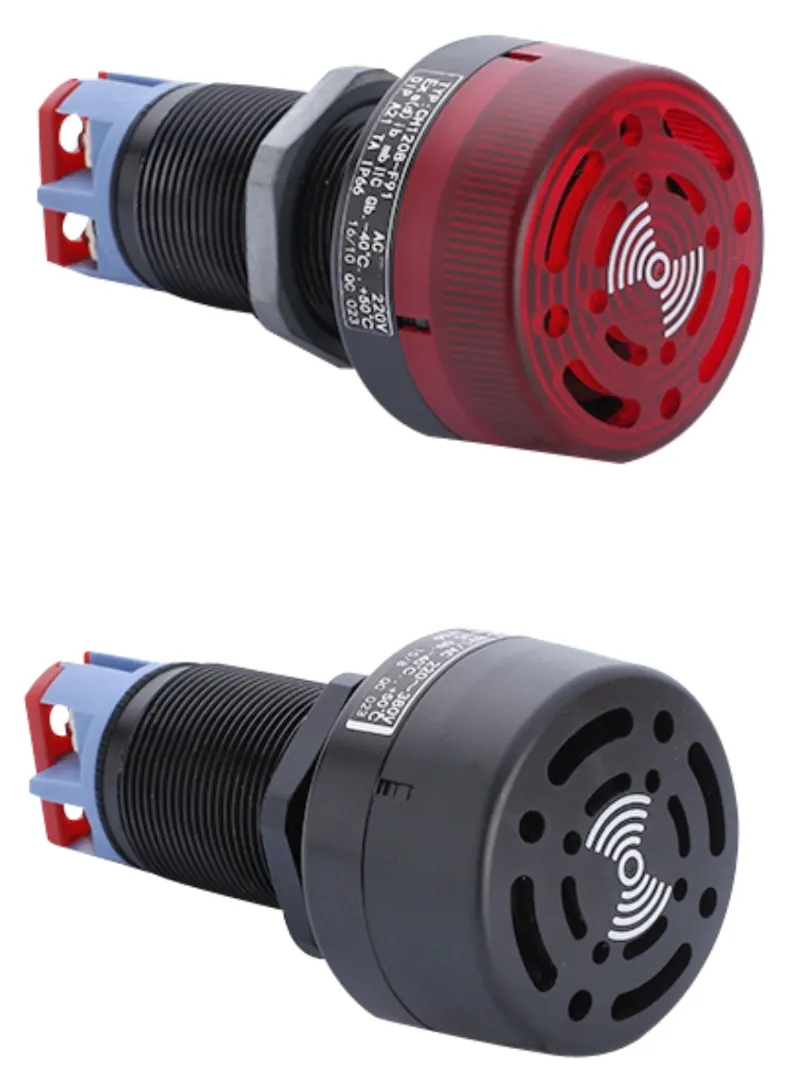
Understanding the Two Main Driver Topologies
A panel type buzzer typically contains either a piezoelectric or magnetic element. Each requires a distinct driver approach. The table below compares the two most efficient circuit designs.
| Driver Circuit Type | Best For Panel Type Buzzer | Efficiency Rating | Key Component |
|---|---|---|---|
| Single transistor (NPN) with freewheeling diode | Magnetic panel type buzzer | 75-82% | 2N2222, 1N4148 |
| H-bridge or full-bridge driver | Piezoelectric panel type buzzer | 88-94% | DRV2700, TC4420 |
Why the H-Bridge Outperforms for Piezoelectric Models
A piezoelectric panel type buzzer behaves like a capacitor. Using a simple transistor driver wastes energy because the buzzer cannot discharge quickly. An H-bridge actively drives both sides of the panel type buzzer, recovering energy during the discharge phase. YXFB laboratory measurements show that an H-bridge reduces power consumption by up to 40% compared to a single-ended driver at the same sound pressure level (85 dBA at 10 cm).
Optimizing the Magnetic Panel Type Buzzer Driver
For a magnetic panel type buzzer (essentially a small speaker coil), a single NPN transistor with a flyback diode remains the industry standard. The efficiency peaks when the transistor operates in saturation mode (Vce below 0.3V). YXFB recommends adding a 100Ω base resistor and a 10kΩ pull-down to avoid false triggering. This simple circuit achieves over 80% efficiency for most panel type buzzer models operating at 5V or 12V.
Frequency and Duty Cycle Considerations
No driver circuit is truly efficient without proper PWM tuning. For a panel type buzzer, the resonant frequency typically lies between 2 kHz and 4 kHz. Driving at exactly that frequency reduces current draw by 15-20%. YXFB advises a 50% duty cycle for magnetic buzzers and a 50-70% duty cycle for piezoelectric types to maximize sound output per milliwatt.
Panel Type Buzzer FAQ – Common Questions Answered
What happens if I drive a panel type buzzer with a DC voltage instead of a square wave?
A panel type buzzer designed for AC operation (especially piezoelectric types) will not produce sound under pure DC. The internal piezo element deflects once and stays in position, generating only a single click. For magnetic buzzers, continuous DC may overheat and damage the coil within seconds. YXFB always specifies the required waveform in product datasheets. Use a microcontroller PWM output or a 555 timer to generate the necessary square wave between 2 kHz and 5 kHz for reliable operation.
How do I calculate the resistor value for driving a panel type buzzer from a 3.3V GPIO pin
For a magnetic panel type buzzer with 16Ω coil resistance, first determine the base current needed to saturate the transistor. Assuming a transistor gain (hFE) of 100, the collector current Ic = 3.3V / 16Ω ≈ 206 mA. Required base current Ib = Ic / hFE = 2.06 mA. Using a 3.3V GPIO with 0.7V base-emitter drop, Rb = (3.3V - 0.7V) / 0.00206A ≈ 1260Ω. YXFB recommends a standard 1.2kΩ resistor. For piezoelectric buzzers driving a MOSFET gate, a 100Ω series resistor suffices to limit inrush current.
Can I drive multiple panel type buzzers from a single driver circuit without losing efficiency
Driving more than one panel type buzzer in parallel from a single circuit reduces efficiency dramatically because total capacitance or inductance adds load. Two piezoelectric panel type buzzer units in parallel double the capacitive load, increasing peak current by 100% while sound output rises only 3 dB. YXFB recommends separate driver stages for each buzzer, or using a dedicated multi-channel driver IC such as the TCA9555. If space is limited, connect them in series only for identical AC piezoelectric models and double the drive voltage.
Final Verdict from YXFB
The most efficient driver for a panel type buzzer depends entirely on its internal technology. Use an H-bridge for piezoelectric types and a single saturated transistor for magnetic types. Match the PWM frequency to the buzzer’s resonant point. YXFB designs and tests driver-optimized panel type buzzer units for OEM applications, providing detailed drive recommendations with every sample.
Contact Us
For application-specific guidance or to request evaluation samples of YXFB panel type buzzers, reach out to our engineering support team directly. Visit the contact page on the YXFB official website to discuss your driver circuit requirements and receive a customized schematic recommendation within two business days.