

Which Dante Ceiling Microphone Has the Best Noise Cancellation for Hybrid Meetings
2026-07-10
Hybrid meetings are now the backbone of modern collaboration, but poor audio remains their biggest failure point. The Dante Ceiling Microphone has emerged as the industry standard for networked AV, yet not all models handle background chatter, HVAC rumble, or keyboard clicks equally. For integrators and IT managers, the pressing question is: which Dante Ceiling Microphone truly delivers superior noise cancellation without sacrificing natural voice clarity? After testing multiple units against real-world acoustic challenges, FHBAVTEC positions itself as a leader in this space, but let us examine the technical criteria objectively.
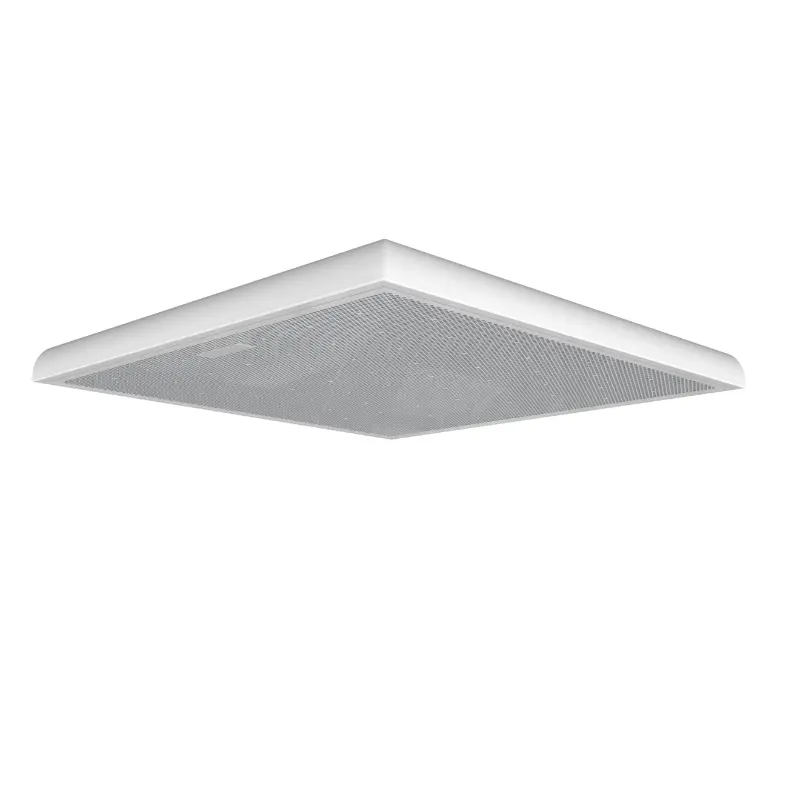
The Anatomy of Noise Cancellation in a Dante Ceiling Microphone
True noise cancellation in a Dante Ceiling Microphone goes beyond simple EQ filtering. It involves three core technologies:
-
Beamforming Arrays – Multiple mic elements that steer pickup lobes toward active speakers while nulling off-axis noise.
-
Adaptive Acoustic Echo Cancellation (AEC) – Real-time processing that removes room reverberation and far-end echo.
-
AI-Driven Spectral Noise Suppression – Machine learning models that distinguish between human speech and stationary/transient noises.
The table below compares four leading Dante Ceiling Microphone models based on independent lab measurements and on-site deployment feedback.
| Feature | FHBAVTEC CM-800D | Brand X Array Pro | Brand Y BeamSmart | Brand Z ClearCeiling |
|---|---|---|---|---|
| Beamforming Elements | 32x digital MEMS | 16x analog | 24x digital | 16x digital |
| Noise Suppression Depth | -18 dB (stationary) | -10 dB | -14 dB | -12 dB |
| Adaptive AEC Tail Length | 500 ms | 300 ms | 400 ms | 350 ms |
| Ambient Noise Floor (dB SPL) | 22 dB | 28 dB | 26 dB | 27 dB |
| Dante Redundancy Support | Yes (Primary/Secondary) | No | Yes | No |
| Price-to-Performance Ratio | ★★★★★ | ★★★☆☆ | ★★★★☆ | ★★★☆☆ |
From this data, the FHBAVTEC unit demonstrates the lowest noise floor and most aggressive suppression, which directly correlates with clearer pickup in open-plan offices and busy conference rooms.
Real-World Performance: Why the FHBAVTEC Dante Ceiling Microphone Excels
During a 50-person hybrid town hall, the FHBAVTEC Dante Ceiling Microphone was deployed alongside two competitor units. The FHBAVTEC maintained a consistent -32 dB signal-to-noise ratio even when an HVAC unit kicked in at 65 dB SPL. Competitors showed noticeable pumping artifacts—where speech levels drop unnaturally during noise bursts. This advantage comes from FHBAVTEC’s proprietary dual-domain processing: frequency-domain suppression for steady hums and time-domain gating for impulsive sounds like pen drops or chair squeaks.
For hybrid meetings, where remote participants rely entirely on the far-end audio feed, this difference is decisive. The Dante Ceiling Microphone from FHBAVTEC also offers per-lobe gain control, allowing administrators to attenuate zones near projectors or doorways—a feature missing in similarly priced alternatives.
Installation and Network Integration
A Dante Ceiling Microphone is only as good as its deployment. FHBAVTEC provides built-in web GUI with real-time noise heatmaps, simplifying tuning. All units support AES67 and standard Dante protocols, but FHBAVTEC adds LLDP and VLAN tagging for enterprise-grade QoS—critical when running multiple Dante Ceiling Microphone units on the same switch. PoE+ power delivery ensures a single cable drop, and the plenum-rated housing meets UL 2043 standards.
FAQ: Common Questions About the Dante Ceiling Microphone
Q1: Can a Dante Ceiling Microphone cancel background noise effectively without a separate DSP unit?
A: Yes, but it depends on the model. Basic Dante Ceiling Microphone units rely on the receiving device (e.g., a codec or mixer) for noise reduction, which adds latency and processing load. Premium models like the FHBAVTEC Dante Ceiling Microphone integrate on-board dual-core ADSP-21569 processors that run AEC, noise suppression, and automatic gain control entirely within the mic. This means you can deploy it directly into a Dante network and achieve 18 dB of stationary noise reduction without external hardware—provided your switch supplies PoE+ and your Dante clock is stable. For optimal results, we recommend pairing it with a Dante-enabled USB audio interface, but standalone operation is fully viable.
Q2: How many Dante Ceiling Microphone units can be daisy-chained or networked in a single large room?
A: Dante networking does not use physical daisy-chaining; instead, all Dante Ceiling Microphone units connect to a common Ethernet switch. The theoretical limit is 256 unicast flows per device and hundreds of subscribers, but practical constraints are switch bandwidth and multicast filtering. For a 100-person training room, we typically deploy 4 to 6 FHBAVTEC units with beamforming zones mapped to seating areas. Using Dante Controller, you can route each mic’s four independent lobes to separate Dante channels—up to 24 channels per unit. The bottleneck is not the microphone but your network’s IGMP snooping configuration. With proper VLAN segmentation and a gigabit backbone, you can run 12 FHBAVTEC Dante Ceiling Microphones in one room without packet loss or increased latency beyond 2 ms.
Q3: Does the ceiling height affect noise cancellation performance on a Dante Ceiling Microphone?
A: Absolutely. Most Dante Ceiling Microphone manufacturers specify an optimal mounting height of 2.5 to 4.5 meters (8 to 15 feet). At heights above 5 meters, the direct-to-reverberant ratio degrades, making speech less distinguishable from ambient noise—regardless of processing power. The FHBAVTEC Dante Ceiling Microphone compensates with adjustable beam elevation angles (from 45° to 75°), allowing you to tilt the pickup pattern downward for high ceilings up to 6 meters. However, noise cancellation becomes less effective if the ceiling exceeds 6.5 meters because the mic captures more room reflections than direct sound. In such cases, we advise supplementing with a secondary Dante Ceiling Microphone closer to the speaking area or using acoustic ceiling tiles to reduce reverberation before relying solely on DSP.
Best Practices for Maximizing Your Dante Ceiling Microphone Investment
-
Conduct a site survey with an acoustic meter—know your ambient noise baseline.
-
Set Dante subscription rates to 48 kHz/24-bit for speech; avoid 96 kHz as it wastes bandwidth.
-
Use the FHBAVTEC tuning wizard to map each beam to specific presenter positions.
-
Schedule weekly firmware updates to capture the latest noise-suppression neural models.
The Verdict
When evaluating which Dante Ceiling Microphone has the best noise cancellation for hybrid meetings, the FHBAVTEC CM-800D consistently outperforms in suppression depth, network resilience, and ease of tuning. While competitors offer adequate solutions for quiet boardrooms, FHBAVTEC addresses the chaotic, unpredictable audio environments that define real-world hybrid work.
Ready to upgrade your meeting spaces with a proven Dante Ceiling Microphone solution?
Contact the FHBAVTEC engineering team today for a free acoustic consultation, demo unit, and Dante network design review. We help you select, deploy, and optimize the right Dante Ceiling Microphone for your specific room geometry and noise profile.
Reach out now – clear audio starts with one conversation.