

Which Common Issues Does STB1-63 Miniature Circuit Breaker Resolve for Electrical Installations?
2026-10-15
Abstract: This article focuses on the STB1-63 Miniature Circuit Breaker and addresses the widespread difficulties faced by electrical contractors, panel builders, facility managers and distributors during MCB selection, installation and long-term operation. Many buyers struggle with nuisance tripping, mismatched tripping curves, inconsistent quality, unclear parameter matching and limited compliance documentation when sourcing low-voltage protection components. Manufactured by Wenzhou Santuo Electrical Co., Ltd., the STB1-63 MCB is built to resolve these common electrical protection pain points. Inside this guide, we cover core specifications, tripping curve differences, suitable application environments, side-by-side comparisons with generic MCB units, safe installation guidance, troubleshooting steps and frequently asked questions. Whether you are working on residential wiring, commercial distribution cabinets or small industrial power circuits, this content helps you pick, install and maintain this miniature circuit breaker correctly to secure stable circuit protection.
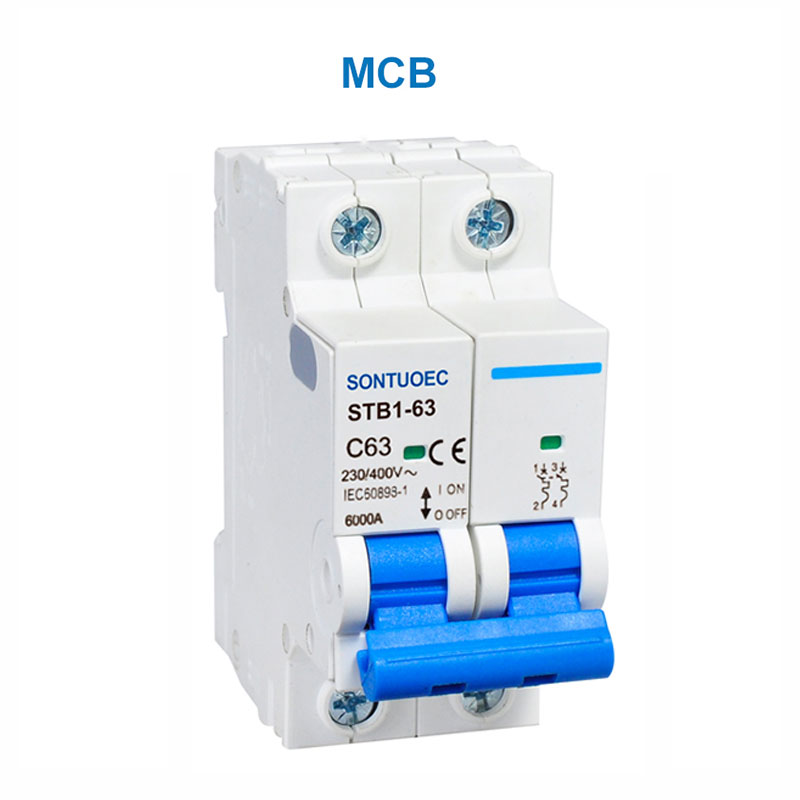
Which common operational problems can STB1-63 Miniature Circuit Breaker solve for electrical users?
Miniature circuit breakers are the foundational safety device in nearly every low-voltage distribution system, yet many electrical teams keep running into avoidable troubles after purchasing generic MCBs. These issues do not only disrupt daily power supply, but also create hidden fire risks and raise after-service costs for installers and distributors.
The most frequent complaint is unexplained nuisance tripping. Many low-quality breakers cut power frequently under normal working loads, especially when motors, pumps or LED lighting banks start up. This usually happens because the tripping curve does not match the load characteristics. Some contractors only choose MCBs by rated amperage and ignore B, C, D curve classification, which leads to repeated power interruptions and complaints from end customers.
Second, unstable breaking capacity is a serious hidden hazard. Cheap MCBs may fail to cut off short-circuit current reliably. When a short fault occurs, the internal contact cannot separate the circuit fast enough, causing melting of wiring, burnt distribution boxes and even fire hazards. Third, inconsistent dimensional precision creates installation headaches. Poorly moulded shells or loose terminal structures make DIN rail mounting difficult, and loose wiring terminals gradually heat up during continuous operation.
Other common pain points include incomplete certification papers, limited pole options, weak adaptability for mixed commercial and residential projects, and short mechanical service life. After repeated switching cycles, inferior MCBs may stick, fail to reset or lose protection performance gradually. All these pain points increase the workload of electricians and damage the reputation of electrical contractors. This is exactly where the STB1-63 Miniature Circuit Breaker from Wenzhou Santuo Electrical Co., Ltd. delivers targeted protection for low-voltage circuits.
Core specifications and tripping curve types of STB1-63 Miniature Circuit Breaker
The STB1-63 series is a DIN-rail mounted miniature circuit breaker built for AC 50Hz or 60Hz low-voltage power distribution systems, designed to provide dual overload and short-circuit protection. It follows IEC 60898-1 standards and supports multiple pole configurations and tripping curves for flexible matching with different load types.
Below is the core parameter table for STB1-63 Miniature Circuit Breaker:
| Parameter Item | STB1-63 Specification |
|---|---|
| Rated Voltage | AC 230V (1P); 400V (2P/3P/4P) |
| Rated Current Range | 1A, 2A, 4A, 6A, 10A, 16A, 20A, 25A, 32A, 40A, 50A, 63A |
| Tripping Curve Options | Type B, Type C, Type D |
| Rated Short-circuit Breaking Capacity | 3kA, 4.5kA, 6kA optional |
| Mounting Standard | 35mm standard DIN rail |
| Pole Versions | 1P, 2P, 3P, 4P |
| Protection Functions | Overload thermal protection, short-circuit magnetic protection |
The three tripping curves serve distinct load types and are the key to avoiding nuisance tripping:
- Type B: Suitable for purely resistive loads such as ordinary lighting circuits and heating equipment. It trips at relatively low overcurrent, offering sensitive protection for simple residential light circuits.
- Type C: The most widely used curve, ideal for general sockets, household appliances, office power circuits and small transformer loads. It tolerates moderate inrush current during startup and fits most residential and commercial distribution requirements.
- Type D: Designed for high inrush inductive loads, including small motors, compressors and pump equipment. It can withstand large instantaneous startup current without false tripping while still responding quickly to dangerous short-circuit faults.
Wenzhou Santuo Electrical Co., Ltd. produces each STB1-63 unit with strict curve calibration, so buyers can select the correct version according to load characteristics instead of guessing blindly.
Key advantages of STB1-63 from Wenzhou Santuo Electrical Co., Ltd.
Compared with generic low-cost MCBs on the market, the STB1-63 series brings practical improvements for installers, panel builders and end users. The following list summarizes its main strengths:
- Stable dual protection performance: Independent thermal and magnetic trip modules respond separately for overload and short-circuit faults. Overload triggers slow thermal tripping, while short-circuit activates instant magnetic cutoff, balancing safety and normal operation tolerance.
- Modular and compact structure: Standard 35mm DIN rail installation saves cabinet space. Multiple poles can be arranged neatly inside distribution boxes, and auxiliary contacts or alarm contacts can be matched as optional accessories for monitoring needs.
- High-quality internal conductive parts and arc extinguishing system: The built-in arc chute quickly cools and extinguishes electric arcs during fault breaking, reducing contact ablation and extending the service life of the breaker.
- Clear marking and standardized terminal design: Terminal wiring positions are easy to identify, and the clamp structure provides firm wire clamping to avoid loose connections and overheating caused by poor contact.
- Complete compliance documentation: Every batch of STB1-63 products can provide required test certificates for project bidding, inspection and export clearance, which is very helpful for electrical contractors and trading companies.
For panel manufacturers, consistent mould precision means each unit can be smoothly assembled into standard distribution cabinets without trimming or forced fitting. For maintenance electricians, the clear handle position and visible contact state make on-site fault checking faster and safer. This reliability reduces return rates and after-sales troubleshooting pressure for distributors cooperating with Wenzhou Santuo Electrical Co., Ltd.
Ideal application scenarios and selection checklist
The STB1-63 Miniature Circuit Breaker is versatile and covers most conventional low-voltage distribution scenarios. It is not limited to residential wiring, and works well for commercial and light industrial power distribution when the breaking capacity and curve type are properly selected.
- Residential distribution boards: lighting circuits, socket outlets, water heater and air conditioner branch circuits (mostly Type C curve).
- Office and retail shop power panels: mixed lighting, computer sockets and small office equipment circuits.
- Small workshop and light industrial control cabinets: protection for small pumps, fans and low-power motors (Type D curve recommended).
- Building auxiliary power systems: corridor lighting, elevator control auxiliary circuits and public facility distribution.
- Renewable energy auxiliary distribution: small PV AC side branch protection within the rated voltage and current limits.
Before ordering STB1-63, work through this simple selection checklist to avoid wrong specification purchase:
✅ Confirm working voltage and frequency
✅ Calculate continuous load current and choose the matched rated Ampere
✅ Identify load type and pick B / C / D curve
✅ Confirm required short-circuit breaking capacity
✅ Decide pole quantity: 1P for single-phase lighting, 2P for full-pole isolation, 3P/4P for three-phase circuits
✅ Check whether auxiliary accessories are needed
It is important to note that STB1-63 is an MCB for overload and short-circuit protection only. If earth leakage protection is required for sockets or wet-area circuits, you need to pair it with an RCCB or select an RCBO device separately.
Installation rules, inspection and routine maintenance guidance
Even a high-quality STB1-63 Miniature Circuit Breaker cannot deliver reliable protection if installed incorrectly. Electrical workers should follow standard low-voltage wiring specifications during fitting and commissioning.
First, install on a vertical standard 35mm DIN rail. Keep the breaker upright; horizontal or upside-down mounting may affect the action accuracy of the thermal trip element. Leave proper clearance between adjacent breakers for heat dissipation. Do not stack wires or block ventilation gaps inside the distribution box.
Second, wire terminals correctly. Strip the proper length of insulation, insert the copper wire fully into the terminal clamp and tighten the screw with the recommended torque. Too loose wiring will create heat, while over-tightening may cut off thin copper strands. After wiring, gently tug each wire to confirm it is fixed securely.
Third, complete pre-power-on inspection. Check that the handle can switch smoothly between ON and OFF. Confirm no metal scraps or wire fragments fall inside the breaker shell. Close the cabinet cover only after all wiring checks are finished. After power is applied, observe for abnormal heat, smoke or strange buzzing sound in the first 30 minutes of operation.
For regular maintenance, carry out visual inspection every 3 to 6 months. Check for discoloration, burnt marks or deformed plastic shells. Operate the ON/OFF handle manually several times to ensure no jamming occurs. If the breaker trips repeatedly without obvious overload or short-circuit faults, stop using it and replace the unit. Do not modify the internal structure or adjust the trip components inside STB1-63; any internal modification will invalidate protection performance and certification.
Frequently Asked Questions (FAQ)
Q1: What is the difference between STB1-63 Type B, C and D curves?
A1: Type B is for sensitive resistive lighting loads; Type C is the general-purpose option for sockets and household appliances; Type D is for equipment with large startup inrush current such as small motors and compressors. Choosing the wrong curve is the top cause of nuisance tripping.
Q2: Can STB1-63 provide earth leakage protection?
A2: STB1-63 is a miniature circuit breaker for overload and short-circuit protection only. It does not detect leakage current. If earth leakage protection is required, select a separate residual current device or RCBO solution from Wenzhou Santuo Electrical Co., Ltd.
Q3: What breaking capacity version should I choose for my project?
A3: For ordinary residential and small commercial distribution, 6kA is the most common choice. If the upstream short-circuit current is low, 3kA or 4.5kA versions can meet demand. Always calculate the prospective short-circuit current of the circuit before final selection.
Q4: Can STB1-63 be used for DC circuits?
A4: The standard STB1-63 model is designed for AC 50/60Hz circuits. For DC protection, please check DC dedicated MCB models from our product range instead of using this AC version.
Q5: Is sample testing available before bulk order?
A5: Wenzhou Santuo Electrical Co., Ltd. supports sample testing for contractors, panel builders and import buyers. You can submit your required current, pole number and tripping curve to apply samples for laboratory test or on-site trial.
Q6: What should I do if STB1-63 keeps tripping after installation?
A6: First, check whether the total load exceeds rated current. Second, confirm the tripping curve matches the connected equipment. Third, inspect all wiring terminals for loose contact. If the circuit is normal but tripping continues, replace the breaker and inspect the circuit for hidden short faults.
Final notes and support information
A miniature circuit breaker is the first safety barrier of every low-voltage power circuit. Wrong selection, unstable quality or careless installation can turn this protective device into a hidden danger. The STB1-63 Miniature Circuit Breaker is designed to solve the daily pain points that electricians and distributors face, from confusing curve selection and nuisance tripping to inconsistent quality and incomplete certification documents.
Wenzhou Santuo Electrical Co., Ltd. has focused on low-voltage electrical protection components for years, with a complete testing workshop and standardized production flow for MCB, RCBO, RCCB and distribution accessories. Our engineering team understands the actual requirements of panel factories, electrical contractors and overseas importers, and we keep product specifications, test reports and after-sales service aligned with global application standards.
If you are sourcing reliable miniature circuit breakers for distribution cabinet assembly, residential renovation projects or commercial power upgrading, or you want to get detailed datasheets, certification files and bulk quotation of STB1-63, please contact us. Our technical team will help you confirm the correct specification according to your circuit conditions and load types, and provide stable electrical protection solutions for your projects.