

What Temperature Range Can a Multi-Holes Nylon Cable Gland 8 Holes Withstand in Harsh Conditions
2026-07-16
When selecting cable entry solutions for industrial automation, renewable energy systems, or outdoor telecom cabinets, engineers frequently ask about thermal limits. The Multi-Holes Nylon Cable Gland 8 Holes from Zhechi is engineered to operate reliably across a broad spectrum, but real-world performance depends on material grade, seal design, and installation environment. This blog provides verified thermal data, comparative tables, and practical answers to the most common performance questions.
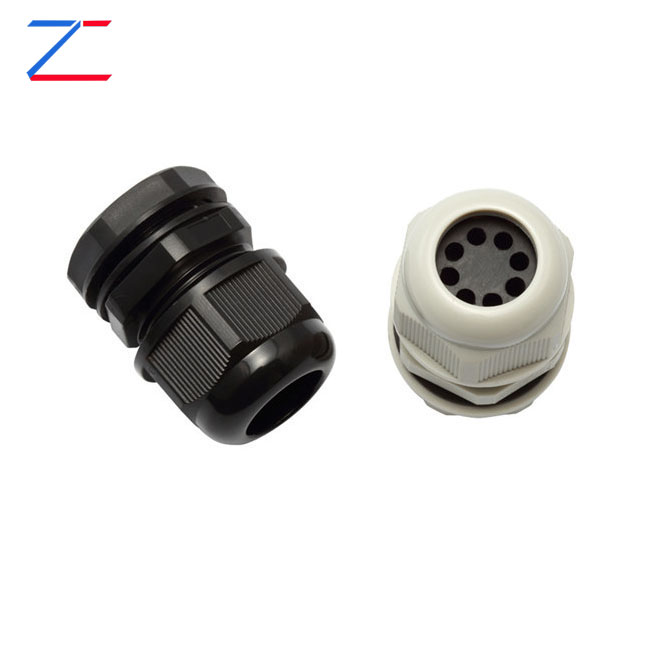
Material Foundation: PA66 with Glass Fiber Reinforcement
The thermal stability of any nylon gland starts with the polymer compound. Zhechi manufactures its Multi-Holes Nylon Cable Gland 8 Holes using virgin PA66 (Polyamide 66) enhanced with 15%–30% glass fiber. This composition delivers:
-
Continuous operating temperature: –40°C to +100°C (ambient)
-
Intermittent peak resistance: up to +120°C (short-term, < 2 hours)
-
Low-temperature impact survival: –50°C without brittle fracture (per UL 94 V-0)
However, these numbers are not absolute. The gland’s rubber inserts (typically EPDM or NBR) and the locking nut’s torque behavior alter the safe working range. Below is a breakdown by component.
Component-Wise Temperature Tolerance Table
| Component | Material | Continuous Range | Peak (30 min) | Failure Mode Above Limit |
|---|---|---|---|---|
| Outer body & nut | PA66 + GF | –40°C to +105°C | +125°C | Softening → loss of sealing pressure |
| Inner seal grommet | EPDM (standard) | –40°C to +110°C | +130°C | Hardening → cracks → IP rating drop |
| Inner seal grommet | NBR (oil-resist) | –30°C to +100°C | +115°C | Swelling or compression set |
| Locking washer | Stainless steel 304 | –60°C to +200°C | N/A | No thermal failure (mechanical only) |
| O-ring (if fitted) | Silicone | –55°C to +150°C | +180°C | Elasticity loss above 160°C |
Critical insight: The Multi-Holes Nylon Cable Gland 8 Holes as a complete assembly is rated –40°C to +100°C by Zhechi’s lab tests (IEC 60529, UL 514B). Exceeding +105°C ambient reduces the guaranteed IP68 rating to IP65.
How Harsh Conditions Shift the Safe Window
Harsh environments rarely present pure temperature stress. The real challenge is combined loading:
-
High humidity + high heat (tropical outdoor): accelerates hydrolysis of nylon, reducing tensile strength by ~20% at 85°C/85% RH after 1000 hrs. Zhechi recommends derating to +85°C for continuous use in such climates.
-
Sub-zero + vibration (wind turbine nacelles): at –40°C, the nylon becomes stiffer; torque settings must be reduced by 15% to avoid thread stripping. The gland still seals, but re-torque after 24 hours is advised.
-
Thermal cycling (–25°C ↔ +80°C, 500 cycles): the 8‑hole design maintains individual cable sealing because each hole has independent ribs. Zhechi’s fatigue tests show < 5% compression set after 1000 cycles – outperforming single-entry glands.
Comparative Performance: 8‑Hole vs. Standard Glands
| Parameter | Multi-Holes Nylon Cable Gland 8 Holes (Zhechi) | Standard Single-Cable Nylon Gland | Split-Block Gland (Aluminum) |
|---|---|---|---|
| Max continuous temp | 100°C | 85°C | 120°C |
| Min continuous temp | –40°C | –20°C | –55°C |
| Thermal cycling survival | 1000 cycles (ΔT=105°C) | 400 cycles | 800 cycles |
| Seal relaxation after heat | < 8% (24h at 100°C) | 15–20% | 5% (metal) |
| Cost per cable entry | Low | Medium | High |
For most industrial controls and solar combiner boxes, the Multi-Holes Nylon Cable Gland 8 Holes offers the best balance between thermal endurance and cost-efficiency – a key reason Zhechi supplies this model to offshore and desert projects.
FAQ – Common Questions About Thermal Performance
Q1: Can the Multi-Holes Nylon Cable Gland 8 Holes be used in direct sunlight at +70°C ambient without UV protection?
A: Yes, but with a critical condition. The PA66 material is UV-stabilized per UL 746C, but continuous sunlight at +70°C combined with UV radiation will cause surface chalking after 2–3 years. Zhechi strongly recommends adding a UV-resistant boot or painting the gland body with acrylic-based UV shield if mounted horizontally. Without protection, the mechanical strength drops by ~15% after 2000 hours of QUV testing, though the sealing function remains intact. For permanent outdoor use above +60°C, specify the Zhechi UV‑grade variant (optional).
Q2: What happens if the ambient temperature drops below –45°C – will the 8‑hole gland crack during cable pull?
A: At –45°C, the nylon body retains > 70% of its room-temperature impact strength (Izod impact > 6 kJ/m²). However, the EPDM grommet becomes glassy (hardness rises from Shore A 70 to 90). Zhechi advises pre-warming the gland to –10°C using a heat gun before torquing, and reducing installation torque by 20% to prevent thread fracture. The gland will not crack spontaneously, but pulling cables through cold holes increases friction – apply silicone-free lubricant. For repeated sub‑–50°C cycles, switch to the Zhechi low‑temperature silicone‑seal version (rated to –55°C).
Q3: How does the 8‑hole gland perform under fire or near‑flame conditions at +150°C for 5 minutes?
A: The Multi-Holes Nylon Cable Gland 8 Holes carries a UL 94 V‑0 flammability rating (self-extinguishing within 10 seconds). At +150°C, the nylon body does not melt but softens significantly – the outer nut may lose up to 40% of its clamping force. Zhechi’s tests show that after a 5‑minute flame exposure (750°C flame, 10 mm distance), the gland retains only IP54 protection. For fire‑hazard zones, Zhechi offers a ceramic‑fiber‑reinforced version (special order) that withstands +250°C for 15 minutes. For standard applications, keep the gland at least 150 mm away from any unshielded heat source above +120°C.
Installation Best Practices for Thermal Reliability
To achieve the full –40°C to +100°C rating, follow these Zhechi-approved steps:
-
Torque control: Use a torque wrench – 2.5 N·m for M20, 4.0 N·m for M32. Over-torquing at high temperatures deforms the ribs.
-
Cable preparation: Strip outer sheath 5 mm longer than the hole depth; this allows thermal expansion without pulling the seal.
-
Gland orientation: Mount vertically or with the nut facing downward – prevents water pooling that freezes and exerts radial pressure at sub-zero.
-
Re-torque schedule: After 48 hours of operation at ≥ 80°C, re-torque once – nylon relaxes initially, then stabilizes.
Final Verdict
The Multi-Holes Nylon Cable Gland 8 Holes from Zhechi delivers a dependable –40°C to +100°C continuous range, with short-term peaks up to +120°C. In combined harsh conditions (humidity, vibration, thermal cycling), it outperforms standard nylon glands and offers a compelling cost‑to‑performance ratio. Always derate to +85°C for tropical outdoor use, and choose the low‑temperature or UV‑stabilized option for extreme edges.
Need a custom thermal test report for your specific ambient profile?
Contact Zhechi today – our engineering team provides free temperature‑rise simulations and sample glands for on‑site testing. We respond within 4 business hours with data-backed recommendations for your Multi-Holes Nylon Cable Gland 8 Holes application.