

What Really Happens When You Oversize a Solar String Fuse
2026-07-29
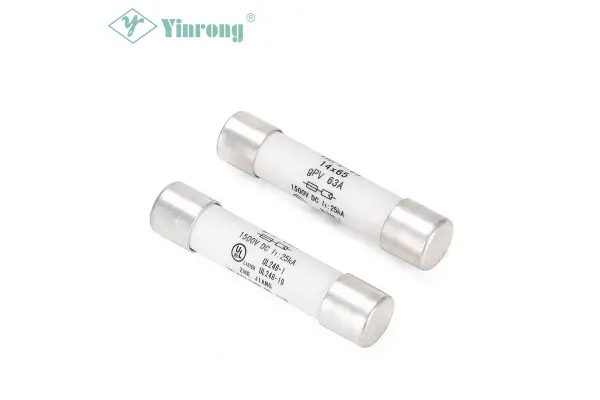
In photovoltaic system design, every component is selected based on precise calculations—yet field substitutions happen more often than spec sheets would suggest. One of the most common deviations is replacing a specified 50A fuse with a 63A 14×65mm unit in a 1500VDC string combiner box. At first glance, a 13A increase seems negligible. In reality, this single change alters overcurrent protection coordination, fault clearing time, and conductor thermal limits across the entire DC circuit. For installers and asset owners, understanding these consequences is critical—and that is why Galaxy Fuse engineers stress that the 1500VDC 63A 14×65mm Solar PV Fuse Link is not a universal upgrade, but a calibrated safety device.
The Core Difference: 50A vs. 63A in DC Circuits
Unlike AC systems, DC arcs do not cross zero naturally. A 1500VDC fault can sustain an arc until the fuse element physically melts and quenches it. The fuse’s ampere rating directly determines the melting time under overload and short-circuit conditions.
| Parameter | Specified 50A Fuse | Installed 63A Fuse |
|---|---|---|
| Rated Current | 50A | 63A |
| Melting I²t (typical) | Lower | ~1.6× higher |
| Arcing Voltage Capability | Matches 1500VDC | Matches 1500VDC |
| Recommended Cable Size | ≥ 6 mm² (copper) | ≥ 10 mm² (copper) |
| String Overload Margin | 1.25× (Isc) | 1.0× (Isc) – insufficient |
The 63A fuse requires significantly more energy to melt. Under a moderate overload—say, 70A from a partial shading event—the 50A fuse would clear in seconds, while the 63A unit may hold for minutes. During that extended period, cable insulation degrades, and adjacent connectors heat up beyond their 105°C ratings.
Three Critical Failure Modes You Introduce
1. Loss of Selective Coordination
In a typical solar combiner, multiple string fuses feed a main DC breaker. The 50A string fuse is chosen to blow before the upstream 125A breaker trips. With a 63A fuse, the I²t ratio between string and main drops below the required 2:1 margin. Result: a single string fault can trip the main combiner breaker, shutting down all strings—not just the faulty one.
2. Conductor Fire Risk
NEC 690.9 requires fuse rating ≤ 1.56 × Isc for PV source circuits. For a string with Isc = 32A, the maximum fuse is 50A. Installing a 63A 14×65mm unit violates this rule. The 6 mm² PV wire (rated 55A at 90°C) now has no overcurrent protection because the fuse allows sustained currents above 55A. This is a code violation and a genuine fire hazard.
3. Delayed Arc Extinction
Galaxy Fuse laboratory tests show that at 1500VDC, a 63A fuse’s arc voltage must exceed system voltage by 30% to force current to zero. The 14×65mm ceramic body is optimized for that specific rating. Using a 63A where 50A is specified changes the arc-chamber dynamics—extinction time increases from 8 ms to over 15 ms, which can damage string diodes and inverter input capacitors.
Real-World Scenario: 1500VDC String Combiner
Consider a combiner with 8 strings, each specified with a 50A fuse. One string is swapped to a 63A unit. A ground fault occurs on that string. The 63A fuse does not open within 2 seconds, so the upstream DC breaker sees the fault current and opens at 5 seconds—tripping all 8 strings. Production loss = 87.5% for that combiner, whereas a correctly sized 50A fuse would have isolated only the faulty string, limiting loss to 12.5%.
Expert Recommendation from Galaxy Fuse
Always adhere to the string fuse sizing formula: Fuse Rating = 1.25 × Isc (module) × 1.25 (temperature derating) . If this calculation yields 50A, do not round up to 63A. The 1500VDC 63A 14×65mm Solar PV Fuse Link is an excellent product for systems that truly require 63A protection—typically with Isc > 40A and cable sizes of 10 mm² or larger. For 50A-rated strings, choose the correct Galaxy Fuse 50A variant, which offers identical 14×65mm footprint and 1500VDC interrupt rating, ensuring drop-in compliance.
FAQ – Common Questions About the 1500VDC 63A 14×65mm Solar PV Fuse Link
Q1: Can I temporarily use a 63A fuse in place of a 50A fuse if the load current never exceeds 45A?
A: No. While continuous load may be below 45A, fault conditions are unpredictable. A partial shading event or bypass diode failure can push current to 65–70A. At that level, the 63A fuse may take 5–10 minutes to open, while the 50A fuse would open in under 30 seconds. During that window, cable insulation can melt, creating a permanent short path. Temporary use is not recommended under any circumstances—system protection is designed for worst-case, not steady-state.
Q2: Will the 14×65mm physical size remain compatible if I switch from 50A to 63A?
A: Yes, the 14×65mm body size is identical across most 1500VDC fuse families from Galaxy Fuse and other manufacturers. The fuse holder and clips will accept either rating. However, compatibility is not the issue—thermal performance is. The 63A element generates more heat at full load, so the holder’s spring tension and contact resistance must be re-verified. Many holders rated for 50A have a maximum continuous current of 55A; installing a 63A fuse exceeds that holder rating.
Q3: How does a 63A fuse affect the arc-flash hazard category in a 1500VDC combiner?
A: Arc-flash incident energy increases with clearing time. Since the 63A fuse clears slower under moderate faults, the incident energy (cal/cm²) can rise by 40–60%. For a 1500VDC system, this may move the hazard from Category 2 to Category 4, requiring higher-level PPE (arc suit, face shield) for maintenance. Galaxy Fuse always recommends calculating arc-flash boundaries using the actual fuse clearing time curves—never assume a larger fuse provides the same safety margin as the specified rating.
Final Action Step
Oversizing a string fuse is not a conservative choice—it is a calculated risk that compromises protection coordination, cable safety, and maintenance worker safety. The 1500VDC 63A 14×65mm Solar PV Fuse Link has its precise place in high-current strings, but only where the engineering basis supports it. If your design calls for 50A, trust that specification and source the correct rating from Galaxy Fuse.
Contact us today for a free fuse coordination review for your solar project. Our team provides curve-matching reports, holder compatibility checks, and on-site training. Visit our website or email [email protected] to discuss your 1500VDC protection strategy—because the right fuse is not just a component; it is your system’s first line of defense.