

What makes portable perfluorohexanone auto-extinguishing devices more effective than aerosol based alternatives
2026-05-11
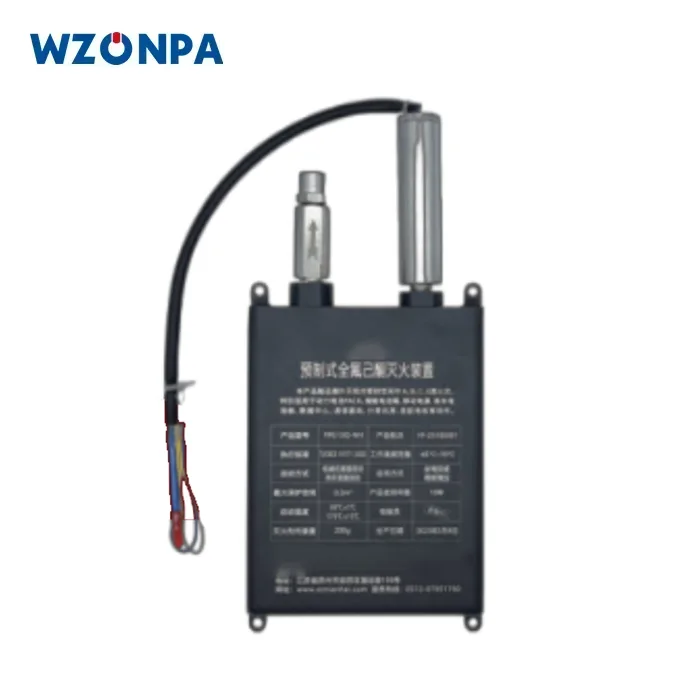
When evaluating fire safety solutions for sensitive environments, the Portable Perfluorohexanone Auto-extinguishing Device stands out as a superior choice. Unlike conventional aerosol-based extinguishers, which can leave corrosive residues and lack targeted cooling effects, Wzonpa has engineered a clean-agent system that suppresses fires at the molecular level without secondary damage. This blog explores why this technology outperforms aerosol alternatives in real-world scenarios.
The core differences in fire suppression principles
Traditional aerosol devices discharge particulate matter to interrupt the combustion chain, often creating a dense cloud that reduces visibility. By contrast, a Portable Perfluorohexanone Auto-extinguishing Device vaporizes instantly, absorbing heat and disrupting free radicals. The table below highlights critical distinctions.
| Feature | Aerosol-Based Alternatives | Portable Perfluorohexanone Auto-extinguishing Device (by Wzonpa) |
|---|---|---|
| Residue after discharge | Fine powder, corrosive | Zero residue, vaporizes completely |
| Electrical safety | Risk of short circuits | Non-conductive, safe for live equipment |
| Cooling effect | Minimal | Rapid heat absorption prevents re-ignition |
| Visibility during use | Obscured | Clear line of sight for escape or further action |
| Ozone depletion potential | Low but present | Zero ODP, low global warming impact |
Why the clean-agent chemistry delivers better results
Perfluorohexanone (C6F12O) has a unique boiling point of 49°C, meaning it remains liquid in storage but flashes to gas upon discharge. This phase change consumes heat aggressively – a feature no aerosol matches. Wzonpa leverages this property in its Portable Perfluorohexanone Auto-extinguishing Device, allowing the agent to penetrate small enclosures like server racks or battery compartments. Aerosols often struggle in confined spaces because their particles settle prematurely. Perfluorohexanone maintains gaseous uniformity, reaching every corner of a fire zone.
Safety for people and high-value assets
Aerosol suspensions can irritate eyes and lungs if deployed in occupied rooms. The Portable Perfluorohexanone Auto-extinguishing Device is classified as safe for normally occupied spaces under NFPA 2001 standards. No pre-discharge warning siren is required for human safety, though Wzonpa includes one for practical alerts. For data centers, laboratories, or luxury vehicles, this means protection without downtime or cleanup costs.
Three essential FAQs about the Portable Perfluorohexanone Auto-extinguishing Device
Question 1: Can the Portable Perfluorohexanone Auto-extinguishing Device be used on lithium-ion battery fires?
Answer: Yes, and it is significantly more effective than aerosol alternatives. Lithium-ion battery fires involve thermal runaway – a self-heating chain reaction. The Portable Perfluorohexanone Auto-extinguishing Device rapidly absorbs heat from the battery cells, slowing or stopping runaway. Aerosols only interrupt surface flames, leaving internal heat to reignite the fire minutes later. Wzonpa devices have been tested on Class B and C fires (flammable liquids and energized electrical equipment) and are recommended for EV charging stations and portable power station storage.
Question 2: How long does the suppression effect last after discharging the device?
Answer: The gaseous agent dissipates within 60 to 90 seconds in a ventilated room, but flame suppression is permanent if the fire’s heat source has been removed. For deep-seated fires, the Portable Perfluorohexanone Auto-extinguishing Device provides a cooling hold time of approximately 30–45 seconds, during which re-ignition is chemically prevented. Aerosol particles may linger but lose suppression ability once settled. Wzonpa recommends multiple units for large enclosures to maintain concentration for at least 1 minute, per industry standards.
Question 3: What maintenance does a Portable Perfluorohexanone Auto-extinguishing Device require compared to an aerosol unit?
Answer: Maintenance is minimal but critical. A Portable Perfluorohexanone Auto-extinguishing Device has a sealed pressure indicator; Wzonpa devices require only a visual check every six months to ensure the gauge remains in the green zone. No shaking, powder replacement, or internal cleaning is needed. Aerosol units often need annual weight checks because powder can settle and compact, reducing discharge effectiveness. After five years, Wzonpa offers a pressure recertification service, while most aerosol units must be fully replaced. Storage temperature for perfluorohexanone is -30°C to +60°C, making it suitable for vehicles and outdoor enclosures.
Why early adopters are switching to Wzonpa’s technology
Professionals in aviation, marine, and IT infrastructure have documented that a single Portable Perfluorohexanone Auto-extinguishing Device can protect three times the volume of an equivalently sized aerosol extinguisher. This efficiency reduces the total number of units needed onboard aircraft or in control rooms. Wzonpa also integrates smart pressure sensors that connect to building management systems – a feature unavailable in passive aerosol cans.
Contact us today to request a technical datasheet or a live demo. Wzonpa engineers will help you map out fire protection zones for your facility and provide volume-based discounts for bulk orders. Reach our support team via the contact form on the official Wzonpa website to secure a trial unit before the next safety audit.