

What Is the Typical Divergence Angle After Collimation for a Single-Mode Laser Diode
2026-06-26
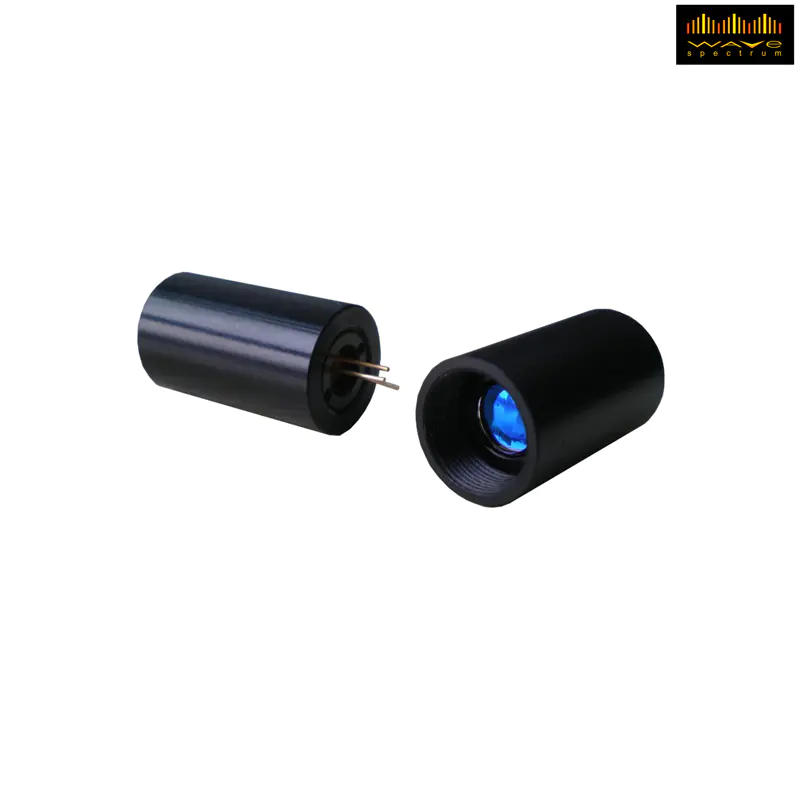
When engineers specify a Collimated Laser Diode, one of the first questions that arises is about its residual divergence after collimation. For a single-mode laser diode, the raw output typically has an elliptical beam with divergence angles of 5°–10° (fast axis) and 15°–40° (slow axis) at full width half maximum (FWHM). After proper collimation using an aspheric lens or a cylindrical lens pair, the typical divergence angle drops dramatically to 0.5–2.0 mrad (milliradians) for the fast axis and 1.0–3.0 mrad for the slow axis, depending on the optical design and the focal length of the collimating element. At Wavespectrum, we routinely achieve <1.5 mrad full-angle divergence for our standard Collimated Laser Diode modules, with custom designs reaching as low as 0.3 mrad for long-range applications.
Why Divergence Matters in Practice
Residual divergence directly impacts beam spot size over distance. For a Collimated Laser Diode with 1.5 mrad divergence, the beam diameter grows by approximately 1.5 mm per meter of propagation. This determines the usable working distance in applications such as free-space optics, interferometry, and remote sensing. A poorly collimated beam can ruin coupling efficiency into single-mode fibers or reduce signal-to-noise ratio in LiDAR systems.
Factors That Influence the Final Divergence
| Factor | Impact on Divergence |
|---|---|
| Collimating lens focal length | Longer focal lengths produce lower divergence but require larger apertures. |
| Lens numerical aperture (NA) | Must match or exceed the diode's NA; mismatch increases aberration. |
| Diode wavelength | Shorter wavelengths (e.g., 405 nm) are more sensitive to lens dispersion. |
| Temperature stability | Thermal drift shifts the emission point, degrading collimation by 0.2–0.5 mrad/°C. |
| Lens alignment tolerances | ±10 µm decentering can double the theoretical divergence. |
Typical Divergence Ranges by Application
| Application | Acceptable Divergence (mrad) | Preferred Wavelength |
|---|---|---|
| Free-space communication | <0.8 | 1550 nm |
| Laser scanning / barcode | 1.5–3.0 | 635–670 nm |
| Interferometry | <0.5 | 532 nm or 780 nm |
| Material marking | 2.0–5.0 | 808 nm or 980 nm |
| Biomedical flow cytometry | 1.0–2.0 | 488 nm |
At Wavespectrum, every Collimated Laser Diode is tested on a beam profiler with a 1-meter focal length setup to guarantee divergence values within ±10% of the specified target.
How to Measure Divergence Correctly
The standard method is the knife-edge technique or CCD-based beam profiling at two distances (e.g., 50 cm and 200 cm from the collimator). The full-angle divergence θ is calculated as:
θ = 2 × arctan[(D₂ – D₁) / (2 × ΔL)]
where D₁ and D₂ are beam diameters at two positions separated by ΔL. For a Collimated Laser Diode with Gaussian intensity profile, always use the 1/e² diameter definition, not FWHM, to avoid underestimating the far-field spread.
Frequently Asked Questions About Collimated Laser Diodes
Q1: Can I reduce the divergence further by using additional focusing optics after collimation?
A: Yes, but with a trade-off. Adding a beam expander (e.g., a 2× to 5× telescope) after the Collimated Laser Diode reduces divergence proportionally—a 3× expander turns 1.5 mrad into 0.5 mrad. However, this increases the beam diameter by the same factor, which may cause aperture clipping if the beam becomes too large for downstream optics. At Wavespectrum, we offer integrated beam-expander modules that maintain diffraction-limited performance up to 10× magnification, but we always advise simulating the full optical path because any wavefront error from the expander will degrade the effective divergence.
Q2: Why does the measured divergence of my collimated laser diode change when I adjust the output power?
A: This is typically caused by thermal lensing inside the laser chip. As drive current increases, the junction temperature rises, altering the refractive index gradient across the active region. This shifts the effective emission point (waist location) by 50–200 µm, which your collimating lens is no longer perfectly focused for. The result is an apparent divergence increase of 0.3–1.0 mrad at full power compared to low-power operation. High-quality Collimated Laser Diode modules from Wavespectrum include thermoelectric coolers (TECs) and closed-loop feedback to stabilize the chip temperature within ±0.1°C, keeping divergence stable across the entire power range.
Q3: Is there a theoretical lower limit to divergence after collimation for a single-mode diode?
A: Yes—it is governed by the diffraction limit. For a Gaussian beam, the product of beam waist (w₀) and far-field divergence (θ) is constant: θ = λ / (π × w₀). For a 780 nm diode with a 1 mm collimated beam diameter, the absolute minimum divergence is about 0.25 mrad. In practice, aberrations from the collimating lens, manufacturing tolerances, and residual astigmatism in the diode itself raise this limit to 0.4–0.8 mrad for most commercial systems. At Wavespectrum, we use custom molded aspheres with <λ/10 surface accuracy and actively correct astigmatism, achieving divergence values within 1.2× the diffraction limit—among the best in the industry for off-the-shelf Collimated Laser Diode products.
Practical Recommendations for System Design
-
Always over-specify your divergence requirement by 30% to account for thermal drift and mechanical settling.
-
Use anamorphic prism pairs if your application demands circular beam profiles—they also help reduce slow-axis divergence by 2–3×.
-
Consider wavelength-dependent coatings on the collimating lens; uncoated optics can introduce 5–10% power loss and slight divergence asymmetry.
-
Request divergence test reports from your supplier. Wavespectrum provides a full beam-characterization certificate with every Collimated Laser Diode, including divergence at three power levels and two temperature points.
Summary Table: Divergence Benchmarks
| Diode Type | Raw Divergence (FWHM) | After Collimation (mrad) | Best Achievable (mrad) |
|---|---|---|---|
| Single-mode 635 nm | 8° × 25° | 1.2 × 2.5 | 0.6 × 1.2 |
| Single-mode 780 nm | 6° × 20° | 0.9 × 1.8 | 0.4 × 0.9 |
| Single-mode 1550 nm | 5° × 18° | 0.7 × 1.5 | 0.3 × 0.7 |
Selecting the right Collimated Laser Diode for your precision application requires balancing divergence, power, and cost. A 0.5 mrad improvement may double the module price, but for long-distance or high-resolution systems, that investment is often justified.
Contact us at Wavespectrum today to discuss your specific divergence requirements—our engineering team will simulate your entire optical path, recommend the optimal collimation strategy, and provide sample units for your validation testing within 5 business days. Reach out via our website or email us directly to get started.