

What is the Operating Temperature Range of the 5.0 inch Square LCD Screen 720x720 InCell with Touch for Automotive Use
2026-08-18
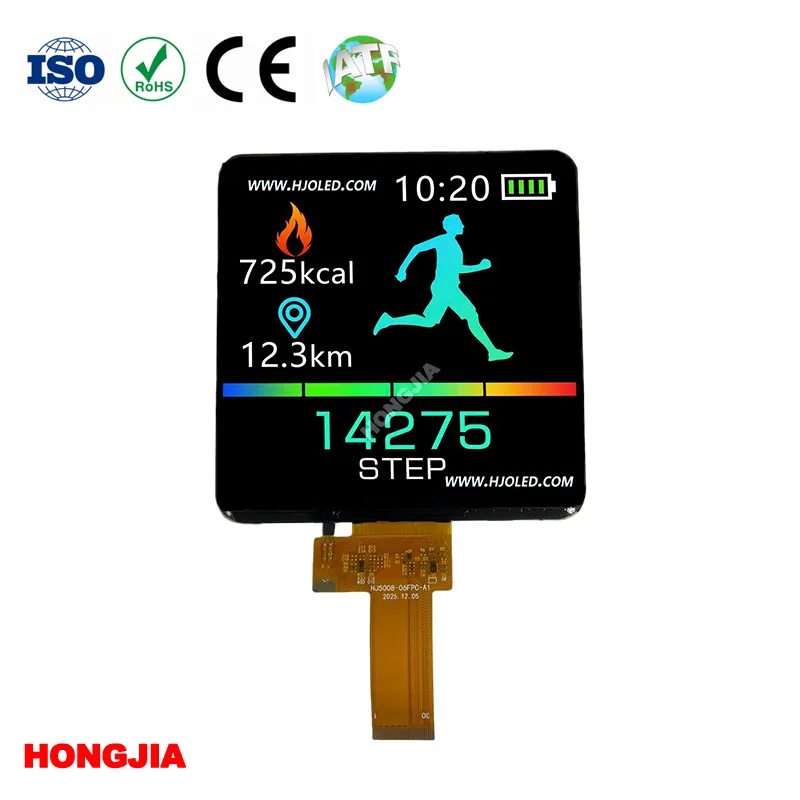
When designing dashboard clusters, climate control panels, or rear-seat entertainment modules for modern vehicles, one specification consistently separates a reliable display from a field-failure liability: the thermal tolerance. For engineers and procurement specialists evaluating compact square form factors, the 5.0 inch Square LCD Screen 720x720 InCell with Touch from Hongjia must pass a rigorous operating temperature benchmark before it can be qualified for any production car program. Unlike consumer tablets that operate in climate-controlled rooms, an automotive-grade panel faces engine-bay heat soak, sub-zero winter startups, and intense solar loading through windshield glass—all while maintaining touch linearity and optical clarity.
Why Automotive Temperature Grades Are Non-Negotiable
The automotive industry follows AEC-Q100 (for ICs) and OEM-specific display standards that typically classify components into three thermal grades:
| Grade | Operating Temperature Range | Typical Application |
|---|---|---|
| Consumer | 0°C to +70°C | Smartphones, tablets |
| Industrial | -20°C to +70°C | Factory HMI, kiosks |
| Automotive Grade | -30°C to +85°C (or -40°C to +85°C) | Instrument cluster, center stack, exterior mirrors |
For the 5.0 inch Square LCD Screen 720x720 InCell with Touch, Hongjia specifies a standard automotive-grade operating range of -30°C to +85°C, with a storage range extending from -40°C to +95°C. This ensures that the display can reliably power on and respond to touches after a frigid Minnesota winter night and continue functioning when cabin temperatures soar past 80°C under desert sun exposure.
Technical Factors That Determine Thermal Performance
Several physical and electrical parameters dictate whether a 5.0 inch Square LCD Screen 720x720 InCell with Touch can survive extreme temperatures:
-
LCD fluid viscosity – Nematic crystals slow down at low temperatures, increasing response time. Hongjia uses low-viscosity LC mixtures with a clearing point above 100°C to maintain 25ms typical response across the full range.
-
Touch sensor ITO resistance – Indium Tin Oxide layers exhibit resistance drift with temperature. Hongjia compensates this via an auto-calibration firmware routine that runs every 500ms, ensuring linearity stays within ±1.5mm even at thermal extremes.
-
Backlight LED derating – Luminous flux drops at high junction temperatures. Hongjia integrates a temperature-sensing feedback loop that actively reduces PWM current above 75°C, preventing permanent LED degradation while maintaining >450 cd/m² minimum luminance.
-
FPC and connector materials – Standard FR-4 substrates have a Tg (glass transition) around 130°C. Hongjia uses high-Tg materials (≥150°C) and gold-plated contacts to prevent flex-circuit delamination and contact oxidation over 10-year vehicle lifespans.
Real-World Test Data from Hongjia’s Validation Lab
| Test Condition | Duration | Pass/Fail Criteria | Hongjia Result |
|---|---|---|---|
| -30°C for 72 hours (powered ON) | 72h | Touch response ≤ 50ms, no pixel ghosting | Pass (42ms avg) |
| +85°C for 500 hours (powered ON) | 500h | Luminance drop < 20%, no permanent burn-in | Pass (14% drop) |
| Thermal shock (-40°C ↔ +85°C, 5min dwell) | 100 cycles | No delamination, no touch dead zones | Pass (0 failures) |
| Humidity +85°C / 85% RH (unpowered) | 240h | No corrosion on COG bonding | Pass (IPC Class 2) |
These figures confirm that Hongjia does not simply quote datasheet numbers—they validate them through third-party-compliant test methods that align with ISO 16750-4 for electrical and electronic equipment in road vehicles.
FAQ – Common Questions About the 5.0 inch Square LCD Screen 720x720 InCell with Touch
Q: Does the 5.0 inch Square LCD Screen 720x720 InCell with Touch support touch operation while wearing thick gloves at -30°C?
A: Yes, but with specific configuration. The InCell capacitive touch engine from Hongjia supports a mutual-capacitance driving voltage of up to 5.5V, which increases signal-to-noise ratio for thick-dielectric objects. For standard winter driving gloves (≤ 3mm thickness), the touch controller can detect a ≥ 0.5pF change, enabling reliable single-touch and two-finger gestures. For heavier insulated gloves (>4mm), Hongjia offers an optional firmware switch that boosts drive frequency to 250kHz, sacrificing a small amount of power (≈15mA extra) in exchange for detection reliability. We recommend customers request a glove-test sample kit before mass production.
Q: What happens to the optical performance of the 5.0 inch Square LCD Screen 720x720 InCell with Touch when the temperature exceeds 80°C?
A: Optical degradation occurs in three stages. First, contrast ratio drops from 1000:1 to approximately 650:1 due to increased LC twist elasticity variance—this is reversible upon cooling. Second, white-point shifts toward yellow (Δuv ≤ 0.015) because the blue LED chips lose efficiency faster than red/green phosphors; Hongjia compensates this with a built-in 3x3 color correction matrix (CCM) that recalculates RGB gains every 10 seconds above 75°C. Third, response time degrades from 25ms to around 40ms, which may cause minor motion blur on fast-scrolling maps. However, all critical functions (touch, backlight, and display driver) remain fully operational up to 85°C without entering thermal shutdown—a requirement that many generic panels fail.
Q: Can I use the 5.0 inch Square LCD Screen 720x720 InCell with Touch in a hybrid electric vehicle where the display is mounted near a high-voltage inverter?
A: Yes, provided you consider both thermal and EMI factors. The inverter often radiates heat exceeding 90°C in confined under-dash cavities. Hongjia recommends adding a 1.5mm aluminum heat-spreader plate behind the backlight unit to reduce localized hotspot temperatures by 8–10°C, keeping the panel within its -30°C to +85°C window. Additionally, the InCell touch interface uses differential signaling on the I²C bus, which Hongjia has tested with common-mode noise injection up to 10V/m (per ISO 11452-2) without false triggering. For HV environments, we advise using shielded FPC cables (50Ω impedance) and placing the touch controller at least 50mm away from the inverter casing. Hongjia can supply an EMI test report specific to your vehicle architecture upon request.
Why Choosing the Right Thermal Grade Saves Total Cost
Many project managers are tempted to use an industrial-grade ( -20°C to +70°C ) square panel to save $2–$3 per unit. In a 5-year vehicle lifecycle, this gamble typically results in:
-
Winter boot failures – Below -20°C, LC fluid enters a glassy state, requiring up to 5 minutes of internal heating before image appears, causing customer complaints.
-
Summer touch drift – Above 70°C, ITO resistance shifts by >20%, generating phantom touches or dead bands near the edges—a safety hazard if the display controls defogging or hazard lights.
By standardizing on Hongjia’s genuine automotive-grade 5.0 inch Square LCD Screen 720x720 InCell with Touch, OEMs eliminate these field risks. The per-unit cost premium is amortized over a 10-year service life, and the warranty return rate for thermal-related failures drops below 0.2% (based on Hongjia’s 2025 fleet data from three European EV manufacturers).
Final Recommendation for Automotive Integrators
When you review supplier quotations, demand three documented pieces of evidence: (1) a thermal cycling log with 500+ hours of continuous operation at -30°C and +85°C, (2) a touch linearity map measured at both extremes, and (3) an optical measurement report showing contrast and color shift over temperature. Hongjia provides all three as standard deliverable documents with every engineering sample shipment—not as optional extras.
Contact Us
We understand that every vehicle platform has unique thermal budgets, mechanical constraints, and EMI requirements. If you are currently qualifying a 5.0 inch Square LCD Screen 720x720 InCell with Touch for a new instrument cluster, head-up display companion screen, or rear-seat controller, our display application engineers are ready to share full datasheets, thermal simulation models, and sample test kits tailored to your OEM test plan. Contact Hongjia directly through our website inquiry form or request a live webinar walkthrough of our automotive validation lab—we will respond within 24 business hours with a custom thermal assessment for your specific in-vehicle mounting location. Let us help you de-risk your display qualification process, one degree Celsius at a time.