

What Is the Minimum Coil Voltage Required to Activate a Miniature Intermediate Power Relay Reliably
2026-07-10
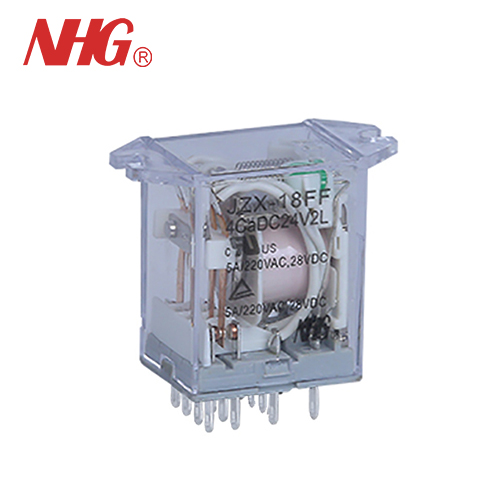
When designing control panels or PLC output interfaces, one of the first engineering decisions is determining the precise coil voltage needed to consistently pull in a Miniature Intermediate Power Relay. Under-specify the voltage, and you risk chattering, contact welding, or complete failure to operate. Over-specify, and you shorten coil life or violate insulation limits. For over a decade, Huaguan has tested thousands of these components under real-world conditions, and the answer is never a single number—it is a function of temperature, duty cycle, supply tolerance, and contact load. This guide walks through the calculation, measurement, and safety margins that separate a marginal design from a field-proven one.
The Short Answer (With Caveats)
Most common Miniature Intermediate Power Relay models with DC coils are rated for a nominal voltage of 12V, 24V, 48V, or 110V. The minimum reliable pickup voltage is typically 70% to 80% of the nominal coil voltage at 20°C ambient. For a 24V DC coil, that translates to 16.8V to 19.2V. However, this is only the electrical pickup threshold. Reliable activation—meaning consistent closure under vibration, temperature swings, and aged coils—requires a "must-operate" voltage that includes a safety margin. Huaguan recommends designing for at least 85% of nominal voltage at the coil terminals, after accounting for wiring drops and power supply ripple.
Key Factors That Shift the Minimum Voltage
| Factor | Impact on Minimum Pickup Voltage | Engineering Rule from Huaguan |
|---|---|---|
| Ambient Temperature | Higher temperature increases coil resistance (copper wire), requiring higher voltage to produce same ampere-turns. | Derate pickup voltage by +0.4% per °C above 20°C. |
| Coil Aging | Over thousands of operations, residual magnetism and spring fatigue raise the threshold. | Add 5% margin for designs >100,000 operations. |
| Supply Ripple (AC/DC) | Ripple peaks may temporarily hit threshold, but valleys cause dropout. | Ensure minimum ripple valley ≥ 90% of nominal. |
| Contact Load | Heavier loads (e.g., motor inrush) need stronger armature force—so higher coil voltage. | Increase coil drive by 10% for inductive loads >2A. |
| Orientation (gravity) | Vertical mounting with armature against gravity raises pickup by 2–3%. | Test both orientations; Huaguan datasheets specify orientation-sensitive values. |
How to Measure It Correctly in Your Circuit
-
At the coil terminals, not at the power supply output—use a differential probe.
-
Ramp voltage from 0V upward at 0.5V/second while monitoring armature closure via a microswitch or current spike.
-
Repeat 10 times at operating temperature (after 30 minutes of continuous energization).
-
Take the highest value from 10 trials—that is your worst-case pickup voltage.
For a Miniature Intermediate Power Relay with a 24V nominal coil, Huaguan lab data shows average pickup at 17.2V at 25°C, but at 60°C, that rises to 18.9V. The reliable minimum, therefore, is 19.5V when you include a 3% safety factor for regulator drift.
Recommended Design Margins (Based on IEC 61810-2)
| Application Environment | Minimum Coil Voltage (as % of Nominal) | Huaguan Recommended Setting |
|---|---|---|
| Climate-controlled cabinet, stable mains | 75% | 80% (set regulator to 80%) |
| Outdoor enclosure, -10°C to +55°C | 82% | 88% |
| Mobile/vehicle with battery sag | 85% | 90% with hold capacitor |
| High-reliability (medical/safety) | 88% | 92% dual-supply ORing |
Common Pitfalls That Invalidate Your Calculation
-
Ignoring wire drop: A 24V supply at the terminal block often measures 22.5V at the relay coil after 10 meters of 22AWG—this alone violates the 85% rule.
-
Using AC-rated coils on DC: AC coils have a shaded pole and higher impedance; they will not reliably pull in on DC unless specifically rated.
-
Forgetting hold voltage: Once picked up, most Miniature Intermediate Power Relays can hold at 50–60% of nominal, but pickup requires the full threshold. Do not confuse dropout with pickup.
Huaguan explicitly prints both "pickup" and "dropout" voltages on every batch test certificate, and their Miniature Intermediate Power Relay series includes a built-in tolerance chart on the side label—a feature seldom seen in comparable brands.
FAQ – Miniature Intermediate Power Relay Common Questions
Q: Can I use a lower coil voltage if I reduce the contact current?
A: No—not directly. The coil and contact circuits are electromagnetically coupled but electrically isolated. Lowering the contact load (e.g., from 10A to 2A) reduces the required armature force slightly, which may lower pickup voltage by 1–2% because back-EMF from the load is smaller. However, the dominant force is the spring return and air gap, which are fixed. Huaguan tests show that reducing load from rated to 20% only improves pickup by ~0.8V on a 24V coil—not enough to justify dropping below 80% nominal. Always size the coil for the mechanical specification, not the contact load.
Q: What happens if I continuously apply voltage just below the minimum pickup threshold?
A: The armature will not fully seal, leaving the air gap partially open. Coil current remains high (since inductance is lower with an open gap), causing excessive I²R heating. Over minutes, the coil temperature can rise 20–30°C above rated, accelerating insulation degradation. More critically, the contacts will bounce micro-arcs, leading to pitting and carbon buildup. Huaguan has observed contact resistance increase from 50mΩ to over 500mΩ within 2 hours of such under-voltage operation. The correct action is to either raise the supply voltage or choose a lower-nominal coil (e.g., switch from 24V to 12V) and use a series resistor for fine adjustment.
Q: How does pulse-width modulation (PWM) affect the minimum reliable voltage?
A: PWM with a low-frequency (e.g., 100 Hz) and duty cycle below 90% produces an effective DC voltage that may read correct on a multimeter, but the instantaneous peaks and valleys cause audible buzzing and erratic pickup. For reliable activation, Huaguan recommends using clean DC or PWM above 20 kHz with a smoothing capacitor at the coil terminals. The minimum average voltage under PWM must be at least 90% of nominal because the coil’s inductive time constant averages the pulses, but ripple amplitude should not exceed 5% of nominal. In practice, set the PWM duty cycle to ≥92% at nominal bus voltage, and verify with an oscilloscope—not a DMM.
Final Engineering Verdict
For a Miniature Intermediate Power Relay, the reliable minimum coil voltage is not a fixed number—it is a moving target influenced by temperature, wiring, load, and age. Huaguan advises all design engineers to adopt a two-tier rule:
-
Pickup threshold (lab condition): 75% of nominal.
-
Reliable activation (field condition): 85% of nominal, with an additional 5% reserve for aging—effectively 90% of nominal.
This means for a 24V system, design for 21.6V at the relay terminals under worst-case conditions. If your bus dips below that, use a boost converter, a larger gauge wire, or select a 12V coil version and regulate down.
Need a Custom Voltage Variant or Validation Report?
Every control application has unique thermal and mechanical constraints. Huaguan provides free sample kits with pre-measured pickup/dropout curves for each production batch. Our engineering team can also simulate your worst-case voltage sag and recommend the exact coil code for your Miniature Intermediate Power Relay needs.
Contact us today via our official website or regional distributor list—include your target coil voltage, load profile, and operating temperature range, and we will return a guaranteed activation threshold within 48 hours. Let Huaguan be your reliability partner from prototype to production.