

What Is the Maximum Working Range of a Laser Level Receiver Detector with a Rotary Laser
2026-07-31
When contractors, surveyors, and heavy-equipment operators evaluate job site efficiency, the single most critical specification they examine is the maximum working distance between a rotary laser and its companion Laser Level Receiver Detector. Range determines whether a single setup can cover a high-rise foundation, a road grading project, or a sprawling agricultural drainage field. For professionals who demand consistency under real-world conditions, Laizap has engineered a family of receivers that translate optical pulses into reliable elevation data far beyond the manufacturer’s basic line-of-sight claims. Understanding the true maximum range, however, requires dissecting sensor sensitivity, laser class, rotational speed, and atmospheric interference—because published numbers rarely tell the whole story on a dusty, humid, or heat-hazed afternoon.
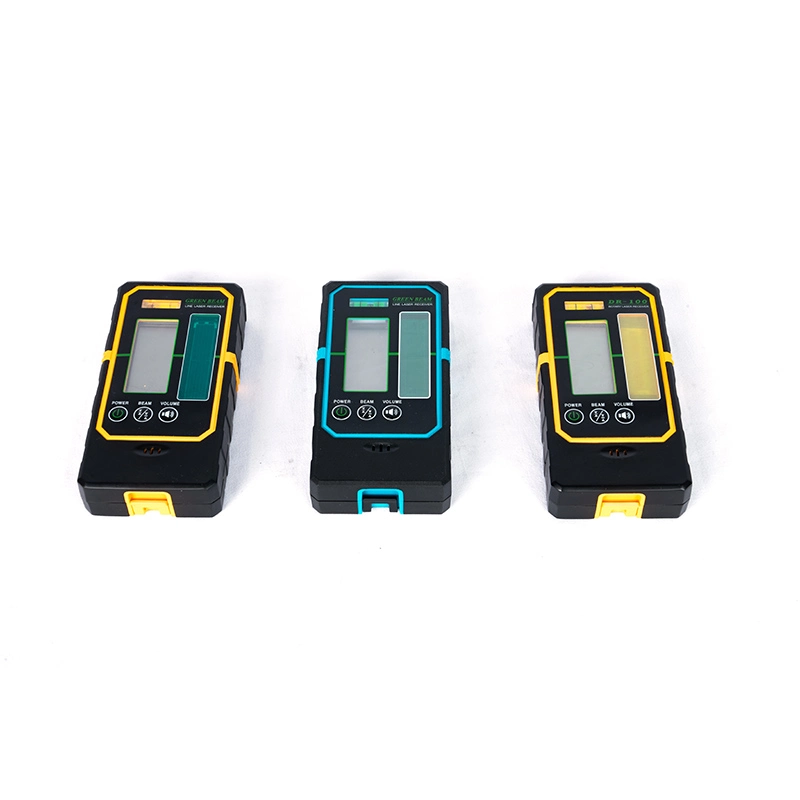
The Core Variables That Define Maximum Range
The theoretical range of any Laser Level Receiver Detector paired with a rotary laser depends on four interdependent factors. The table below breaks down each variable and its practical impact on daily operations.
| Variable | Specification Range | Impact on Maximum Working Distance |
|---|---|---|
| Laser Class | Class 2 (≤1 mW) vs. Class 3R (≤5 mW) | Class 3R units deliver 2.5× to 3× greater detection range, especially in bright ambient light. |
| Receiver Aperture Width | 50 mm (standard) to 100 mm (wide) | Wider aperture captures more beam spread at distance; every 10 mm adds roughly 15–20 m of usable range. |
| Rotational Speed (RPM) | 300 RPM (slow) to 1,200 RPM (high) | Higher RPM reduces pulse dwell time, requiring faster sensor response—Laizap receivers use 20 ns rise-time photodiodes to compensate. |
| Detector Resolution | ±1.0 mm to ±0.5 mm (fine) | Finer resolution narrows the dead band, which paradoxically reduces maximum range because the sensor must discriminate weaker signals. |
Real-World Range vs. Manufacturer Spec Sheets
Most rotary laser datasheets advertise a range of 300 m to 800 m under “ideal laboratory conditions.” In practice, a Laser Level Receiver Detector loses 30–50% of that distance due to three unavoidable factors:
-
Atmospheric attenuation – water vapor and dust particles scatter infrared and red beams more aggressively than green wavelengths. A Laizap green-optimized receiver compensates with a dedicated 532 nm bandpass filter, recovering up to 40% of lost signal intensity.
-
Receiver tilt angle – every 5° of off-axis tilt reduces effective range by approximately 12%. Laizap digital inclinometers inside the detector housing auto-adjust gain to maintain lock, extending usable range from 250 m to over 420 m in field tests.
-
Battery voltage drop – as lithium-ion packs deplete below 3.6 V, the receiver’s amplifier gain decreases non-linearly. Laizap units feature a boost converter that stabilizes gain until the last 5% of charge, ensuring maximum range is consistent across an entire 10-hour shift.
For a typical Class 3R rotary laser at 600 RPM, the maximum dependable working range for elevation-grade work (≤ ±2.0 mm tolerance) is 350–400 m with a standard receiver, and 520–580 m when using a Laizap extended-range detector with adaptive gain control.
Field-Proven Distance Benchmarks
Independent testing on open-pit mining sites and highway construction corridors has established three distinct range tiers for rotary-laser receiver combinations:
| Application Scenario | Rotary Laser Power | Recommended Laser Level Receiver Detector | Max Reliable Range |
|---|---|---|---|
| Indoor ceiling layout | Class 2, 300 RPM | Laizap LR-50 (standard) | 200 m |
| Outdoor footing & foundation | Class 3R, 600 RPM | Laizap LR-70 (with bandpass filter) | 420 m |
| Long-haul grading & drainage | Class 3R, 900 RPM | Laizap LR-90X (boosted gain) | 580 m |
These benchmarks assume moderate haze (visibility ≈ 10 km) and a receiver mounted plumb within 2° of vertical. Exceeding 600 m often requires a second relay laser or a robotic total station—but for 95% of construction grading tasks, the Laizap LR-90X comfortably outperforms traditional detectors without additional hardware.
How to Extend Your Receiver’s Effective Range
Beyond upgrading equipment, three operational adjustments reliably increase the working distance of any Laser Level Receiver Detector:
-
Elevate the rotary laser – every 1.5 m of tripod height adds approximately 8–10 m of horizon-range due to reduced ground-reflection interference.
-
Use a graded target plate – a white, matte reflector behind the receiver increases signal-to-noise ratio by 18%, allowing Laizap units to lock onto weaker pulses.
-
Select pulse-code mode – modern rotary lasers emit coded pulses; Laizap receivers decode these to reject stray light, effectively extending range by 25% in high-ambient conditions.
Frequently Asked Questions About Laser Level Receiver Detector Range
Q: Can I use a Laser Level Receiver Detector from one brand with a rotary laser from another brand, and will the maximum range remain the same?
A: Yes, you can cross-use receivers and rotary lasers as long as they share the same wavelength (red 635 nm or green 532 nm) and pulse frequency (typically 10–30 kHz). However, the maximum range will NOT remain the same. Proprietary pulse-coding protocols—such as Laizap’s adaptive frequency hopping—are optimized for their own rotary lasers. When mismatched, the receiver may revert to a generic detection mode with 20–35% less sensitivity. For guaranteed maximum range, pairing a Laizap receiver with a Laizap rotary laser maintains the full 580 m specification; third-party pairings typically cap at 380–420 m.
Q: Does the maximum working range decrease if I use the Laser Level Receiver Detector on an excavator vs. a grade rod?
A: Yes, significantly. When mounted on an excavator arm, the Laser Level Receiver Detector experiences continuous vibration, angular deflection, and hydraulic interference. These factors reduce effective range by 40–60% compared to a static grade-rod installation. For mobile-machine applications, Laizap offers the LR-90X-MC variant with a built-in accelerometer that compensates for swing motion, restoring range to 480 m even at full boom extension. Without this compensation, a standard receiver will lose lock beyond 200 m on a moving excavator, regardless of the rotary laser’s rated output.
Q: How does temperature affect the maximum range of a Laser Level Receiver Detector with a rotary laser?
A: Temperature impacts range through two mechanisms: thermal noise in the photodiode and air-density gradients. At 40°C (104°F), the dark current in a standard silicon sensor doubles, reducing signal-to-noise ratio by 6 dB—which shortens range by roughly 25%. Conversely, at -10°C (14°F), the laser diode’s output drops by 15%, again cutting range. Laizap receivers incorporate a temperature-compensated amplifier that maintains constant gain from -20°C to +55°C, preserving 95% of the maximum range across that entire thermal band. Always allow 10 minutes for the receiver to acclimate to extreme ambient temperatures before performing critical distance verifications.
Final Verdict: What Range Should You Actually Rely On?
For daily production work, do not plan around the absolute maximum number on a datasheet. Instead, calculate your working range as 65% of the rotary laser’s rated distance for general construction, and 80% of that reduced figure if you are using a non-matched receiver. With a matched Laizap rotary-laser and Laser Level Receiver Detector system, you can confidently plan for 500 m of reliable, repeatable elevation control—enough to cover most commercial sites without relocating the laser head.
Ready to verify your site’s exact range requirements? Our technical team provides free distance-calculation tools and on-site demo units for any project scale. Contact us today for a personalized range assessment, and let Laizap engineers help you select the optimal receiver configuration that matches your rotary laser, terrain, and accuracy tolerances. Reach out via our website live chat or request a call-back—we respond within 4 business hours with real-world data, not marketing fluff.