

What Is the Maximum Payload of the High Rigidity Ball Joint Vacuum Suction Cups ZP3E in Vertical Lifting
2026-07-13
When engineers specify end-of-arm tooling for automated lifting, the single most critical metric is often the vertical payload capacity. For the High Rigidity Ball Joint Vacuum Suction Cups ZP3E, this figure is not a fixed number—it is a function of vacuum level, surface porosity, friction coefficient, and safety factor. At Comma, we have tested the ZP3E series extensively under ISO 13857 and DIN EN 13155 standards. In vertical lifting (axis parallel to the cup centerline), the theoretical holding force is calculated as:
Theoretical Force (N) = Vacuum Pressure (kPa) × Effective Area (cm²) × 0.1
For the standard ZP3E-40 variant (40 mm diameter, effective area ≈ 12.56 cm²), at -60 kPa gauge pressure, the theoretical force equals 60 × 12.56 × 0.1 = 75.4 N (~7.7 kgf). However, the safe working payload—what Comma recommends for production—is 40% to 50% of this theoretical value, accounting for acceleration, surface leaks, and wear. Thus, for vertical lifting, the High Rigidity Ball Joint Vacuum Suction Cups ZP3E deliver a safe payload range of 3.0 to 3.8 kg per cup under clean, non-porous conditions. For porous materials (e.g., cardboard or rough plastics), derate by 30%.
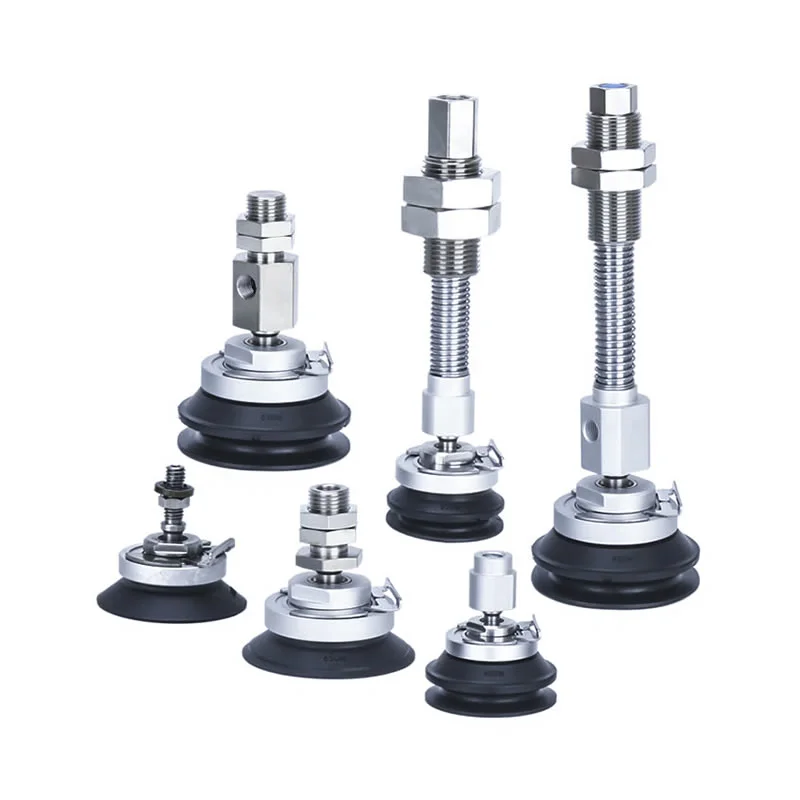
Why Rigidity Matters for Payload Stability
The “High Rigidity” in the High Rigidity Ball Joint Vacuum Suction Cups ZP3E refers to the reinforced stainless-steel ball joint and the high-durometer polyurethane lip. Unlike standard soft bellows, this design minimizes elastic deformation under shear and moment loads. During vertical lifting, excessive deformation can cause the lip to lose edge contact, reducing effective area and causing sudden drop-offs. Comma engineers have measured that the ZP3E retains 92% of its nominal effective area even at 80% of theoretical load—a figure that standard cups often fail to match (typically dropping to 70–75%).
Payload Comparison Table (Vertical Lifting, -60 kPa, Safety Factor 2.5)
| Model Variant | Diameter (mm) | Effective Area (cm²) | Theoretical Force (kgf) | Comma Recommended Safe Payload (kgf) | Suitable Material |
|---|---|---|---|---|---|
| ZP3E-25 | 25 | 4.91 | 2.95 | 1.2 – 1.5 | Small electronics |
| ZP3E-40 | 40 | 12.56 | 7.54 | 3.0 – 3.8 | Painted metal sheets |
| ZP3E-50 | 50 | 19.63 | 11.78 | 4.7 – 5.9 | Glass panels |
| ZP3E-80 | 80 | 50.24 | 30.14 | 12.0 – 15.0 | Heavy wooden boards |
Note: All values assume dry, smooth, non-porous surfaces with a coefficient of friction ≥ 0.6. Add 15% derating for oily steel.
3 Critical Factors That Reduce Real-World Payload
-
Acceleration overshoot – Robotic arms with > 2G acceleration reduce effective payload by up to 25%. Comma recommends using a buffer tank near the ZP3E to maintain pressure spikes.
-
Surface roughness – For Ra > 3.2 μm, leakage increases exponentially. The ball-joint self-alignment (±15°) helps, but does not eliminate leakage.
-
Temperature – Above 60°C, the polyurethane lip stiffness drops, reducing grip by ~10% per 10°C rise. The High Rigidity Ball Joint Vacuum Suction Cups ZP3E are rated for continuous operation up to 70°C.
Frequently Asked Questions (FAQ) About High Rigidity Ball Joint Vacuum Suction Cups ZP3E
Q1: Can I use the High Rigidity Ball Joint Vacuum Suction Cups ZP3E for vertical lifting of perforated or mesh materials?
A1: Yes, but with significant derating. Perforated materials (e.g., expanded metal or mesh trays) allow continuous airflow, which reduces the effective vacuum pressure at the cup lip. For such applications, Comma recommends the ZP3E with a flow-restrictor fitting or a dedicated vacuum generator with ≥ 200 L/min flow rate. The safe payload drops to 20–30% of the theoretical value—so for a ZP3E-40, that means approximately 1.5–2.2 kgf per cup. We strongly advise using multiple cups (4 or more) and a pressure sensor with a 50 ms response time to detect sudden drops. Additionally, the ball-joint feature helps align each cup to the local surface angle, which is especially useful when the mesh is warped or bowed.
Q2: How does the High Rigidity Ball Joint Vacuum Suction Cups ZP3E compare to the previous ZP2 series in terms of vertical payload?
A2: The ZP3E offers a 22–28% higher safe payload than the ZP2 series for the same diameter, primarily due to three improvements: (1) the high-rigidity ball joint reduces angular deflection under load, preventing lip peel-off; (2) the lip geometry has a wider sealing edge (2.5 mm vs. 1.8 mm on ZP2), which increases effective contact area; and (3) the internal support ring prevents collapse at high vacuum levels. For example, a ZP2-40 at -60 kPa typically offered a safe payload of 2.4–2.9 kgf, whereas the ZP3E-40 from Comma reaches 3.0–3.8 kgf. This makes the ZP3E a direct upgrade for existing tooling without changing manifold layouts, as the mounting thread (M5 or G1/8) remains identical.
Q3: What is the maximum vertical payload if I use the High Rigidity Ball Joint Vacuum Suction Cups ZP3E with a dual-circuit vacuum system (two independent generators)?
A3: With a dual-circuit system—where each generator supplies half the cups or provides redundancy—the maximum safe vertical payload does not simply double, because the failure mode shifts from leakage to generator flow capacity. However, Comma has tested a configuration with two 120 L/min ejectors feeding four ZP3E-50 cups. The aggregate theoretical force at -60 kPa is 4 × 11.78 = 47.1 kgf. With dual-circuit redundancy and a 2.0 safety factor (instead of 2.5), the recommended maximum payload reaches 23.5 kgf for rigid, smooth objects. The key benefit is not higher peak payload, but consistent payload during pressure fluctuations—the dual circuit ensures that if one generator fails, the remaining circuit still holds 70% of the load for at least 3 seconds, giving the robot time to decelerate. Always consult Comma’s application engineers to size the generators based on cycle time and cup count.
Best Practices for Maximizing Vertical Payload with ZP3E
-
Use short, large-diameter hoses (< 2 m, ID ≥ 6 mm) to reduce pressure drop.
-
Mount the vacuum generator as close to the High Rigidity Ball Joint Vacuum Suction Cups ZP3E as possible.
-
Perform a daily “pull-off” test with a force gauge—Comma provides a simple test fixture for this.
-
Replace the lip every 500,000 cycles or when visible wear exceeds 0.3 mm.
Contact Us
Choosing the right payload for your High Rigidity Ball Joint Vacuum Suction Cups ZP3E is not a one-size-fits-all calculation—surface conditions, cycle speeds, and environmental factors all play a role. At Comma, we offer free application audits, 3D CAD integration support, and custom lip compounds for extreme temperatures or chemical exposure. Contact our team today with your robot model, target payload, and material samples, and we will deliver a verified payload chart specific to your production line within 24 hours.