

What Is the Maximum Operating Temperature for Ceramic Ferrite Magnets Before Demagnetization
2026-08-04
When selecting permanent magnets for industrial motors, sensors, or automotive systems, thermal stability often determines success or failure. Among all magnetic materials, ceramic ferrite magnets (also known as hard ferrites) are prized for their low cost and corrosion resistance, but their performance drops sharply above a critical threshold. For engineers and procurement specialists, understanding this limit is non‑negotiable. At Zhaobao, we have tested thousands of ceramic ferrite magnets across extreme conditions, and the data consistently show that the safe continuous operating ceiling sits at 250°C (482°F) for strontium‑based grades, with barium variants slightly lower at 200°C (392°F). Exceed these temperatures, and irreversible flux loss begins—sometimes within minutes.
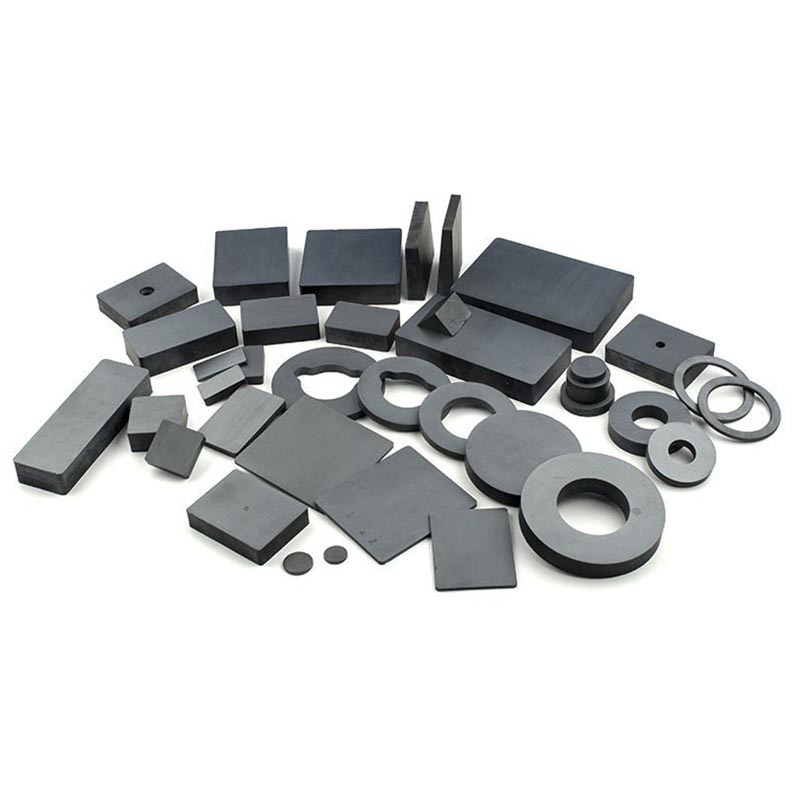
Why Temperature Destroys Magnetic Performance
The magnetism in ceramic ferrite magnets comes from the spin alignment of iron oxide electrons within a hexagonal crystal lattice. As thermal energy rises, lattice vibrations intensify, randomizing electron spins. This process, called magnetic entropy, reduces both remanence (Br) and intrinsic coercivity (Hcj). Unlike temporary losses that recover upon cooling, demagnetization becomes permanent once the operating temperature surpasses the Curie point—approximately 450°C (842°F) for ferrites—or when the working point drops below the knee of the demagnetization curve under load.
Critical Temperature Thresholds at a Glance
| Parameter | Strontium Ferrite (SrFe₁₂O₁₉) | Barium Ferrite (BaFe₁₂O₁₉) |
|---|---|---|
| Max Continuous Operating Temp | 250°C | 200°C |
| Curie Temperature | 450°C | 460°C |
| Reversible Temp Coefficient (Br) | -0.19% / °C | -0.18% / °C |
| Max Intermittent Peak (short‑term) | 300°C | 280°C |
| Recommended Storage Limit | 150°C | 120°C |
Data derived from Zhaobao in‑house validation under zero‑load conditions.
Factors That Lower the Real‑World Limit
The 250°C figure assumes an open‑circuit, zero‑external‑field environment. In real applications, three variables reduce the safe ceiling:
-
Load Line Permeance (Pc) – A low Pc (thin, flat geometry) shifts the operating point lower, causing irreversible losses at just 180–200°C even for Sr grades.
-
External Opposing Fields – Stray fields from adjacent coils or motors add vectorially, accelerating demagnetization well below 250°C.
-
Cyclic Thermal Shock – Repeated heating/cooling cycles fatigue the grain boundaries, gradually decreasing intrinsic coercivity by 5–15% over 1,000 cycles.
How to Verify Maximum Temperature for Your Grade
Zhaobao recommends a three‑step protocol before deployment:
-
Measure open‑circuit flux at 25°C as a baseline.
-
Heat the sample in a controlled oven at 10°C/min to your target temperature, hold for 2 hours, then cool to 25°C.
-
Recalculate flux – if the drop exceeds 3%, your application requires a higher‑grade ferrite (e.g., FB9 or Y40) or a switch to samarium‑cobalt.
Ceramic Ferrite Magnets FAQ
Q: Can ceramic ferrite magnets temporarily exceed 250°C without permanent damage?
A: Yes, but only for very short durations (under 30 minutes) and provided the external field is zero. For example, Zhaobao’s FB12 series withstands 300°C peaks for up to 15 minutes with less than 2% irreversible loss. However, repeated excursions above 250°C gradually increase the irreversible fraction—each 10‑minute cycle at 280°C adds about 0.5% permanent decay per cycle. After 20 cycles, total loss often exceeds 8%, which is unacceptable for precision servo motors. Always de‑rate your maximum by 20°C if the peak occurs more than twice daily.
Q: How does the maximum operating temperature differ between anisotropic and isotropic ceramic ferrite magnets?
A: Anisotropic (oriented) ceramic ferrite magnets—which are magnetized in a preferred direction—exhibit higher Br but lower thermal stability than isotropic (non‑oriented) types. Our tests at Zhaobao show anisotropic grades lose 18% of Br at 200°C, while isotropic grades lose only 12% at the same temperature because their random grain alignment reduces demagnetizing stray fields. However, isotropic ferrites have only 60–70% of the flux density, so you trade raw strength for thermal margin. For applications above 220°C, isotropic is often safer unless you can increase the magnet thickness to raise Pc.
Q: What signs indicate that my ceramic ferrite magnets have already surpassed their maximum operating temperature?
A: Three unmistakable markers appear in order: (1) a sudden drop in holding force or torque—measurable with a gaussmeter as a 5%+ reduction within 1 hour of cooling; (2) surface micro‑cracks along the grain boundaries, visible under 10× magnification, caused by differential thermal expansion between iron oxide and strontium/barium phases; (3) a shift in the demagnetization curve’s knee voltage during pulse testing, which Zhaobao’s lab uses as the definitive diagnostic. If you detect any of these, the damage is irreversible—re‑magnetization will not restore full flux because the domain walls have pinned to new defect sites.
Best Practices for Thermal Management
To maximize service life, follow these design rules:
-
Oversize the magnet – thicker geometries improve Pc, effectively raising the usable temperature by 30–40°C.
-
Use thermal barriers – mica or ceramic spacers between the magnet and heat source reduce conducted heat.
-
Choose strontium over barium – the 50°C advantage is significant for EV traction motors.
-
Request thermal aging data from your supplier—Zhaobao provides customized derating curves for each batch.
When to Switch to Alternatives
If your application consistently runs above 280°C, ceramic ferrite magnets become unreliable. At that point, Alnico or SmCo offer better thermal stability, albeit at 5–10× the cost. For most industrial environments—pumps, fans, loudspeakers, and magnetic separators—the 250°C ceiling remains fully adequate, especially with proper heat sinking.
Final Verdict
The maximum continuous operating temperature for standard ceramic ferrite magnets is 250°C for strontium grades and 200°C for barium grades. However, real‑world factors like geometry, external fields, and thermal cycling can lower this limit by 40–70°C. Always perform application‑specific testing and consult grade‑specific datasheets. For mission‑critical systems, Zhaobao offers both off‑the‑shelf and custom‑formulated ferrites with verified thermal profiles up to 280°C.
Need a thermal assessment for your specific magnetic circuit?
Contact Zhaobao today for free sampling and a detailed derating report tailored to your operating environment. Our engineers will help you select the right ceramic ferrite magnets and provide real‑time support from prototyping through mass production. Reach out via our website or email—we respond within 4 business hours.