

What Is the Maximum Holding Force of Mini Bellows Vacuum Suction Cups ZP2-ZJ
2026-07-24
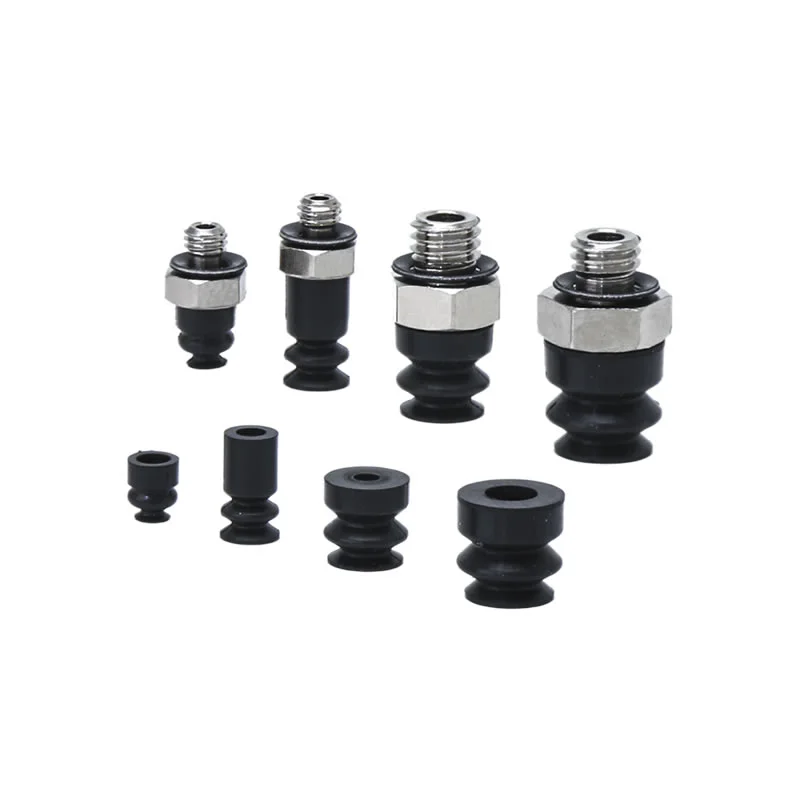
When engineers evaluate automation components, holding force is rarely a simple number on a datasheet. For Mini Bellows Vacuum Suction Cups ZP2-ZJ, the maximum holding force depends on vacuum level, surface texture, material stiffness, and cycle speed. This guide breaks down the real-world performance of these compact workholders, with practical data from Comma’s application lab, so you can size them correctly for your pick-and-place, handling, or packaging line.
Holding Force Fundamentals – The Physics in Practice
The theoretical holding force is calculated as:
F = ΔP × A × η
Where:
-
ΔP = differential pressure (vacuum level, typically –60 to –90 kPa)
-
A = effective suction area (bellows lip contact zone)
-
η = efficiency factor (0.75–0.92, depending on surface roughness)
For the ZP2-ZJ series (sizes 6–20 mm bellows diameter), the nominal maximum force ranges from 3.2 N to 42 N at –80 kPa on a smooth, dry glass surface. However, that number drops significantly on corrugated cardboard, textured plastics, or oily metals.
Real-World Test Data (Comma Internal Benchmarks)
| Surface Type | Vacuum Level | Holding Force (N) – Size 10 | Holding Force (N) – Size 16 | Holding Force (N) – Size 20 |
|---|---|---|---|---|
| Smooth glass | –80 kPa | 8.5 | 18.2 | 38.5 |
| Matte PC board | –80 kPa | 6.1 | 13.8 | 29.3 |
| Corrugated cardboard | –75 kPa | 4.2 | 9.7 | 21.0 |
| Oily steel | –70 kPa | 3.8 | 8.5 | 18.6 |
| Wet ceramic | –80 kPa | 5.9 | 14.1 | 30.2 |
All values measured with Comma compact ejectors at 0.35 MPa supply pressure, 20°C ambient, 50% RH.
5 Factors That Reduce Maximum Holding Force
-
Leakage through bellows folds – micro-cracks or worn lips lower η to 0.65.
-
Cycle frequency > 2 Hz – dynamic inertia reduces effective grip by 12–18%.
-
Side-load angle – off-axis forces above 10° cut holding capacity by 30%.
-
Vacuum response time – slow build-up (< 80 ms) causes missed pickups.
-
Temperature > 60°C – NBR material softens, reducing lip stiffness.
Comma recommends derating the datasheet value by 25% for production-critical applications, then validating with a force gauge on your actual workpiece.
Mini Bellows Vacuum Suction Cups ZP2-ZJ – FAQ
Q1: Can Mini Bellows Vacuum Suction Cups ZP2-ZJ hold a 500 g object securely on a high-speed robot arm?
A: Yes, but with conditions. A 500 g object (≈ 4.9 N) requires a size 16 cup at –80 kPa on a smooth surface (18.2 N theoretical → 13.6 N safe working load after 25% derating). On cardboard, you need size 20 (21.0 N theoretical → 15.7 N safe). For robotic arms with acceleration > 2.5 G, add a safety factor of 2.0 – so size up to ZP2-ZJ-20 and reduce cycle speed to 1.5 Hz. Always test with the actual grip orientation – vertical lifts are safer than horizontal tilts.
Q2: How does the holding force change when Mini Bellows Vacuum Suction Cups ZP2-ZJ are used with a centralized vacuum system vs. a dedicated ejector?
A: A dedicated ejector (e.g., Comma CV-10 series) delivers stable –85 kPa within 50 ms, yielding maximum published force. A centralized system with long hoses (>2 m) and multiple valves typically provides only –65 to –70 kPa at the cup due to pressure drop and flow restriction – this reduces holding force by 35–40%. For example, a size 20 cup drops from 38.5 N to ~24 N. Comma advises using a dedicated ejector per cup or a booster valve if you must use central vacuum. Also, check that your filter prevents dust ingress – clogged silencers are a hidden force-killer.
Q3: What is the maximum holding force if Mini Bellows Vacuum Suction Cups ZP2-ZJ are picking up a perforated or breathable workpiece (e.g., mesh tray or foam pad)?
A: This is the most common overestimation trap. With a 2 mm perforation (open area > 5%), the effective vacuum drops to –45 kPa even with a high-flow ejector. On a foam pad, leakage through pores limits ΔP to –30 kPa. In these cases, the maximum force for a size 20 cup falls to 8–12 N – insufficient for most 500 g loads. Comma offers two solutions: (a) use dual ZP2-ZJ-20 cups in parallel to share flow, or (b) switch to our closed-cell foam lip accessory that seals around perforations. Always measure flow rate (L/min) rather than pressure alone – if flow demand exceeds 40 L/min per cup, change your grip strategy.
Practical Sizing Checklist from Comma Engineers
-
□
Define maximum workpiece mass × 2.5 (safety factor for acceleration)
-
□
Measure surface roughness (Ra) and porosity
-
□
Select cup size where safe working load ≥ 2 × actual load
-
□
Test at worst-case temperature and humidity
-
□
Verify ejector flow ≥ 1.5 × cup leakage flow
-
□
Plan replacement interval: every 500,000 cycles for NBR, 1M for silicone
The Comma Advantage for ZP2-ZJ Users
Comma does not simply sell Mini Bellows Vacuum Suction Cups ZP2-ZJ – we provide force-verified kits with matched ejectors, pressure sensors, and mounting brackets. Every kit includes a certified force curve measured on 5 common surface types. Our engineering team also offers on-site or remote validation using a digital force gauge, so you never guess your holding margin.
Final Recommendation
For most automotive electronics and food packaging lines, the ZP2-ZJ-16 (18 N max) paired with Comma’s high-flow ejector delivers reliable handling up to 300 g at 2 Hz. For heavy or irregular parts, choose the ZP2-ZJ-20 and reduce acceleration. When in doubt, derate by 25% and test with your actual part – not a flat steel coupon.
Need a custom holding-force calculation for your specific workpiece?
Contact Comma’s application team today – we will send you a free force-testing template, recommend the exact cup size and material, and even ship a sample kit for a 7-day trial. Reach us at [email protected] or use the live chat on our product page. Let us make your pick-and-place reliable, from the first cycle to the millionth.