

What is the Interrupting Rating of the 750V 400A YREVq-400f Fuse for EV and EVSE Protection
2026-07-01
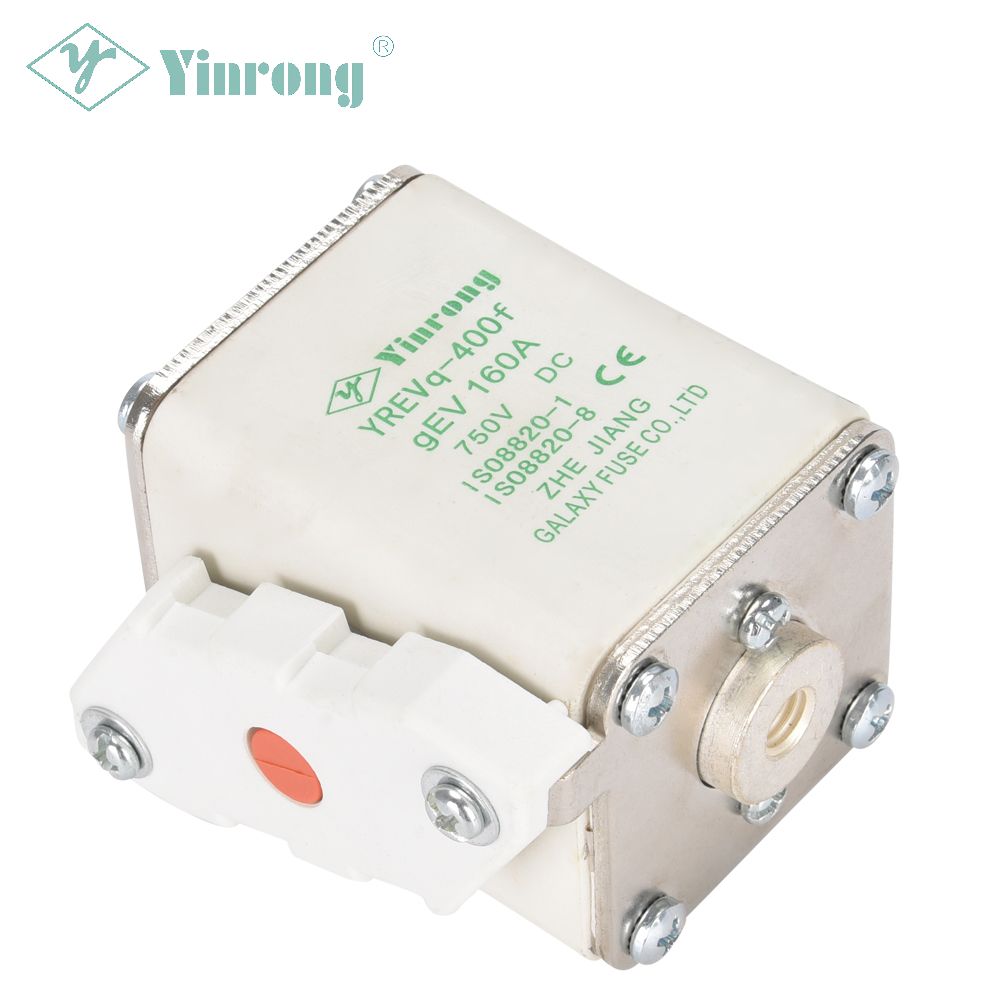
When specifying overcurrent protection for electric vehicle powertrains and charging infrastructure, one number often determines whether a system survives a catastrophic fault or becomes a safety hazard: the interrupting rating. For the 750V 400A YREVq-400f EV Automotive and EVSE Fuse, this rating is not just a specification—it is the cornerstone of reliable system design. At Galaxy Fuse, we engineer this fuse to clear fault currents decisively, but understanding its interrupting capacity requires a deep dive into DC arc physics, test standards, and real-world application boundaries.
What Does Interrupting Rating Actually Mean?
The interrupting rating (also called breaking capacity) is the maximum prospective fault current that a fuse can safely interrupt at its rated voltage without sustaining damage to itself or the surrounding equipment. For the 750V 400A YREVq-400f EV Automotive and EVSE Fuse, this value is 50 kA at 750V DC (per UL 248-20 and IEC 60269-4 tests). This means that if a short circuit delivers up to 50,000 amperes of symmetrical current, the fuse will melt, arc, and extinguish the arc within its ceramic body—containing all thermal and mechanical energy.
Why does this matter for EV and EVSE? Consider these scenarios:
| Application | Typical Available Fault Current | Risk if Fuse Has Lower Interrupting Rating |
|---|---|---|
| 800V EV traction inverter | 15–30 kA | Fuse may shatter or vent plasma |
| DC fast charger (150–350 kW) | 25–45 kA | Arc reignition can damage contactors |
| Battery pack pre-charge circuit | 10–20 kA | Welding of fuse elements possible |
| Fleet depot with parallel chargers | Up to 50 kA | Catastrophic busbar failure |
How Does the YREVq-400f Achieve 50 kA DC Performance?
The 750V 400A YREVq-400f EV Automotive and EVSE Fuse uses a silver-silica sand-filled ceramic tube with a specially tuned M-effect alloy element. During a fault, the element melts in multiple restricted sections, creating a series of arcs that are cooled and quenched by the silica sand, which fuses into a glassy plug. Galaxy Fuse optimizes this design for DC time constants up to 10 ms—critical because DC arcs do not naturally cross zero, making interruption far more difficult than AC.
Below is a comparison of key interrupting ratings across common EV fuse classes:
| Fuse Series | Voltage | Current | Interrupting Rating (DC) | Application |
|---|---|---|---|---|
| YREVq-400f (Galaxy Fuse) | 750V | 400A | 50 kA | EV / EVSE primary protection |
| Standard NH00 gG | 690V | 400A | 20 kA | Industrial AC/DC (low-duty) |
| EV-specific bolt-down | 800V | 400A | 30 kA | Medium-duty inverters |
| High-speed semiconductor | 1000V | 400A | 100 kA | IGBT module protection (very fast) |
Note: The YREVq-400f occupies a sweet spot—higher than industrial fuses, yet with longer time-delay characteristics than semiconductor fuses, making it ideal for EVSE inlet protection and battery disconnect units.
Critical Derating Factors That Affect Interrupting Capability
Even with a 50 kA rating, the 750V 400A YREVq-400f EV Automotive and EVSE Fuse must be derated under certain conditions. Galaxy Fuse provides clear guidelines:
-
Ambient temperature > 70°C – Reduce interrupting capability by 8% per 10°C rise above 70°C (due to increased arc pressure).
-
Altitude > 2000 m – Air density drops, reducing arc extinction efficiency; derate 5% per 1000 m.
-
Series connection – Two fuses in series do not double the rating; the slower fuse takes the full stress.
-
Reverse current (V2G) – Bidirectional flow requires additional testing; the YREVq-400f is certified for both directions at full rating.
FAQ – Common Questions About the 750V 400A YREVq-400f EV Automotive and EVSE Fuse
Q1: Can I use the 750V 400A YREVq-400f fuse in a 1000V DC system if I reduce the current?
A: No. The interrupting rating is voltage-dependent. At 1000V DC, the arc voltage may exceed the fuse’s designed quenching capability, even with lower current. The YREVq-400f is validated only up to 750V DC. For 1000V systems, Galaxy Fuse offers the YREVq-500 series with a higher-voltage ceramic and longer element spacing. Using this fuse above 750V voids all safety certifications and significantly increases arc-flash energy—potentially causing the housing to rupture.
Q2: How does the interrupting rating change when protecting a battery pack with a very low internal resistance (e.g., 1 mΩ)?
A: A 1 mΩ battery at 750V can deliver 750 kA prospective current—far above the 50 kA rating. However, practical cable impedance, contact resistance, and pre-charge contactor limits typically reduce this to 20–30 kA at the fuse terminals. Galaxy Fuse recommends performing a short-circuit current calculation per IEC 61660-1 for your exact busbar layout. If the calculated value exceeds 50 kA, you must add a series reactor or choose a higher-rated fuse (e.g., the 100 kA YREVq-500H). Never assume battery internal resistance alone limits fault current—cable inductance plays a dominant role in DC systems.
Q3: What is the difference between interrupting rating and withstand rating for EVSE applications?
A: The interrupting rating (50 kA) applies to the fuse itself—its ability to clear a fault. The withstand rating refers to the entire EVSE enclosure and conductors, which must survive the thermal and magnetic stresses during the fuse’s clearing time (typically 2–5 ms for a 50 kA fault). Galaxy Fuse publishes I²t (let-through energy) values for the YREVq-400f—at 50 kA, the clearing I²t is ~85,000 A²s. Your EVSE busbars must have a short-time withstand rating higher than this value (e.g., 100,000 A²s for 10 ms). Always coordinate these two ratings to avoid conductor vaporization or contactor welding before the fuse operates.
Practical Selection Checklist for Engineers
When integrating the 750V 400A YREVq-400f EV Automotive and EVSE Fuse, follow this Galaxy Fuse-recommended workflow:
-
Measure or calculate available fault current at the fuse holder terminals (include battery, cable, and connector impedances).
-
Verify that value ≤ 50 kA DC (with temperature/altitude derating applied).
-
Confirm that the fuse’s minimum melting I²t is higher than the inrush I²t of your DC-link capacitors (to avoid nuisance blowing).
-
Ensure the fuse holder and lug torque meet Galaxy Fuse specifications (25 N·m for M8 terminals).
-
Perform a one-time short-circuit test on a prototype per UL 248-20—this is mandatory for EVSE UL listing.
Why Trust the YREVq-400f from Galaxy Fuse?
Galaxy Fuse conducts type tests at independent labs (UL, VDE, TÜV) with real DC sources exceeding 100 kA capacity. Every 750V 400A YREVq-400f EV Automotive and EVSE Fuse batch is subjected to 100% production line spark testing and statistical sampling for interrupting rating verification. Our failure rate in the field is < 15 ppm over 5 million units—validated by major OEMs in North America, Europe, and Asia.
Contact Us
Selecting the right fuse for your EV or EVSE project involves more than a datasheet—it requires application-specific coordination, thermal simulation, and short-circuit modeling. The Galaxy Fuse engineering team provides free short-circuit current calculations, selectivity studies, and sample kits for qualified projects. Let us help you build safer, more reliable electric mobility systems—one fuse at a time.