

What Is the Difference Between NB-IoT Antenna Types and Their Use Cases
2026-10-20
Selecting the right NB-IoT antenna is one of the most consequential decisions in LPWAN device design, yet it is often treated as an afterthought. At Qianmu, we have supported hundreds of IoT deployments across smart metering, asset tracking, and agricultural sensing, and the pattern is consistent: devices that succeed in the field almost always pair a well-matched NB-IoT antenna with a clear understanding of its use case. This guide breaks down the major antenna types, their trade-offs, and where each one belongs.
Why Antenna Type Matters in NB-IoT Systems
NB-IoT operates in licensed sub-GHz and mid-band spectrum (typically 700–900 MHz and 1800–2100 MHz), where wavelength is long and the antenna must often fit inside compact enclosures. The wrong choice produces detuning, reduced radiation efficiency, and link budgets that fall short of the 164 dB target. The right choice depends on four variables: frequency band, device form factor, installation environment, and required gain.
The Main NB-IoT Antenna Types
Qianmu classifies NB-IoT antenna solutions into five families. Each has a distinct electromagnetic behavior and deployment profile.
-
Chip antennas – Surface-mount ceramic resonators; smallest footprint, lowest cost, narrow bandwidth, best for high-volume compact trackers.
-
PCB trace antennas – Etched directly on the board; zero BOM cost, moderate efficiency, requires careful ground-plane clearance.
-
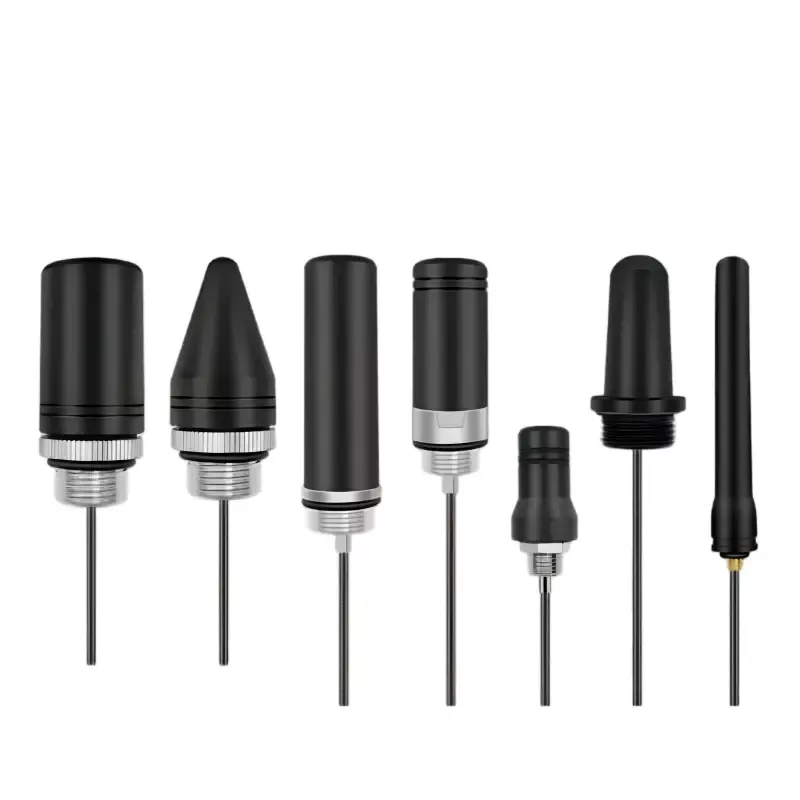
External whip antennas – Connector-mounted monopoles or dipoles; highest gain and isolation from the PCB, ideal for metal enclosures and outdoor units.
-
FPC antennas – Flexible printed circuits with adhesive backing; conform to curved or space-constrained housings, strong performance when kept clear of metal.
-
Ceramic patch and helical antennas – Directional or compact omnidirectional options for gateways and fixed infrastructure.
Comparison Table
| Antenna Type | Typical Gain | Footprint | Bandwidth | Best Use Case | Key Limitation |
|---|---|---|---|---|---|
| Chip | 0–2 dBi | Very small | Narrow | Wearables, compact trackers | Sensitive to ground plane and nearby metal |
| PCB trace | 0–3 dBi | Small–medium | Moderate | Smart meters, consumer IoT | Requires dedicated board area |
| External whip | 2–5 dBi | External | Wide | Outdoor enclosures, industrial | Connector cost, physical protrusion |
| FPC | 1–3 dBi | Flexible | Moderate | Curved housings, handheld devices | Adhesive reliability, metal clearance |
| Patch / helical | 3–8 dBi | Medium–large | Narrow–moderate | Gateways, fixed infrastructure | Bulky, alignment-sensitive |
Matching Types to Real Deployments
The table above is a starting point, but field performance depends on integration. Qianmu recommends the following mapping based on deployment reality:
-
Smart water and gas meters – PCB trace or external whip, depending on whether the meter sits in a basement or an outdoor pit.
-
Asset trackers – Chip antennas for size-critical designs; FPC when the housing is curved.
-
Industrial sensors in metal cabinets – External whip antennas with an RF pigtail to move the radiator outside the shielding.
-
NB-IoT gateways – Patch or helical antennas for stable coverage over a fixed service area.
-
Wearables and medical tags – Chip antennas with a tuned ground plane and strict clearance rules.
Design and Validation Notes
Even the best NB-IoT antenna underperforms if the surrounding ground plane is too small or if the matching network is copied from a reference design without retuning. Qianmu validates every antenna with VNA-based S11 measurements, efficiency testing in an anechoic chamber, and over-the-air sensitivity checks in the target band. Keep the antenna clear of batteries, speakers, and metal fasteners, and always verify performance in the final enclosure rather than on a bare evaluation board.
Frequently Asked Questions
Q: Which NB-IoT antenna type offers the best range?
A: External whip antennas generally deliver the best range because they combine higher gain with physical separation from the PCB and enclosure, but a well-tuned FPC or PCB trace antenna can match them in compact devices when ground-plane clearance and matching are handled correctly.
Q: Can a chip antenna support multiple NB-IoT bands?
A: Most chip antennas cover a single band or a narrow dual-band window, so multiband operation usually requires a broadband FPC or external antenna, or a dedicated matching network that Qianmu tunes for each target band.
Q: How do I know if my NB-IoT antenna needs retuning?
A: If S11 at the operating frequency is worse than about −6 dB, or if OTA sensitivity drops after the enclosure is assembled, retuning is required; Qianmu recommends measuring in the final housing before production release.
Conclusion
Choosing among NB-IoT antenna types is a system-level decision, not a component-level one. Match the antenna family to your band, enclosure, and installation environment, then validate in the final product. Qianmu provides antenna selection support, custom tuning, and full RF validation for NB-IoT designs. Contact us today to discuss your project requirements and request a tailored antenna recommendation.