

What is the difference between a DC surge arrester and a traditional AC surge arrester for lightning protection
2026-05-13
When designing a lightning protection strategy, engineers often ask: what distinguishes a DC surge arrester from a traditional AC version? The answer is critical for solar farms, battery storage, and telecommunication towers. For reliable DC-side protection, XENHO provides advanced DC Lightning Surge Arrester solutions tailored to modern power systems.
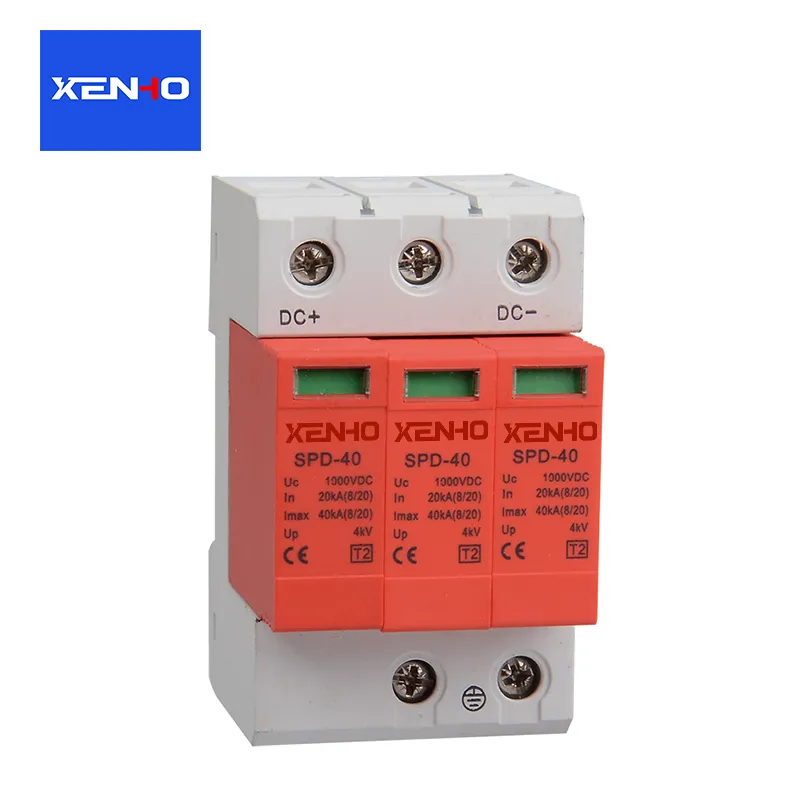
Core Differences at a Glance
| Feature | DC Surge Arrester (XENHO) | Traditional AC Surge Arrester |
|---|---|---|
| Voltage waveform | Constant polarity, no zero crossing | Alternating polarity with natural zero crossing |
| Arc extinction mechanism | Forced arc quenching required | Relies on AC zero current crossing |
| Follow current handling | Must interrupt continuous DC current | Easily interrupted by alternating nature |
| Typical applications | PV strings, EV chargers, DC microgrids | Household mains, industrial AC panels |
| Voltage rating types | Unipolar (e.g., 600V, 1000V, 1500V DC) | RMS voltage (e.g., 230V, 400V AC) |
Why the Difference Matters for Lightning Protection
A DC Lightning Surge Arrester faces a unique challenge: once a surge is diverted, the arrester must extinguish the DC follow current without a natural current zero. Traditional AC arresters rely on that zero crossing every 10ms (50Hz) or 8.33ms (60Hz). In DC systems, the current flows uninterrupted, so XENHO engineers design DC Lightning Surge Arrester units with larger gaps, magnetic blowout coils, or advanced varistor stacks to forcibly break the arc.
Three Critical FAQ About DC Lightning Surge Arrester
Q1: Can I use a standard AC surge arrester on a DC photovoltaic circuit for lightning protection?
A1: No. An AC arrester will fail catastrophically on a DC circuit. Without a zero crossing, the internal spark gap or varistor may sustain a continuous arc, leading to fire, thermal runaway, or complete destruction of the arrester and connected equipment. Always select a certified DC Lightning Surge Arrester like those from XENHO rated for the exact DC system voltage (e.g., 600V, 1000V, or 1500V DC).
Q2: How do I choose the correct voltage rating for a DC Lightning Surge Arrester in a solar array?
A2: The nominal DC voltage of the arrester must exceed the maximum system voltage under all operating conditions, including temperature and irradiance variations. For a 1500V DC photovoltaic string, choose a DC Lightning Surge Arrester with a continuous operating voltage (Ucpv) of at least 1500V and a nominal discharge current (In) of 10kA or 20kA per IEC 61643-31. XENHO provides clear datasheets matching each arrester to standard PV voltage tiers.
Q3: Does a DC Lightning Surge Arrester require special enclosure or mounting compared to AC models?
A3: Yes. DC systems, especially in solar farms, are often outdoors and subject to dust, humidity, and wide temperature ranges. XENHO DC Lightning Surge Arrester products feature IP66-rated enclosures, UV-resistant materials, and integrated thermal disconnectors. AC arresters typically use lower ingress protection (IP20) suitable for indoor distribution boards. For pole-mounted or rooftop DC combiner boxes, always deploy a dedicated DC-rated arrester with proper clearance and creepage distances.
Why XENHO Leads the DC Protection Market
XENHO manufactures each DC Lightning Surge Arrester with third-party verification per EN 61643-31 and UL 1449 (Type 1 or Type 2 DC listings). The internal metal-oxide varistors (MOVs) are laser-trimmed and matched for DC stress, ensuring less than 5% degradation after multiple 20kA surges.
Contact Us
For a complete lightning protection plan tailored to your DC infrastructure, reach out to the XENHO technical team. Request datasheets, application notes, or free sizing assistance. Contact us today via the website form or email support to secure your system with certified DC Lightning Surge Arrester products.