

What Factors Influence the Voltage Delay in a Li-SOCL2 Battery During High-Rate Discharge
2026-04-13
When deploying a Li-SOCL2 Battery for high-rate discharge applications such as automated utility meters, industrial beacons, or emergency tracking devices, engineers often encounter a critical phenomenon known as voltage delay. At VCELL POWER, we have analyzed thousands of discharge curves to identify the root causes. Voltage delay refers to the temporary drop in output voltage immediately after a high-current pulse begins, which can cause device reset or malfunction. Understanding these factors is essential for reliable system design.
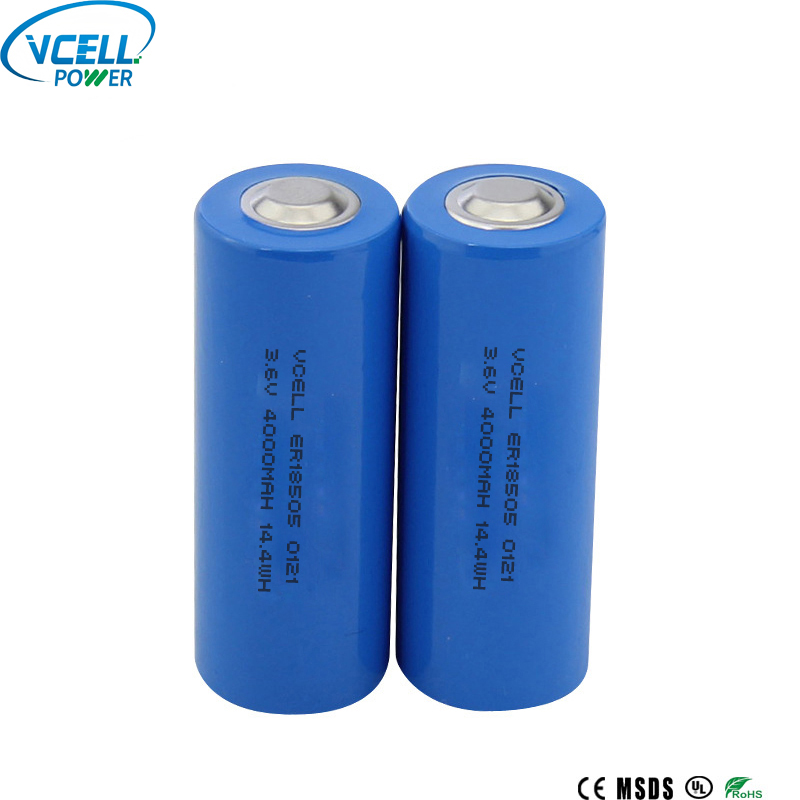
Primary Factors Affecting Voltage Delay in a Li-SOCL2 Battery
| Factor | Mechanism | Impact Level |
|---|---|---|
| Passivation layer thickness | LiCl film grows on lithium anode during storage | High |
| Discharge current density | Higher current accelerates local film rupture | High |
| Storage temperature and duration | Elevated temperature increases layer growth rate | Medium |
| Electrolyte composition | Specific additives reduce film impedance | Medium |
| Pre-conditioning history | Prior small discharges can stabilize interface | Low |
The passivation layer is a natural protective film that forms on the lithium anode in a Li-SOCL2 Battery. While beneficial for shelf life, this layer becomes a resistor during high-rate pulses. Four specific factors dominate voltage delay behavior:
-
Storage Time and Temperature
A Li-SOCL2 Battery stored at 60°C for three months develops a thicker LiCl layer than one stored at 25°C, increasing initial voltage dip by up to 0.8V under 100mA/cm² pulses. -
Pulse Current Magnitude
At 50mA/cm², voltage recovers within 50ms. At 300mA/cm², recovery may take >500ms. The mechanical rupture of the passivation layer requires sufficient local heating and current crowding. -
Anode Surface Morphology
Microscopic irregularities create uneven passivation. VCELL POWER uses precision-etched anodes to minimize this variability. -
Electrolyte Salt Concentration
Higher LiAlCl₄ concentration reduces but does not eliminate delay. Optimal balance is 1.2–1.5M.
Li-SOCL2 Battery FAQ – Common Questions from Engineers
Question 1: Can voltage damage my circuit if I use a Li-SOCL2 Battery for pulsed loads?
Yes, voltage delay can cause temporary undervoltage lockout in sensitive microcontrollers. For a Li-SOCL2 Battery at 80% remaining capacity after 6 months storage at 30°C, the initial 500ms pulse may show voltage as low as 2.4V instead of the nominal 3.6V. This can reset RF modules or data loggers. VCELL POWER recommends either a pre-pulse conditioning (a small 5mA load for 1 second before the main pulse) or selecting a low-passivation grade cell.
Question 2: How does the passivation layer recover after a high-rate pulse?
After the first high-rate pulse, the passivation layer is partially destroyed, but a new layer begins reforming immediately. Within 24 hours at 25°C, a Li-SOCL2 Battery regains approximately 70% of its original voltage delay behavior. After 7 days, full passivation returns. This means frequent pulse applications (every few minutes) see lower voltage delay, while infrequent pulses (weekly) experience full delay each time. VCELL POWER provides application-specific guidance on expected recovery curves.
Question 3: Is voltage delay a sign of end-of-life for a Li-SOCL2 Battery?
Not necessarily. A brand new Li-SOCL2 Battery exhibits voltage delay after long storage. Conversely, a nearly depleted cell (below 5% remaining capacity) also shows voltage drop, but that drop is permanent and does not recover. To differentiate: apply two pulses 10 seconds apart. If the second pulse voltage is significantly higher, the cause is passivation (reversible). If both are equally low, the cell is depleted. VCELL POWER integrates diagnostic pulse routines into our battery management guidelines.
Best Practices to Mitigate Voltage Delay
-
Use a small capacitor bank (1000µF minimum) across the Li-SOCL2 Battery terminals.
-
Program a soft-start or ramp-up sequence before high-rate data transmission.
-
Select a Li-SOCL2 Battery from VCELL POWER with optimized electrolyte additive package.
-
Store cells at ≤25°C and use within 18 months of manufacture.
Contact Us
For custom solutions on voltage delay characterization or to request a Li-SOCL2 Battery sample with low-passivation technology, reach out to VCELL POWER today. Our engineering team provides discharge curve data under pulsed conditions specific to your load profile. Visit our contact page for direct technical support.