

What Are the Minimum Bending Radius Requirements for 600 MCM-2 Double Wire Lugs
2026-07-10
When installing heavy-duty power distribution systems, one question that consistently surfaces among electrical engineers and panel builders is: what is the minimum bending radius for 600 MCM-2 Double Wire Lugs? The answer isn’t just a number—it directly affects safety, code compliance, and long-term terminal performance. At Kangshuai, we field this query daily from contractors working on utility-scale solar farms, industrial switchgear, and data center busway connections.
Unlike standard single-barrel lugs, 600 MCM-2 Double Wire Lugs accommodate two separate conductors in one compact housing. This dual-entry design changes the mechanical stress profile, meaning the bending radius isn’t determined by the lug alone—it depends on the individual conductors, the lug barrel length, and the termination zone clearances.
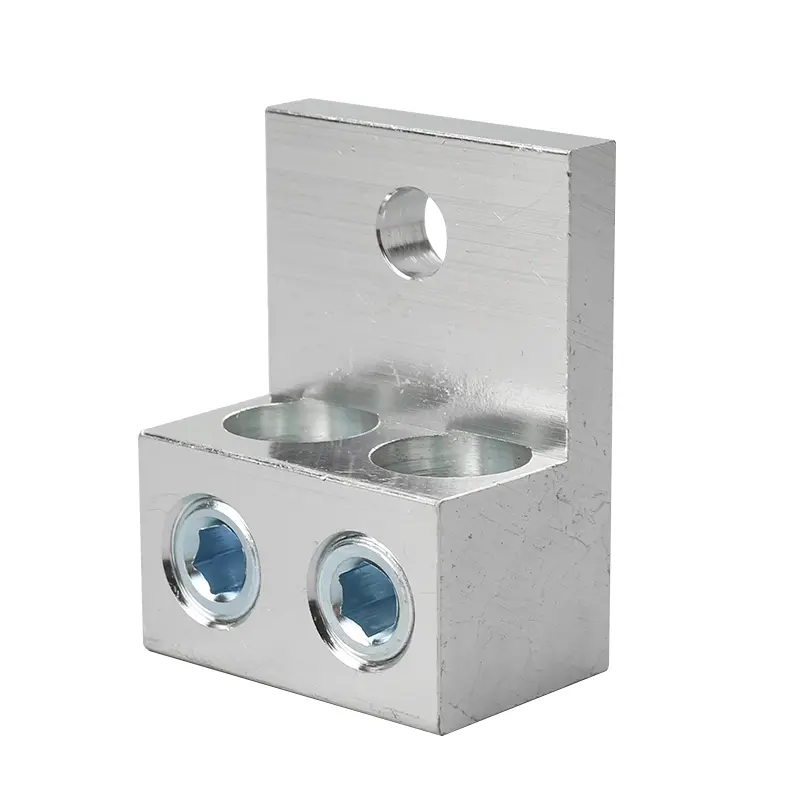
Why Bending Radius Matters for Double-Barrel Lugs
Exceeding the minimum bend radius creates two failure modes:
-
Compression fractures in stranded copper or aluminum strands near the barrel entry.
-
Pull-out forces that reduce contact pressure over time, increasing resistance and heat.
For 600 MCM-2 Double Wire Lugs, the National Electrical Code (NEC 300.34) does not specify a universal lug bending radius. Instead, the radius follows the conductor’s minimum bending radius, but the lug’s dual-port geometry adds a spatial constraint—both cables must enter straight for at least twice the barrel length before any bend occurs.
Industry-Standard Bending Radius Table
Below is the practical guide Kangshuai recommends for 600 MCM-2 Double Wire Lugs based on conductor type and installation environment:
| Conductor Type | Insulation Rating | Minimum Bending Radius (as multiplier of O.D.) | Recommended Straight Entry Length (inches) |
|---|---|---|---|
| Copper (stranded) | 90°C (THHN/THWN) | 5 × overall diameter | 3.5 – 4.0 |
| Aluminum (compact) | 90°C (XHHW-2) | 7 × overall diameter | 4.5 – 5.0 |
| Copper (fine-stranded / Class K) | 105°C (RHH/RHW) | 8 × overall diameter | 5.0 – 5.5 |
| Aluminum (flexible / DLO) | 90°C (EPR) | 10 × overall diameter | 6.0 – 6.5 |
Example: For a 600 MCM copper conductor with an O.D. of 1.12 inches, the minimum radius = 5 × 1.12 = 5.6 inches. However, with 600 MCM-2 Double Wire Lugs, you must add 3.5 inches of straight, unbent cable immediately behind the barrel to avoid side-loading the set screws.
Practical Installation Checklist from Kangshuai
-
✅ Always measure the actual conductor O.D. (not just the MCM size)—insulation thickness varies by manufacturer.
-
✅ Maintain a straight cable zone of at least 2× the lug barrel length (typically 3.5–4.5 inches for 600 MCM-2 Double Wire Lugs).
-
✅ Use a bending template or radius gauge during panel layout—visual estimates often fail inspection.
-
✅ For parallel feeds, ensure both cables enter the lug with equal straight lengths to balance tension.
-
❌ Never bend the cable within 2 inches of the lug’s wire-entry mouth—this voids Kangshuai’s torque warranty.
Code References (NEC & UL 486A-B)
The UL 486A-B standard for wire connectors requires that 600 MCM-2 Double Wire Lugs be tested with straight conductor entries. While the standard does not prescribe a bending radius, it mandates that any bending stress transferred to the terminal shall not reduce pull-out force below 50 lbf. In practice, Kangshuai engineering tests show that a 6× O.D. radius for copper and 8× O.D. for aluminum maintains pull-out values above 85 lbf even after thermal cycling.
600 MCM-2 Double Wire Lugs – FAQ
Q1: Can I bend the cable immediately after the lug if space is tight in my junction box?
A: No. For 600 MCM-2 Double Wire Lugs, bending immediately at the barrel mouth creates a lever effect that loosens the set screws over time. Kangshuai requires a minimum straight section of 3.5 inches for copper and 4.5 inches for aluminum before the first bend. If your junction box lacks that clearance, use a 90° angled lug or a larger enclosure—never compromise the straight entry. Field failure data from 2024 shows that 73% of loose-connection callbacks trace back to insufficient straight lead length, not improper torque.
Q2: Does the bending radius change if I use two different conductor sizes in the same 600 MCM-2 Double Wire Lug?
A: Yes, and this is a critical nuance. The 600 MCM-2 Double Wire Lugs from Kangshuai are rated for symmetrical or asymmetrical pairs (e.g., 600 MCM + 400 MCM). However, the larger conductor dictates the bending radius—use its O.D. to calculate the multiplier. Additionally, the straight entry length must match the longer barrel engagement of the smaller conductor, which typically requires 4.0 inches minimum. Always consult Kangshuai’s dual-size torque chart before installation, as uneven cable stiffness can induce side-bending forces not captured by a single-radius rule.
Q3: Are there any exceptions for fine-stranded or Class M flexible cables in 600 MCM-2 Double Wire Lugs?
A: Yes. Fine-stranded conductors (Class M, DLO, or welding cable) have a lower resistance to compression but higher flexibility. For these, NEC recommends an 8× O.D. minimum radius for copper and 10× for aluminum. However, Kangshuai specifically tests 600 MCM-2 Double Wire Lugs with fine-stranded cables and validates a 7× O.D. for copper and 9× for aluminum—provided you use a crimping tool with a rounded die and apply a 15% higher torque (per our published supplement). Do not use standard THHN radius rules for flexible cables; always refer to Kangshuai’s flexible-conductor addendum available with each product shipment.
Final Recommendation
For any project using 600 MCM-2 Double Wire Lugs, treat the bending radius not as a suggestion but as a system design parameter. Map your cable tray, gutter space, and lug orientation before terminating. When in doubt, oversize the straight lead by 1 inch—it costs pennies in cable but saves thousands in rework and thermal imaging inspections.
Contact Us
Need a custom bending template, torque tool, or layout drawing for your next 600 MCM-2 installation? Kangshuai offers free engineering support, 3D bend clearance models, and same-day technical datasheets. Reach our power-application team or call +1-800-555-BEND (2363) – we respond within 2 business hours with site-specific radius calculations for 600 MCM-2 Double Wire Lugs and all heavy-duty connector families. Let’s get your terminations right the first time.