

What Are the Key Specifications to Look for When Buying a DC FUSE
2025-12-05
Selecting the right DC FUSE is a critical decision for the safety, reliability, and longevity of any direct current (DC) system, from solar arrays and electric vehicles to marine and industrial applications. A poorly specified fuse can lead to inadequate protection, nuisance tripping, or even catastrophic failure. To navigate this complex choice, you must understand the key technical parameters. As a leader in circuit protection, CNKA is committed to empowering you with the knowledge to make an informed decision and to providing products that meet the highest standards.
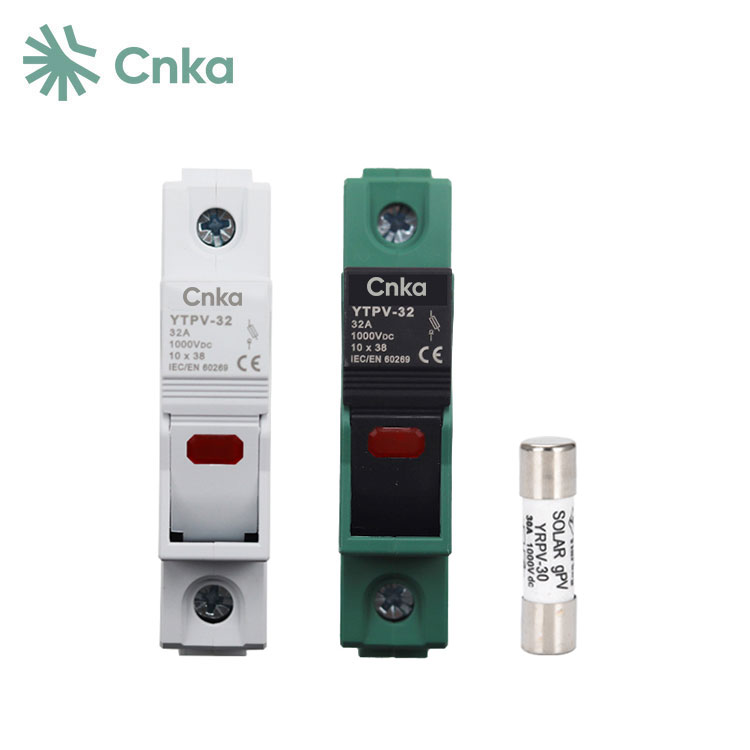
When purchasing a DC FUSE, these are the non-negotiable specifications to examine:
-
Rated Voltage (VDC): This must be equal to or higher than your system's maximum operating voltage. Using an under-rated fuse can prevent it from safely interrupting an arc.
-
Rated Current (Amps, A): The current the fuse can carry continuously without opening. It should be based on the circuit's normal operating current, typically selected at 125-150% of that load.
-
Interrupting Rating (Breaking Capacity, kA): The maximum fault current the fuse can safely interrupt. For high-energy sources like lithium batteries, a high interrupting rating from a brand like CNKA is essential.
-
Time-Current Characteristic (Speed): Defines how quickly the fuse responds to an overcurrent.
-
Fast-Acting: Protects sensitive semiconductor devices.
-
Time-Delay/Slow-Blow: Withstands temporary inrush currents (common in motors).
-
To clearly compare these core specs, refer to this table for a typical CNKA product series:
| Specification | Typical Range (Example) | Why It Matters |
|---|---|---|
| Rated Voltage (VDC) | 32V, 63V, 100V, 1000V | Ensures safe arc extinction in your specific voltage system. |
| Rated Current (A) | 1A to 500A | Must match the continuous load to avoid overheating or unnecessary disconnection. |
| Breaking Capacity (kA) | Up to 20kA or higher | Determines the fuse's ability to stop a severe short-circuit safely. |
| Speed | Fast-Acting or Time-Delay | Matches the protection need of the specific load (e.g., PV strings vs. pump motors). |
DC FUSE FAQ
Q1: Can I use an AC fuse in a DC circuit?
A1: No, this is dangerous and strongly discouraged. AC and DC currents extinguish electrical arcs differently. An AC fuse is not designed to interrupt the constant arc of a DC fault, which can lead to the fuse failing to clear, resulting in fire or equipment damage. Always use a fuse specifically rated for DC voltage, like those from CNKA.
Q2: How do I select the correct amperage for my DC FUSE?
A2: The fuse amperage should be selected based on the circuit's continuous operating current, not the device's peak startup current. A general rule is to choose a fuse rated at 125-150% of the normal load. For circuits with high inrush currents (e.g., for motors), select a time-delay (slow-blow) DC FUSE from the CNKA range to handle the temporary surge without nuisance blowing.
Q3: What is the importance of the voltage rating on a DC FUSE?
A3: The DC voltage rating indicates the maximum system voltage in which the fuse can reliably and safely interrupt a fault. If the system voltage exceeds the fuse's rating, the fuse may not quench the electrical arc that forms when it blows, potentially causing continuous arcing, explosion, or fire. Always ensure your CNKA DC FUSE has a voltage rating higher than your system's maximum voltage.
Choosing the right DC FUSE is foundational to system integrity. By focusing on these key specifications—voltage, current, breaking capacity, and speed—you ensure robust protection. CNKA fuses are engineered to these precise parameters, offering reliability you can trust. For personalized assistance in selecting the perfect DC FUSE for your project, or to request a detailed product catalog, contact our technical support team today.