

What Are the Key Manufacturing Challenges for FPC Circuit Push Button Membrane Keypad
2026-04-23
The production of a high-quality FPC Circuit Push Button Membrane Keypad requires precision, material expertise, and advanced lamination techniques. At TianTai, engineers frequently encounter specific manufacturing hurdles that directly affect product reliability, tactile feel, and long-term durability. Understanding these challenges helps buyers and designers make informed sourcing decisions.
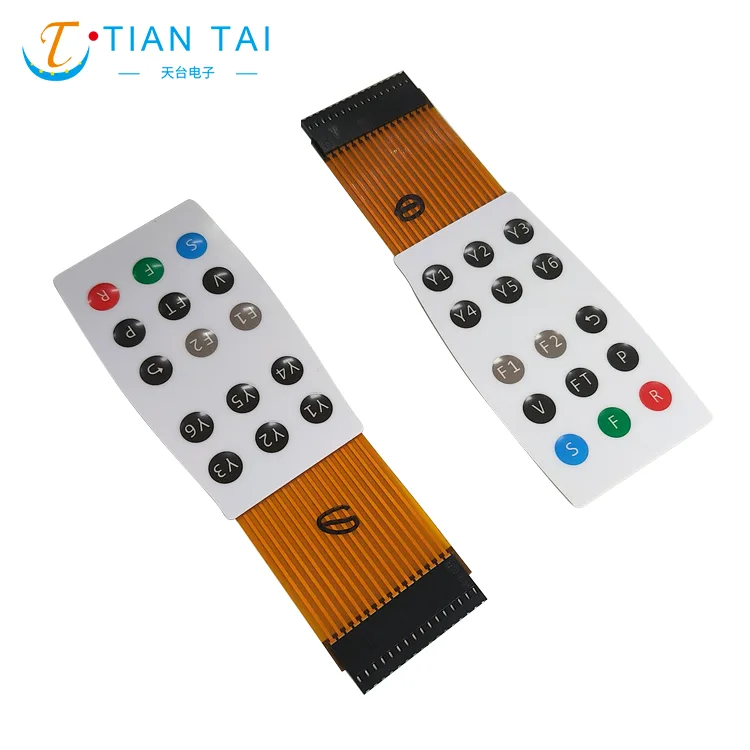
Major Manufacturing Challenges
| Challenge Category | Specific Issue | Impact on FPC Circuit Push Button Membrane Keypad |
|---|---|---|
| Material alignment | Flex layer shifting during lamination | Short circuits or non-responsive buttons |
| Conductive printing | Inconsistent silver ink thickness | Variable resistance and key failure |
| Spacer adhesion | Poor bonding between layers | Delamination and environmental ingress |
| Tail bending | Cracking at the flexible extension | Broken traces after installation |
| Dome placement | Off-center metal or poly domes | Reduced tactile feedback or stuck keys |
1. Layer Registration and Alignment
An FPC Circuit Push Button Membrane Keypad consists of multiple thin layers: the top graphic overlay, spacer, conductive circuit layer (printed silver or copper on polyimide), and bottom shield. Even a 0.2mm misalignment can cause unintended key activation or open circuits. TianTai uses optical registration systems to maintain ±0.1mm tolerance across production batches.
2. Conductive Trace Durability
Unlike rigid PCBs, the flexible circuits undergo repeated bending during user operation. Silver-based inks, while cost-effective, develop micro-cracks after 10,000+ actuations. Copper-on-flex offers better longevity but requires specialized etching and plating processes. Manufacturers must balance electrical performance against mechanical fatigue.
3. Environmental Sealing Standards
Many applications—medical devices, industrial controls, outdoor kiosks—demand IP67 or higher sealing. Achieving this on an FPC Circuit Push Button Membrane Keypad requires perfectly controlled adhesive dispensing around the tail exit point. Incomplete sealing leads to oxidation of exposed silver traces.
FPC Circuit Push Button Membrane Keypad FAQ
Question 1: What causes intermittent key failure in an FPC Circuit Push Button Membrane Keypad after six months of use?
Answer 1: Intermittent failure most often results from micro-cracking in the printed silver traces at the flex tail bending radius. Each keypress applies tensile and compressive stress to the circuit layer. If the bending radius is below 3mm or the tail is folded sharply during installation, silver particles dislocate, increasing resistance beyond the controller’s detection threshold. TianTai mitigates this by using rolled-annealed copper circuits for dynamic bending zones and performing 100,000-cycle flex life tests before production approval.
Question 2: How does humidity affect the long-term reliability of an FPC Circuit Push Button Membrane Keypad?
Answer 2: Humidity above 85% RH can cause silver migration between closely spaced traces on the FPC layer. Over time, dendritic growth creates low-resistance paths, leading to ghost touches or stuck keys. Additionally, absorbed moisture in the adhesive spacer reduces dielectric strength. To counter this, TianTai applies conformal coating over exposed conductive areas and uses low-hygroscopic adhesives. For high-humidity environments, a vented design with hydrophobic membrane is recommended.
Question 3: Why do some FPC Circuit Push Button Membrane Keypads develop hard-to-press buttons while others stay consistent?
Answer 3: This is typically caused by inconsistent dome height or spacer thickness. Poly domes vary slightly from batch to batch; if the spacer layer is even 0.05mm too thick, the actuation force increases by 20–30%. Conversely, a thinner spacer causes premature contact. TianTai uses laser-measured dome placement and precision-milled spacers to ensure that all keys on the same FPC Circuit Push Button Membrane Keypad require identical operating force (±15g tolerance). Every production batch is sampled on a force-displacement tester.
Why Choose TianTai for Your Next Project
From material sourcing to final electrical testing, TianTai implements statistical process control (SPC) at every stage of FPC Circuit Push Button Membrane Keypad manufacturing. Whether you need ultra-flexible circuits for wearable devices or robust sealed keypads for industrial panels, the engineering team provides design-for-manufacturing feedback to avoid common failure modes.
Contact us today to request a DFM review or to receive sample kits showing different circuit materials and dome technologies. Reach TianTai via the website contact form or email [email protected] for a customized quotation within 24 hours.