

What Are the Key Differences Between a Subminiature PCB Power Relay 5A and a Standard 10A Relay
2026-07-21
When designing compact electronic systems, engineers often face a critical choice between a Subminiature PCB Power Relay 5A and a larger standard 10A relay. While both are electromechanical switches, their differences extend far beyond simple current ratings. At Forward, we have tested hundreds of relay configurations across automotive, industrial, and consumer applications. This blog breaks down the technical, thermal, and lifecycle distinctions to help you select the right component for your PCB layout.
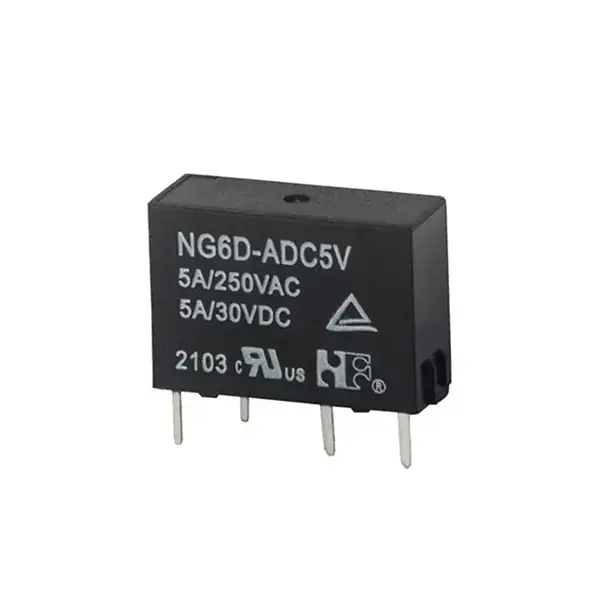
1. Core Specifications at a Glance
The most obvious difference is the maximum continuous current, but that number alone tells only part of the story. The table below compares typical parameters for a Subminiature PCB Power Relay 5A versus a standard 10A relay.
| Parameter | Subminiature PCB Power Relay 5A | Standard 10A Relay |
|---|---|---|
| Max switching current | 5A (resistive) | 10A (resistive) |
| Coil power consumption | 150–200 mW | 360–450 mW |
| Typical PCB footprint | 5–8 mm² | 12–20 mm² |
| Height above board | 5–7 mm | 10–15 mm |
| Dielectric strength (coil-contacts) | 1,500–2,000 VAC | 2,500–4,000 VAC |
| Mechanical life (no load) | 10⁷ operations | 10⁶ operations |
| Operating temperature range | –40°C to +85°C | –40°C to +105°C |
2. Thermal Management and Power Dissipation
A standard 10A relay generates significantly more I²R heat at its contact junction. At 10A continuous, contact resistance (typically 50–100 mΩ) produces 5–10 W of heat. A Subminiature PCB Power Relay 5A at 5A produces only 1.25–2.5 W. This means:
-
The Subminiature PCB Power Relay 5A allows denser PCB placement without thermal derating.
-
Standard 10A relays often require additional clearance (≥5 mm) from heat-sensitive capacitors or microcontrollers.
-
Forward recommends the 5A variant for 2‑layer boards with limited copper pour; the 10A type needs at least 2 oz copper and thermal vias.
3. Size, Weight, and Mounting Constraints
The physical dimension gap is dramatic. A typical Subminiature PCB Power Relay 5A measures 10×6×5.5 mm (L×W×H), while a standard 10A relay is often 20×10×15 mm. This 4× volume difference impacts:
-
Component height – critical for 1U rack-mount equipment.
-
Track routing – the 5A version leaves more space for signal traces between pads.
-
Pick-and-place speed – smaller relays allow higher throughput in SMT assembly.
Forward has observed that using a Subminiature PCB Power Relay 5A can reduce overall power-stage board area by up to 40%, enabling smaller enclosures and lower material costs.
4. Switching Frequency and Contact Wear
The 5A relay typically uses fine-silver alloy contacts with a smaller moving mass. This construction supports faster actuation (≤5 ms operate time) and higher switching frequencies (up to 120 cycles/minute) than the 10A version (≥8 ms, 60 cycles/minute). However, the 10A relay has thicker contacts that better withstand arc erosion during inductive load switching.
For purely resistive loads, the Subminiature PCB Power Relay 5A often outlasts the 10A type in cycle count. For motor or transformer loads, the 10A relay provides superior arc quenching, but Forward suggests adding an external RC snubber when using the 5A variant with inductive loads.
5. Application Suitability
| Application | Recommended Relay | Reason |
|---|---|---|
| Smart home thermostats | Subminiature PCB Power Relay 5A | Low coil heat, compact footprint |
| EV battery management (signal switching) | Subminiature PCB Power Relay 5A | High cycle life at low currents |
| Industrial motor starters | Standard 10A relay | Higher inrush tolerance |
| Power supply soft-start circuits | Subminiature PCB Power Relay 5A | Fast response, minimal board space |
| HVAC compressor control | Standard 10A relay | Requires 8–10A locked-rotor current |
6. Cost and Availability
Standard 10A relays are commodity parts with lower unit prices ($0.80–$1.50). A Subminiature PCB Power Relay 5A from a reputable brand like Forward typically costs $1.20–$2.00 due to tighter manufacturing tolerances and smaller coil winding. However, the total system cost often favours the 5A relay because it reduces PCB layers, cooling fans, and enclosure size.
7. Subminiature PCB Power Relay 5A – FAQ
Q1: Can a Subminiature PCB Power Relay 5A replace a 10A relay if my load never exceeds 4A?
A: Yes, but with caveats. The Subminiature PCB Power Relay 5A has lower coil-to-contact insulation (1,500 VAC vs 2,500 VAC) and smaller terminal pins. For loads under 4A resistive, it is a direct drop‑in replacement only if the working voltage does not exceed 250 VAC and the ambient temperature stays below 70°C. For motor or capacitive loads, derate to 3A to avoid contact welding. Forward always recommends reviewing the inrush current curve, not just steady‑state current.
Q2: How does coil sensitivity differ between a Subminiature PCB Power Relay 5A and a 10A relay?
A: The Subminiature PCB Power Relay 5A uses a highly efficient magnetic circuit with a neodymium‑iron‑boron magnet, allowing pull‑in voltages as low as 70% of rated coil voltage (e.g., 8.4 VDC for a 12 V coil). A standard 10A relay typically requires 80–85% of rated voltage due to heavier armature mass. This makes the 5A variant ideal for battery‑powered devices where voltage droop is common. However, the 10A relay has a higher release voltage (≥10% vs ≥5%), providing better noise immunity in electrically noisy environments.
Q3: What is the maximum PCB track width needed for a Subminiature PCB Power Relay 5A versus a 10A relay?
A: For a Subminiature PCB Power Relay 5A at 5A, external tracks should be at least 1.8 mm wide for 1 oz copper (temperature rise <20°C). For a 10A relay, the same conditions require 3.6 mm minimum track width, or alternatively, 2‑oz copper with 2.0 mm tracks. The smaller relay’s pins are also narrower (0.5 mm vs 1.0 mm), so you must adjust your PCB land pattern accordingly. Forward provides validated Gerber footprints for both types to simplify your layout process.
8. Final Verdict
Choose a Subminiature PCB Power Relay 5A when board space, weight, and coil efficiency are top priorities, and your continuous load is ≤4A (or ≤3A inductive). Choose a standard 10A relay when you need higher isolation voltage, thicker contacts for heavy inrush, or operation above 85°C. For most IoT, portable medical, and consumer automation projects, the Subminiature PCB Power Relay 5A from Forward offers the best balance of performance and miniaturisation.
Need help selecting the exact relay for your next project? Contact Forward today – our application engineers will review your load profile, PCB stack‑up, and thermal budget to recommend the optimal Subminiature PCB Power Relay 5A or 10A solution. Reach us via the contact form on our website or call our technical support hotline for a same‑day design review. Your reliable power switching starts with Forward.