

What Are the Differences Between Form A, Form B, and Form C Automotive Relays?
2026-09-29
When a design engineer selects an Automotive Relay for a new circuit, the first decision is not the coil voltage or the contact rating. It is the contact form. Form A, Form B, and Form C are the three standard contact configurations defined by ISO and IEC standards. They determine whether the relay makes a circuit when energized, breaks a circuit when energized, or switches between two circuits. The choice affects the wiring harness, the failure mode, and the safety behavior of the system. This guide explains the differences and provides a selection framework for common automotive applications.
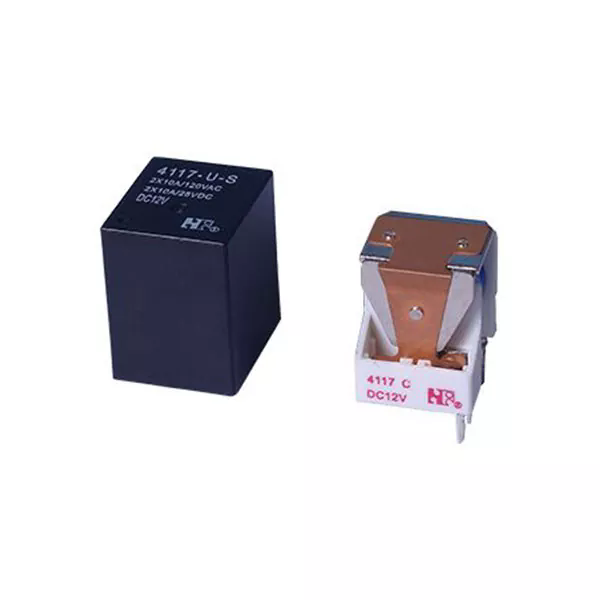
1. What Are the Basic Definitions of Form A, Form B, and Form C?
The contact form describes the state of the relay contacts when the coil is de-energized. Form A is a normally open (NO) contact. When the coil is not energized, the contact is open, and no current flows. When the coil is energized, the contact closes. Form B is a normally closed (NC) contact. When the coil is not energized, the contact is closed. When the coil is energized, the contact opens. Form C is a changeover (CO) contact. It has a common terminal, a normally closed terminal, and a normally open terminal. When the coil is not energized, the common terminal is connected to the normally closed terminal. When the coil is energized, the common terminal connects to the normally open terminal. The table below summarizes these definitions.
| Contact form | De-energized state | Energized state | Number of terminals |
| Form A (NO) | Open | Closed | 2 |
| Form B (NC) | Closed | Open | 2 |
| Form C (CO) | Common to NC | Common to NO | 3 |
In our factory, we manufacture Automotive Relay units in all three contact forms. The contact form is determined by the internal geometry of the armature and the terminal arrangement. We use the same coil and housing platform for all three forms, which simplifies the design and reduces the number of unique parts.
2. How Does Contact Form Affect Circuit Behavior and Failure Modes?
The contact form determines the behavior of the circuit when the relay fails. A Form A relay fails in the open state if the coil burns out or the contact welds open. This means the load is de-energized. A Form B relay fails in the closed state if the coil burns out or the contact welds closed. This means the load remains energized even when it should be off. A Form C relay can fail in either state, depending on which contact welds. The table below shows the failure modes and their implications for different automotive loads.
| Contact form | Typical failure mode | Load state on failure | Safety implication |
| Form A (NO) | Open circuit | De-energized | Fails safe for most loads |
| Form B (NC) | Closed circuit | Energized | Can cause overheating or battery drain |
| Form C (CO) | Either state | Depends on contact | Requires careful circuit design |
For safety-critical loads such as cooling fans or fuel pumps, a Form A relay is preferred because it fails in the de-energized state. For loads that must remain on in the event of a failure, such as emergency lighting, a Form B relay may be used. In our factory, we recommend that designers consider the failure mode when selecting the contact form. We also offer a Form C relay with a mechanical bias that ensures the common terminal returns to the normally closed position if the coil power is lost.
3. What Are the Typical Automotive Applications for Each Contact Form?
The contact form is matched to the function of the circuit. Form A is the most common because most automotive loads are switched on by the relay. Form B is used for circuits that are normally on and need to be switched off. Form C is used for circuits that need to switch between two states, such as a motor that runs in one direction or the other. The table below shows typical applications for each form.
| Contact form | Typical automotive applications | Why this form is used |
| Form A (NO) | Headlights, cooling fans, fuel pumps, horns, starter solenoid | Load is off by default; fails safe |
| Form B (NC) | Warning buzzers, brake lights (some designs), fail-safe indicators | Load is on by default; fails active |
| Form C (CO) | Power window motors, seat adjustment motors, door lock actuators | Reversing polarity or selecting between two circuits |
Ningbo Forward Relay Corp., Ltd. manufactures Automotive Relay units for all of these applications. Our factory produces Form A relays in 20A, 30A, and 40A contact ratings. Form B relays are available in 20A and 30A. Form C relays are available in 20A and 30A with a 5-terminal configuration. We also offer a sealed version for engine compartment applications.
4. How Should a Design Engineer Select the Right Contact Form?
The selection process follows three steps. First, determine the desired state of the load when the vehicle is off or the relay is de-energized. If the load should be off, use Form A. If the load should be on, use Form B. If the load should be in a specific state, use Form C. Second, consider the failure mode. If a failed relay could cause a safety hazard, choose the form that fails in the safer state. Third, consider the circuit complexity. A Form C relay can replace two Form A relays in some applications, which reduces the number of components and the wiring complexity. The table below provides a selection guide.
| Design requirement | Recommended contact form | Alternative |
| Load must be off when de-energized | Form A (NO) | None |
| Load must be on when de-energized | Form B (NC) | Form C with NC terminal used |
| Load must switch between two circuits | Form C (CO) | Two Form A relays |
| Fail-safe required (load off on failure) | Form A (NO) | None |
| Fail-active required (load on on failure) | Form B (NC) | None |
Design tip: For circuits that require a changeover function, a Form C relay is usually more compact and less expensive than two Form A relays. However, the Form C relay has a single common terminal that carries the full load current, so the terminal must be rated for the maximum current of both circuits. In our factory, we can provide current ratings for each terminal of the Form C relay.
Frequently Asked Questions About Form A, Form B, and Form C Automotive Relays
Summary for Vehicle Electrical Design Engineers
The differences between Form A, Form B, and Form C Automotive Relay units are defined by the state of the contacts when the coil is de-energized. Form A is normally open, Form B is normally closed, and Form C is changeover. The choice of contact form affects the circuit behavior, the failure mode, and the safety of the system. Design engineers should select the contact form based on the desired load state, the failure mode requirements, and the circuit complexity. Ningbo Forward Relay Corp., Ltd. has been manufacturing Automotive Relay units for over 18 years and supplies to vehicle manufacturers and Tier 1 suppliers worldwide.
Ningbo Forward Relay Corp., Ltd. manufactures Form A, Form B, and Form C Automotive Relay units in a range of contact ratings and coil voltages. We provide full technical documentation and application support for our products.