

What Are the Common Pin Configurations of M12 Series Industrial Sensor Connectors
2026-09-11
When specifying connectivity for automated machinery, engineers quickly discover that the M12 Series Industrial Sensor Connector is the de facto standard for reliable signal and power transmission. At Reunion, we have spent years supplying these connectors to factory floors, robotic cells, and outdoor installations, and one question consistently arises: which pin layout is correct for a given application? Understanding the available pin configurations is essential to avoid mismating, signal loss, or costly downtime. This guide breaks down the most common arrangements, their coding, and where each is typically deployed.
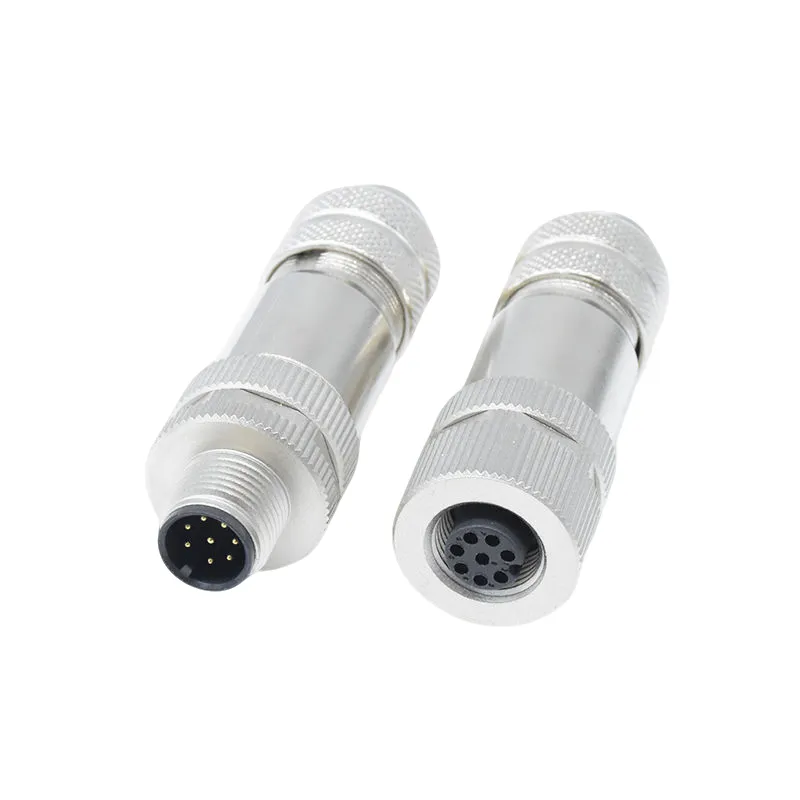
Why Pin Configuration Matters
A M12 Series Industrial Sensor Connector is not a single product but a family defined by a 12 mm locking thread. Within that family, the number of pins and the keyway (coding) determine whether a connector carries analog sensor signals, digital I/O, or industrial Ethernet. Choosing the wrong configuration can physically damage contacts or create intermittent faults that are difficult to trace.
Common Pin Counts and Their Applications
The table below summarizes the most widely used pin counts for the M12 Series Industrial Sensor Connector.
| Pin Count | Typical Coding | Common Application | Notes |
|---|---|---|---|
| 3-pin | A-coded | Basic proximity sensors, simple actuators | Often used for 2-wire or 3-wire DC sensors |
| 4-pin | A-coded | Photoelectric sensors, limit switches | Most common general-purpose configuration |
| 5-pin | A-coded | Sensors with additional function or shield | Supports dual-channel or diagnostic signals |
| 8-pin | A-coded | Multi-signal bundles, compact I/O | Higher density for space-constrained panels |
| 4-pin | D-coded | PROFINET, EtherCAT, Industrial Ethernet | 100 Mbit/s data transmission |
| 8-pin | X-coded | Gigabit Ethernet, high-speed vision | Cat6A performance for demanding networks |
A-Coded vs. D-Coded vs. X-Coded
The coding key prevents a D-coded Ethernet cable from being inserted into an A-coded sensor port. This mechanical safeguard is one reason the M12 Series Industrial Sensor Connector remains so dependable in mixed-technology environments. Reunion stocks all three codings, and our technical team frequently helps customers match the coding to the protocol.
Pinout Examples for Common Configurations
For a standard 4-pin A-coded M12 Series Industrial Sensor Connector, the pinout is typically:
-
Pin 1 – Brown (+24 V DC)
-
Pin 2 – White (Signal or N/C)
-
Pin 3 – Blue (0 V)
-
Pin 4 – Black (Signal)
For a 4-pin D-coded Ethernet version, the assignment follows the Ethernet standard:
-
Pin 1 – TX+
-
Pin 2 – RX+
-
Pin 3 – TX–
-
Pin 4 – RX–
These assignments are not interchangeable, which is why Reunion labels every connector and provides datasheets for verification.
M12 Series Industrial Sensor Connector FAQ
Q: Can I use a 5-pin A-coded connector in place of a 4-pin A-coded connector?
A: Yes, provided the mating half accepts 5 pins and the extra contact is either unused or assigned correctly. The keyway is identical, but you must confirm the circuit does not require the fifth pin for a shield or secondary signal.
Q: What is the difference between A-coded and D-coded M12 connectors?
A: A-coded connectors are designed for sensor and actuator signals up to 250 V, while D-coded connectors are specifically engineered for Industrial Ethernet at 100 Mbit/s. They are physically incompatible to prevent cross-mating.
Q: Are M12 pin configurations standardized across manufacturers?
A: Yes, IEC 61076-2-101 defines the mechanical and electrical requirements for A-coded, D-coded, and X-coded versions. However, always verify the pinout, because some suppliers offer custom assignments for proprietary systems.
Selecting the Right Configuration with Reunion
With decades of experience in industrial connectivity, Reunion supports engineers from prototype to mass production. Whether you need a 3-pin A-coded M12 Series Industrial Sensor Connector for a proximity switch or an 8-pin X-coded version for a vision system, our catalog and technical support ensure a precise match. We also provide IP67 and IP68 sealing options, shielded variants, and custom cable assemblies.
Contact us today to discuss your M12 Series Industrial Sensor Connector requirements, request samples, or receive a quote tailored to your project.