

Is a Whole-House AC 230V Surge Protective Device Better Than Multiple Plug-In Power Strips
2026-06-18
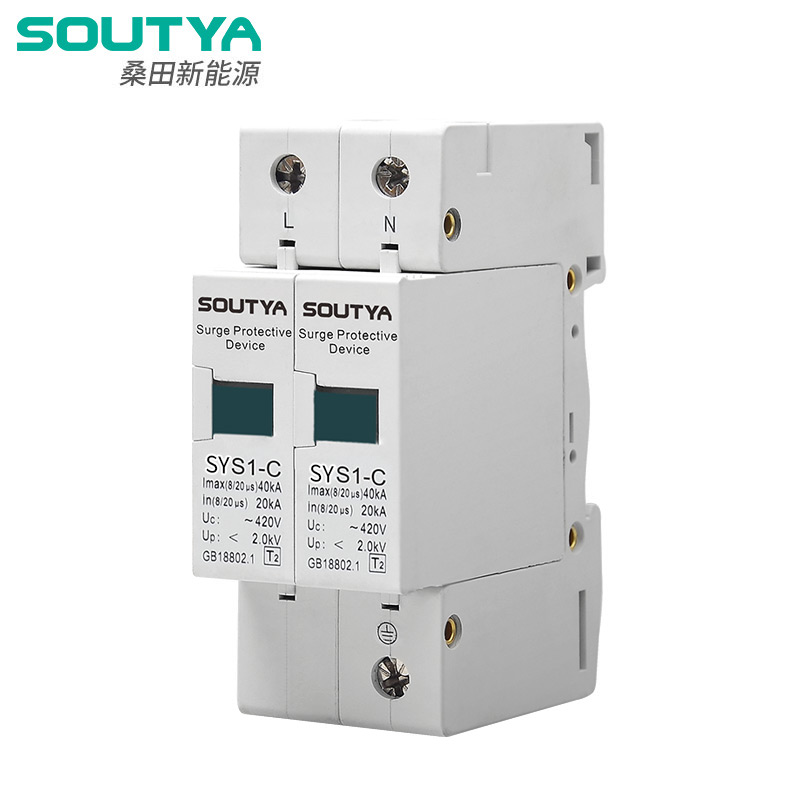
When protecting your home or small business from voltage spikes, the debate often narrows to two options: a single AC 230V Surge Protective Device installed at the main electrical panel versus several plug-in power strips distributed across outlets. For most property owners, the answer is not simply “one or the other”—but a strategic combination. However, if forced to choose one primary solution, the whole-house AC 230V Surge Protective Device consistently outperforms multiple strips in safety, coverage, and long-term value. Brands like Soutya have engineered tiered solutions that clarify this decision, yet many users still overlook critical differences.
Coverage Scope: One Point vs. Many Points
A whole-house AC 230V Surge Protective Device intercepts surges at the service entry—before electricity reaches any branch circuit. This single unit shields every wired appliance: HVAC compressors, well pumps, ovens, EV chargers, and lighting. In contrast, plug-in strips only protect devices physically connected to them. Surges entering through electric vehicle supply equipment, hardwired smoke detectors, or outdoor AC units bypass strips entirely.
| Protection Aspect | Whole-House AC 230V Surge Protective Device | Multiple Plug-In Strips |
|---|---|---|
| Surge interception point | Main breaker panel (upstream) | Individual outlets (downstream) |
| Covered appliances | All hardwired + plugged-in loads | Only plugged-in devices |
| Response to external surges | Blocks before entry | Blocks only after entry |
| Wiring protection | Protects branch wiring itself | Does not protect in-wall wiring |
| Typical clamping voltage | ≤ 600 V (Type 1 or 2) | 330–400 V (Type 3) |
Performance Under Real-World Surges
Utility switching, nearby lightning, and large motor startups generate surges with energy exceeding 1,000 joules. A high-quality whole-house AC 230V Surge Protective Device—such as those from Soutya—offers nominal discharge current ratings (In) of 20 kA or more per mode, capable of diverting hundreds of thousands of amps. Plug-in strips rarely exceed 3–5 kA per mode. More critically, a whole-house unit reduces the let-through voltage to safe levels for all downstream strips, allowing those strips to function as secondary filters rather than primary defenders.
Key engineering fact: The IEEE Emerald Book recommends a two-tier approach—primary at the service entrance and secondary at point-of-use. A whole-house AC 230V Surge Protective Device fulfills the primary role; strips serve only the secondary role.
Cost, Maintenance, and Hidden Expenses
A single whole-house AC 230V Surge Protective Device costs between $150 and $400 (unit plus electrician installation). Plug-in strips range from $20 to $120 each. For a typical 3-bedroom home with 10 sensitive electronics, buying ten high-quality strips costs $300–$600—comparable to or exceeding a whole-house unit. However, strips degrade with every surge and offer no visual remote indicator on most models. Soutya whole-house units include LED status and audible alarms, reducing the risk of running unprotected without notice.
-
Replacement frequency: Strips need replacement every 2–5 years (or after one major surge). Whole-house units typically last 8–15 years.
-
Insurance implications: Some insurers offer premium credits for panel-mounted surge protection—not for strips.
-
Labor cost: Strips require zero installation labor; whole-house units need a licensed electrician (1–2 hours).
Safety and Fire Risk Considerations
Plug-in strips, especially low-cost models, present a tangible fire hazard when daisy-chained or overloaded. The internal Metal Oxide Varistors (MOVs) can fail catastrophically if the surge exceeds their capacity. A whole-house AC 230V Surge Protective Device integrates thermal disconnection and failsafe designs that comply with IEC 61643-11 or UL 1449 4th Edition. Soutya units, for example, incorporate over-temperature protection and short-circuit current ratings up to 50 kA, dramatically lowering thermal stress on downstream wiring.
The Verdict: Which Is Better?
For primary protection, the whole-house AC 230V Surge Protective Device is unequivocally superior. It protects everything, reduces internal stress on all branch circuits, and provides a stable foundation. Plug-in strips remain valuable as supplemental protection for expensive electronics (e.g., PCs, AV receivers, medical devices) because they offer lower clamping voltages at the outlet. The optimal strategy: install a Soutya whole-house unit at the panel, then use high-quality strips with EMI/RFI filtering for your most sensitive loads.
AC 230V Surge Protective Device FAQ
Q1: Can a whole-house AC 230V Surge Protective Device prevent all damage from a direct lightning strike?
A1: No. Direct lightning strike carries millions of volts and hundreds of kiloamps—no consumer-grade device can fully block that. However, a properly rated whole-house AC 230V Surge Protective Device (Type 1 or 2 with Iimp ≥ 12.5 kA) diverts the vast majority of induced surge energy to earth ground, limiting let-through voltage to ≤ 1.5 kV. This reduces the likelihood of equipment failure from ~90% to under 5% for indirect strikes. For direct strikes, you need additional external lightning protection (air terminals and down conductors). Soutya recommends combining their panel-mounted SPD with a Type 1 device for high-exposure regions.
Q2: How do I know when my whole-house AC 230V Surge Protective Device needs replacement?
A2: Most whole-house units feature visual status indicators—green LED for normal operation, red or off for failure. Soutya models include a remote dry-contact signal that can trigger a buzzer or smart-home alert. Additionally, if you notice frequent nuisance tripping of your main RCD/GFCI after storms, or if your sensitive electronics start failing intermittently, the internal MOVs have likely degraded. Unlike strips, which have no built-in diagnostic, a whole-house unit’s end-of-life indicator is mandatory per UL 1449. Test the unit annually by pressing the built-in test button (if available) or by measuring leakage current with a clamp meter—values above 1 mA suggest aging.
Q3: Will a plug-in strip work better if I already have a whole-house AC 230V Surge Protective Device installed?
A3: Yes—and this is the recommended practice. The whole-house unit clamps the massive incoming surge to a safer level (e.g., 1,000 V), while a high-quality plug-in strip (Type 3) further reduces it to 330–400 V for your laptop or TV. This two-stage cascade improves overall protection because the strip’s lower clamping voltage complements the panel unit’s higher energy capacity. Without the whole-house unit, a direct surge can saturate the strip’s MOVs instantly, leading to failure or fire. With both, the strip handles only residual energy, extending its lifespan. Soutya offers compatible kits that pair a Type 2 panel unit with Type 3 strips, ensuring impedance matching and coordinated protection levels.
Final Recommendation
If your budget allows only one solution, invest in a whole-house AC 230V Surge Protective Device from a reputable brand like Soutya. It delivers broader coverage, higher surge capacity, better safety certifications, and lower total cost of ownership over a decade. Add plug-in strips later for your most valued electronics. Never rely solely on strips—they are band-aids, not shields.
Ready to safeguard your entire property? Contact Soutya’s engineering support team for a free load assessment and product selection guide. We provide detailed coordination charts, wiring diagrams, and certified installation partners in your area. Visit our official website or email us directly—we respond within 4 business hours. Your equipment’s longevity starts with one decision. Make it count.