

How Wearable Round LCD Balances Power and Clarity?
2026-09-24
In a smartwatch, the display is the single largest consumer of battery power, accounting for 40 to 60 percent of the total energy budget. A typical wearable battery has a capacity of 300 to 500 milliampere-hours. If the display draws 30 milliamps continuously, the battery will last only 10 to 16 hours. This is the fundamental constraint that drives every decision in Round LCD design for wearables. The engineering challenge is to deliver sufficient brightness and resolution for outdoor readability while keeping the average power draw below 15 milliamps. This guide explains the trade-offs and how our factory approaches them.
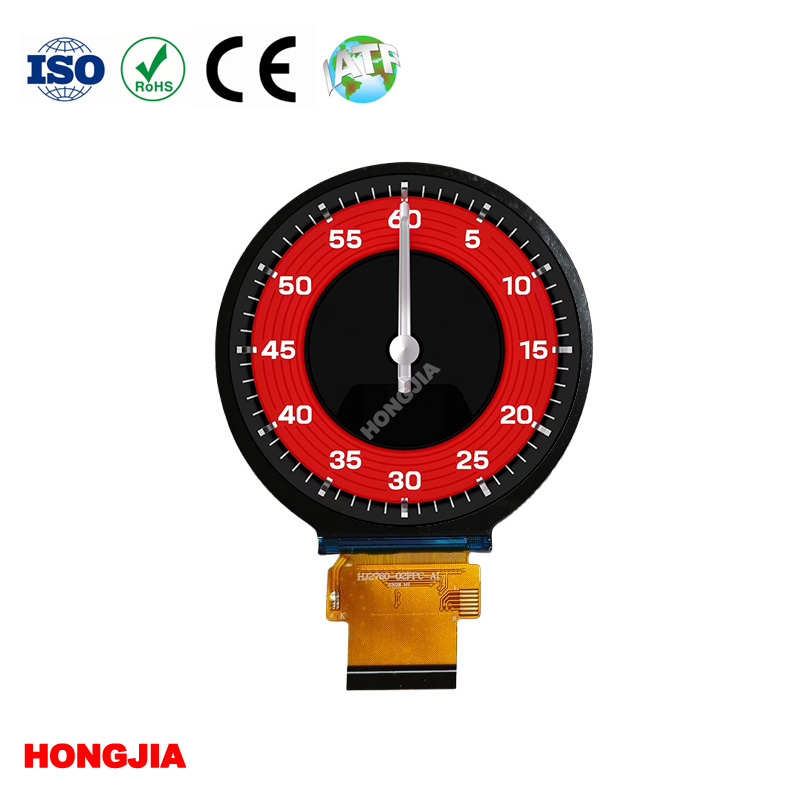
1. What Is the Power Budget for a Wearable Round LCD?
The power budget for a wearable display is determined by the battery capacity and the target operating time. For a 400 mAh battery and a target of 5 days of operation with 2 hours of active use per day, the average display power draw must be below 12 milliamps. During active use, the display can draw 25 to 40 milliamps for short periods. During standby, it must draw less than 1 milliamp. The table below shows a typical power budget for a wearable Round LCD.
| Operating mode | Display power draw | Duration per day | Energy contribution |
| Active mode (full brightness) | 35 mA | 1 hour | 35 mAh |
| Active mode (50% brightness) | 18 mA | 2 hours | 36 mAh |
| Always-on display (AOD) | 2.5 mA | 12 hours | 30 mAh |
| Standby (display off) | 0.1 mA | 9 hours | 0.9 mAh |
| Total daily display energy | N/A | 24 hours | ~102 mAh |
This budget shows that the display consumes about 25 percent of the battery capacity per day. The remaining capacity is shared by the processor, sensors, wireless radios, and other components. In our factory, we design Round LCD modules that meet this budget by optimizing the backlight, the driver IC, and the polarizer. SZ Hongjia Technology Shares Limited has been developing wearable display solutions for over 8 years.
2. How Does Backlight Efficiency Affect Power and Clarity?
The backlight is the primary power consumer in an LCD. A typical edge-lit LED backlight uses 20 to 30 milliamps at full brightness. The efficiency of the backlight is measured in lumens per watt. A standard LED backlight produces 80 to 100 lumens per watt. A high-efficiency backlight produces 120 to 150 lumens per watt. The higher efficiency allows the same brightness with less power or higher brightness with the same power. The clarity of the display is determined by the brightness and the contrast ratio. For outdoor readability in sunlight, the display needs a brightness of at least 800 nits. The table below shows the relationship between backlight efficiency, brightness, and power draw.
| Backlight efficiency | Brightness at 20 mA | Power for 800 nits | Outdoor readability |
| 80 lm/W | 500 nits | 32 mA | Marginal |
| 100 lm/W | 620 nits | 26 mA | Good in shade |
| 120 lm/W | 750 nits | 21 mA | Good in sunlight |
| 150 lm/W | 920 nits | 17 mA | Excellent in sunlight |
The backlight efficiency is determined by the LED chip, the light guide, and the reflector. Our factory uses high-efficiency LED chips and a precision-molded light guide that minimizes light loss. The result is a backlight that achieves 130 lumens per watt, which provides 850 nits at 20 milliamps.
3. How Do Pixel Density and Refresh Rate Affect Clarity and Power?
Pixel density is measured in pixels per inch (PPI). A higher PPI produces sharper text and images. However, a higher PPI also requires more power because the driver IC must switch more pixels. The power consumption of the driver IC is proportional to the pixel count and the refresh rate. For a 1.4-inch round display, a PPI of 326 provides a sharp image that is comparable to a printed page. A PPI of 400 provides a slightly sharper image but increases the driver power by 25 percent. The refresh rate affects the smoothness of animations. A 60 Hz refresh rate is standard for wearables. A 30 Hz refresh rate reduces power by 40 percent but can make animations look choppy. The table below shows the trade-offs.
| Pixel density (PPI) | Driver power (relative) | Refresh rate | Driver power (relative) | Perceived clarity |
| 280 | 0.7x | 30 Hz | 0.6x | Adequate |
| 326 | 1.0x | 60 Hz | 1.0x | Sharp |
| 400 | 1.25x | 60 Hz | 1.0x | Very sharp |
| 326 | 1.0x | 45 Hz | 0.75x | Sharp (slight motion blur) |
Our factory recommends a PPI of 326 and a refresh rate of 45 Hz for most wearable applications. This combination provides a sharp image with smooth animations while keeping the driver power within the budget. We also offer a variable refresh rate mode that drops to 30 Hz when the display content is static.
4. What Are the Design Strategies for Balancing Power and Clarity?
There are four strategies for balancing power and clarity in a wearable Round LCD. The first is adaptive brightness. The display brightness is adjusted based on the ambient light sensor. In a dark room, the brightness can be reduced to 100 nits, which reduces the backlight power by 80 percent. The second is content-adaptive refresh. The refresh rate is reduced when the content is static. The third is local dimming. The backlight is divided into zones, and only the zones that are needed are illuminated. The fourth is a high-efficiency polarizer. The polarizer transmits only the light that is aligned with the liquid crystal, which improves the contrast ratio and allows a lower backlight power. In our factory, we combine all four strategies in our Round LCD modules. The result is a display that achieves 850 nits of brightness while consuming only 18 milliamps in active mode.
Frequently Asked Questions About Wearable Round LCD Power and Clarity
Summary for Hardware Engineers
Balancing power and clarity in a wearable Round LCD requires a system-level approach. The backlight efficiency, the pixel density, the refresh rate, and the polarizer all contribute to the power draw and the perceived clarity. The optimal configuration for most wearables is a PPI of 326, a refresh rate of 45 Hz, and a high-efficiency backlight that achieves 130 lumens per watt. Adaptive brightness and content-adaptive refresh can reduce the average power draw by 40 percent. SZ Hongjia Technology Shares Limited has been developing wearable display solutions for over 8 years and provides full technical support for power optimization.
SZ Hongjia Technology Shares Limited manufactures Round LCD modules for wearable applications with high-efficiency backlights, 326 PPI resolution, and adaptive refresh rate. We provide full power consumption data and design support for our products.