

How to Align a Collimated Laser Diode with a Fiber Optic Coupling System
2026-06-10
Precision alignment of a Collimated Laser Diode with a fiber optic coupling system is essential for maximizing power transmission and maintaining beam quality. At Wavespectrum, we have helped hundreds of engineers achieve coupling efficiencies above 70% by following a structured, alignment-first workflow. This guide walks through that process step by step.
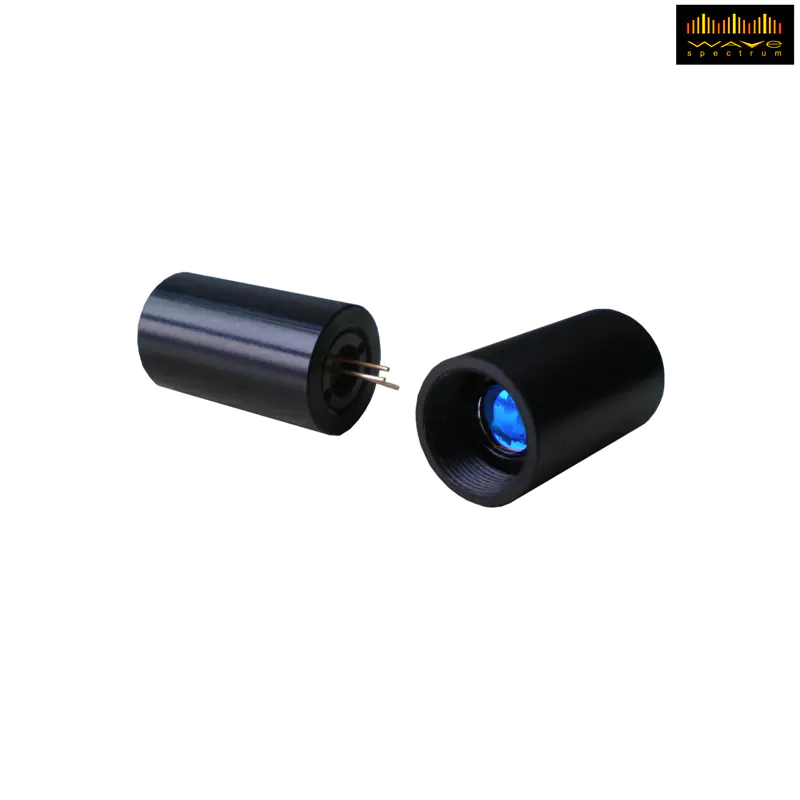
Understanding the Coupling Challenge
A Collimated Laser Diode produces a parallel beam with minimal divergence, but that same property makes it challenging to focus into a small fiber core. The goal is to condense the collimated beam into a focused spot smaller than or equal to the fiber’s core diameter while matching the numerical aperture (NA). Misalignment of even 1–2 microns can drop coupling efficiency by half.
Step-by-Step Alignment Procedure
| Step | Action | Key Tool | Expected Outcome |
|---|---|---|---|
| 1 | Mount the Collimated Laser Diode on a 5-axis kinematic mount | Kinematic mount | Beam axis parallel to optical table |
| 2 | Place a focusing lens (aspheric recommended) between diode and fiber | Aspheric lens, NA-matched | Focused spot size calculated |
| 3 | Launch low power (1–5 mW) and position a pinhole at the focal plane | Pinhole (10–25 µm) | Centered Airy pattern observed |
| 4 | Mount single‑mode or multimode fiber on a 3‑axis nano‑positioner | Nano‑positioner + power meter | Fiber core aligned to focal spot |
| 5 | Perform fine X‑Y‑Z dithering while monitoring optical power | Photodetector or power meter | Peak power reading found |
| 6 | Lock mounts and apply index‑matching gel (for temporary coupling) | Index‑matching gel | Reduced back reflection |
Common Mistakes and Fixes
| Mistake | Consequence | Wavespectrum Recommended Fix |
|---|---|---|
| Using a spherical instead of aspheric lens | Spherical aberration → enlarged focal spot | Replace with NA‑matched asphere |
| Ignoring polarization axis | 3–5 dB loss in single‑mode fiber | Rotate Collimated Laser Diode to match fiber’s polarization axis |
| Rough translation stages | Coupling instability | Upgrade to differential micrometer stages |
Collimated Laser Diode FAQ – Common Alignment Questions
Q1: Why does my Collimated Laser Diode show less than 10% coupling efficiency into single‑mode fiber even after alignment?
A1: The most frequent cause is a mismatch between the focused spot size and the fiber’s mode field diameter (MFD). A Collimated Laser Diode with a 3 mm beam diameter, focused by a 10 mm focal length lens, yields a spot size roughly 4–6 µm. Standard single‑mode fiber at 1310 nm has an MFD near 9 µm. If your spot is significantly smaller, you lose power due to underfilling. Use a longer focal length lens to expand the spot, or deliberately defocus slightly. Also verify that your Collimated Laser Diode is single‑mode itself; multimode diodes cannot couple efficiently into single‑mode fiber regardless of alignment.
Q2: Can I use a Collimated Laser Diode with a collimator permanently attached for fiber coupling, or must I remove the collimator first?
A2: You should remove the internal collimator or bypass it entirely. A packaged Collimated Laser Diode already creates a parallel beam; adding another collimator only expands the beam unnecessarily. Instead, place the focusing lens directly after the diode’s exit window. If the collimator is non‑removable, insert a negative focal length lens (beam expander) followed by a positive lens. However, Wavespectrum recommends using an uncollimated diode with a dedicated single‑lens coupling design for maximum efficiency.
Q3: How do I confirm that my Collimated Laser Diode remains aligned after tightening mechanical mounts?
A3: Thermal and mechanical relaxation are the main culprits. Use the “tightening walk” method: while watching the power meter, alternately tighten opposing screws on the mount by 1/8 turn, always returning to the peak power position. After final tightening, wait 10 minutes for thermal equilibrium, then perform a 2‑axis dither (X and Y only). A stable alignment will show less than 5% power drop. For long‑term stability, Wavespectrum offers Collimated Laser Diode modules with integrated flexure mounts that eliminate screw‑induced walk.
Best Practices for Reliable Coupling
-
Always start with the Collimated Laser Diode running at 5–10% of rated power to prevent accidental damage during alignment.
-
Clean all optical surfaces before final lock. Dust particles of 10 µm can scatter 20–30% of coupled power.
-
Record the X‑Y‑Z position readings after peaking; this allows quick realignment after maintenance.
Why Choose Wavespectrum for Your Laser Diode Integration?
Wavespectrum designs Collimated Laser Diode systems with pre‑aligned fiber coupling ports, reducing alignment time from hours to minutes. Our modules include integrated power monitoring photodiodes and thermal stabilization, ensuring that your coupled power remains stable across a 0–50°C range.
Contact Us
Ready to integrate a Collimated Laser Diode into your fiber optic system? Contact Wavespectrum today for a free coupling efficiency simulation and a detailed mechanical drawing of our pre‑aligned fiber‑coupled laser modules. Our application engineers respond within 24 hours.