

How Often Should You Perform Maintenance on an SF6 Gas Insulated Ring Main Unit to Ensure Reliability
2026-07-01
For utility managers, facility engineers, and switchgear operators, the question of maintenance frequency for an SF6 Gas Insulated Ring Main Unit is not merely a scheduling preference—it is a critical decision that directly impacts system availability, safety, and total cost of ownership. At Timetric Electric, we have analyzed field data from over 3,000 installed units across industrial and utility networks. The consensus is clear: a one-size-fits-all maintenance interval does not exist. Instead, reliability hinges on a condition-based strategy anchored by regular inspections, gas monitoring, and operational history.
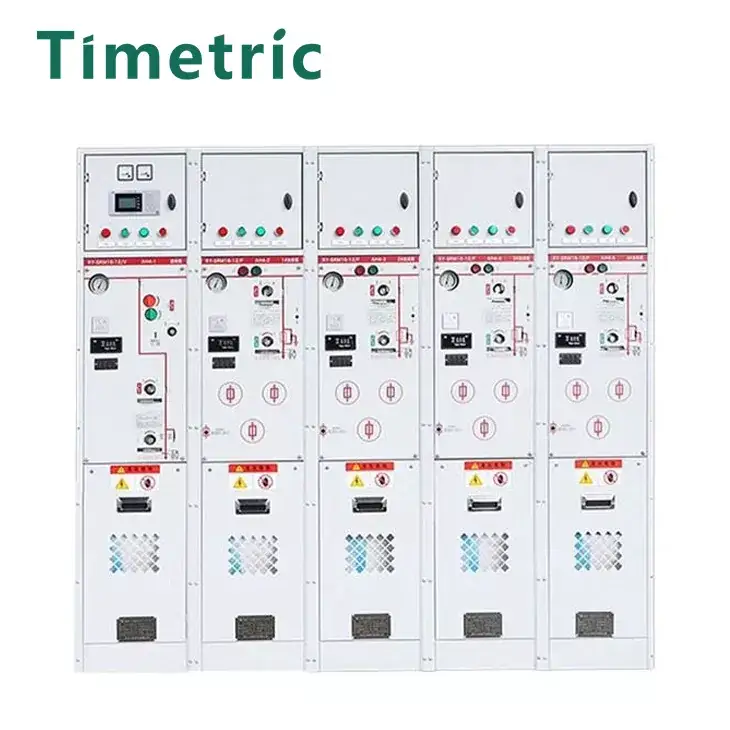
The Baseline Standard: What Do Manufacturers Recommend?
Most original equipment manufacturers, including Timetric Electric, prescribe a general framework for routine servicing of an SF6 Gas Insulated Ring Main Unit:
| Maintenance Type | Recommended Interval | Key Actions |
|---|---|---|
| Visual & Mechanical Inspection | Every 6–12 months | Check enclosure integrity, operate disconnectors manually, inspect earthing switches |
| SF6 Gas Density & Moisture Check | Quarterly (or continuous online) | Record pressure at 20°C reference; measure dew point (-40°C or better) |
| Partial Discharge (PD) Screening | Annually | Use transient earth voltage (TEV) or ultrasonic sensors for live testing |
| Full Overhaul (including contact inspection) | Every 10–15 years or after 2,000 operations | Open tank, inspect arc contacts, replace desiccants, recondition mechanism |
| Gas Recovery & Refilling | As needed (when pressure drops below alarm threshold) | Leak repair, vacuum treatment, refill to nominal pressure |
This baseline, however, assumes ideal operating conditions—indoor installation, stable ambient temperature, and low switching duty. Real-world environments demand adjustments.
Three Factors That Shift Your Maintenance Calendar
Factor 1: Switching Frequency – A SF6 Gas Insulated Ring Main Unit in a distribution network with frequent load transfers (e.g., renewable integration) may require contact inspection every 5–7 years instead of 10. Each arcing operation consumes the SF6 decomposition by-products and erodes tungsten‑copper contacts.
Factor 2: Ambient Environment – Coastal or high‑humidity sites accelerate seal degradation. Timetric Electric recommends semi‑annual gas sampling if the unit is exposed to salt fog or temperature cycles exceeding 40°C daily.
Factor 3: Leak Rate Trend – A stable unit losing less than 0.1% per year can safely extend visual inspections to 18 months. Conversely, a unit with a historical leak above 0.5% per year demands quarterly density checks and immediate seal replacement.
The Condition‑Based Maintenance (CBM) Approach
Moving from time‑based to condition‑based maintenance is the gold standard. For an SF6 Gas Insulated Ring Main Unit, this means installing continuous online monitoring for:
-
Gas pressure (compensated for temperature)
-
Moisture content (ppm)
-
Partial discharge activity (UHF or HFCT sensors)
When these parameters remain within the green zone, Timetric Electric authorises deferring the annual shutdown inspection by up to 12 months. However, a yellow alert (e.g., pressure drift > 2% over 3 months) triggers a targeted intervention—saving unnecessary labour while preempting failures.
Recommended Maintenance Matrix for Different Duty Classes
| Duty Class | Typical Application | Visual + Gas Check | PD Test | Major Overhaul |
|---|---|---|---|---|
| Light (< 50 operations/year) | Substation feeders, transformers | Annually | Every 2 years | 15 years |
| Medium (50–200 ops/year) | Industrial plants, data centres | Semi-annually | Annually | 10–12 years |
| Heavy (> 200 ops/year) | Wind farms, arc furnaces | Quarterly | Semi-annually | 6–8 years |
This matrix is a starting point. Timetric Electric provides customised service schedules based on actual SCADA‑recorded operation counts and gas trend analytics—free of charge for units under our extended warranty programme.
SF6 Gas Insulated Ring Main Unit FAQ – Common Questions from the Field
Q1: Can I skip the annual partial discharge test if my gas pressure readings are normal?
A1: No. Normal gas pressure indicates good sealing but reveals nothing about internal insulation integrity. Partial discharge (PD) is often the first symptom of loose shielding, particle contamination, or incipient contact wear—long before pressure drops. In a SF6 Gas Insulated Ring Main Unit, PD activity can escalate into a flashover within weeks under high humidity. Timetric Electric has documented cases where PD screening caught developing faults 8–14 months before any gas anomaly appeared. We strongly recommend at least one live PD measurement per year using UHF sensors, or continuous monitoring for critical feeders. Skipping PD testing saves a few hours but risks a catastrophic outage costing 50–100 times that saving.
Q2: How do I know when to replace the desiccant inside the SF6 tank?
A2: The desiccant (molecular sieve) absorbs moisture that permeates through seals over time. You should replace it whenever the gas dew point rises above -35°C at nominal pressure, or immediately after any tank opening for internal inspection. For a typical SF6 Gas Insulated Ring Main Unit, desiccant life is 8–12 years under normal conditions, but high ambient humidity or frequent valve operations can reduce it to 5 years. Timetric Electric recommends testing a small gas sample in our laboratory every 3 years—we measure moisture and decomposition products (SO₂, HF) simultaneously. If SO₂ exceeds 5 ppm, replace desiccant and check contacts, as this indicates arcing by-products are not being fully adsorbed.
Q3: Is it acceptable to top up SF6 gas without recovering the existing gas first?
A3: Only if the remaining pressure is above 80% of nominal and the gas quality test (dew point + purity) passes. Topping up from a bottle without prior recovery is permissible for minor leaks in an emergency, but Timetric Electric advises against it as a routine practice. Why? Because repeated topping without recovery concentrates impurities (air, moisture, decomposition products) over time, gradually reducing dielectric strength. For a SF6 Gas Insulated Ring Main Unit that has been in service over 7 years, we always perform a full gas recovery, filter/dry the gas, and refill to specification during major maintenance. If you must top up, use only virgin SF6 with a purity certificate ≥ 99.99% and ensure the filling hose is evacuated to avoid air ingress.
Practical Checklist for Every Maintenance Visit
-
Record operating mechanism timing (close‑open‑close) – deviations > 10% indicate lubrication or spring wear.
-
Inspect all O‑ring seals and flanges with a leak detector (sniffer or acoustic imager).
-
Verify heater and thermostat function (prevents condensation inside the low‑pressure compartment).
-
Exercise all visible isolating switches at least twice to clear oxide films.
-
Download event logs – look for repeated “low gas alarm” resets, which often point to intermittent seal leakage.
Final Word on Frequency
The safest, most cost‑effective answer to “how often” is: start with the manufacturer’s annual schedule, then tailor it using continuous gas monitoring and operation counters. With Timetric Electric’s remote diagnostic platform, we can pinpoint the optimal window for each of your SF6 Gas Insulated Ring Main Unit assets—eliminating guesswork and extending intervals where data supports it. Reliability is not about doing more maintenance; it is about doing the right maintenance at the right time.
Contact us today for a free maintenance audit of your SF6 Gas Insulated Ring Main Unit fleet. Our Timetric Electric service engineers will analyse your operating data, propose a customised schedule, and supply OEM‑grade desiccants, seals, and test equipment. Reach out via our website or call your regional support centre—we respond within 2 business hours. Let us keep your network powered, protected, and perfectly maintained.