

How Much Contact Current Can a Subminiature Intermediate Power Relay Safely Switch
2026-07-02
When designing compact control systems, engineers frequently face a critical bottleneck: the contact current rating. For a Subminiature Intermediate Power Relay, this number is not a fixed guarantee—it is a dynamic limit shaped by load type, ambient conditions, and duty cycle. At Forward, we have tested thousands of these relays across automotive, industrial automation, and HVAC applications. The safe switching current typically ranges from 5A to 15A for resistive loads at 28V DC or 250V AC, but the real answer depends on far more than the datasheet’s first line.
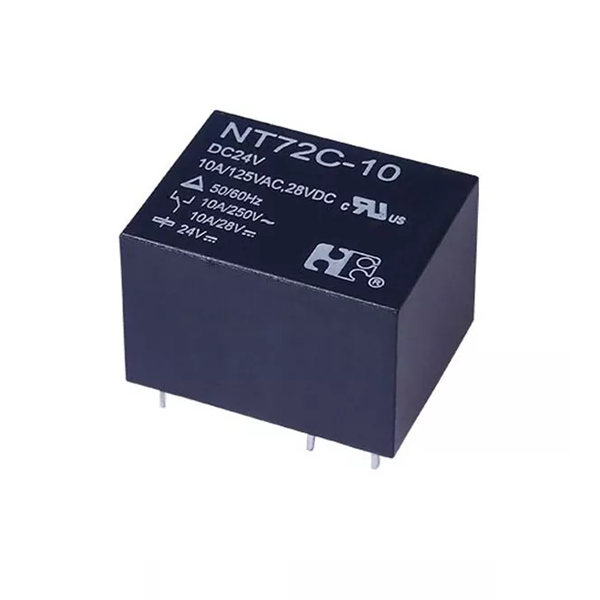
The Core Rating vs. Real-World Derating
Most manufacturers specify a nominal contact current at 25°C with a resistive load (e.g., silver alloy contacts). However, a Subminiature Intermediate Power Relay operating in a 70°C panel or switching a motor (inductive load) must be derated significantly. The table below summarizes Forward’s recommended safe continuous currents under common conditions:
| Load Type | Typical Inrush Multiple | Safe Continuous Current (30°C) | Safe Continuous Current (70°C) |
|---|---|---|---|
| Resistive (heater, lamp) | 1x | 12A | 8A |
| Inductive (solenoid, motor) | 3–5x | 7A | 5A |
| Capacitive (power supply) | 10–20x | 5A | 3.5A |
| DC resistive (30V) | 1x | 10A | 6A |
For a Subminiature Intermediate Power Relay with a 10A AC rating, Forward always advises applying a 0.6–0.7 derating factor for continuous operation beyond 50°C. The contact material (AgNi, AgSnO₂, or AgCdO) also alters the maximum break current—AgSnO₂ handles DC arcing better, making it Forward’s preferred choice for battery-powered systems.
Three Critical Factors That Redefine "Safe"
1. Switching Frequency
If your Subminiature Intermediate Power Relay cycles more than 10 times per minute, the contact temperature rises from accumulated arc energy. At 20 cycles/minute, the safe current drops by ~25% compared to static testing.
2. Mounting Orientation
PCB-mounted relays dissipate heat through leads and copper traces. Forward recommends a minimum of 2 oz copper pad area under the relay to achieve the rated current. Without it, even a 8A-rated Subminiature Intermediate Power Relay may fail at 6A.
3. Minimum Load Current
For dry circuits (≤100mA at 5V), contact oxidation can increase resistance. Forward suggests a "wetting current" above 50mA to maintain low contact resistance—otherwise, the effective switching current becomes unreliable, even if the maximum is within spec.
Frequently Asked Questions About Subminiature Intermediate Power Relay Contact Current
Q1: Can I safely switch 15A DC with a Subminiature Intermediate Power Relay rated at 10A AC?
A1: Not directly. AC ratings are based on zero-crossing arc extinction, while DC arcs sustain longer because voltage does not cross zero. For a Subminiature Intermediate Power Relay with a 10A AC rating, the DC switching capacity is usually 30% lower—approximately 7A at 24V DC and only 3–4A at 110V DC. Forward tests every relay batch with DC loads and provides a separate DC current chart. If your application requires 15A DC, select a relay specifically rated for DC (e.g., Forward F-SMI series with 15A DC @ 28V). Never assume AC ratings translate to DC—this is the number one cause of contact welding in field returns.
Q2: How does inrush current affect the safe switching limit, and how long can that inrush last?
A2: Inrush current can reach 10–20 times the steady-state current for capacitive or incandescent loads. A Subminiature Intermediate Power Relay can withstand this inrush for less than 10 milliseconds without damage, provided the steady-state current stays below the rated continuous value. For example, a 10A-rated relay can handle a 100A inrush pulse if it decays within 5ms. However, if the inrush persists beyond 20ms (common with large electrolytic capacitors), the contacts may bounce and micro-weld. Forward recommends using an external NTC thermistor or series resistor to limit inrush to ≤15× the rated current. Always check the "make current" (switching-on capacity) in the datasheet—Forward clearly specifies both make and break currents for each Subminiature Intermediate Power Relay model.
Q3: What is the maximum safe current if I operate the relay in a sealed, non-ventilated enclosure?
A3: Sealed enclosures trap heat, raising the internal ambient temperature by 15–25°C above the external environment. For a Subminiature Intermediate Power Relay rated at 10A @ 25°C, the safe continuous current inside a sealed plastic box at 60°C ambient drops to 5.5–6A for resistive loads and 4A for inductive loads. Forward conducts thermal rise tests in actual sealed enclosures and publishes derating curves for each product. To maximize current, ensure the PCB has thermal vias under the relay pins, and keep at least 5mm clearance from other heat-generating components. If your load exceeds 6A in a sealed environment, consider Forward’s high-temperature variant (rated to 105°C) or use a forced-air cooling duct.
Practical Verification – The Only Reliable Method
Datasheets provide starting points, but the actual safe current for your Subminiature Intermediate Power Relay must be verified with a thermocouple on the contact pin (temperature rise ≤60°C above ambient) and an oscilloscope capturing the voltage drop across closed contacts (≤50mV drop indicates healthy contact resistance). Forward offers a free online calculator tool that factors in your load profile, ambient temperature, and switching frequency to output a tailored safe current—used by over 2,000 design engineers globally.
Final Recommendation from Forward
Always select a Subminiature Intermediate Power Relay with a nominal current at least 1.5× your maximum steady-state load. For example, if your circuit draws 8A continuously, choose a 12A-rated relay. This margin accounts for voltage dips, temperature drift, and contact aging over 100,000 operations. Forward’s SMI-2 series, with AgSnO₂ contacts and a 15A resistive rating, is specifically engineered for high-inrush DC applications, delivering proven reliability in EV charging stations and industrial robotics.
Need a precise current rating for your specific load and environment?
Contact Forward’s application engineering team today—we will analyze your switching waveform, temperature profile, and duty cycle to recommend the exact Subminiature Intermediate Power Relay model, including free sample testing under your actual conditions.