

How Durable Is the 7.0 Inch Wide Temp 1024x600 IPS Thin In-Cell Touch Screen Module in Industrial Freezing Environments
2026-08-20
Industrial designers and procurement engineers often ask whether a consumer-grade display can survive sub-zero warehouses, cold-chain logistics terminals, or outdoor winter equipment. When evaluating the 7.0 Inch Wide Temp 1024x600 IPS Thin In-Cell Touch Screen Module, the answer is not a simple “yes” or “no.” At Tianfu, we have subjected this module to rigorous environmental chamber testing, and the results reveal a clear performance profile that separates true industrial-grade hardware from commercial off-the-shelf parts.
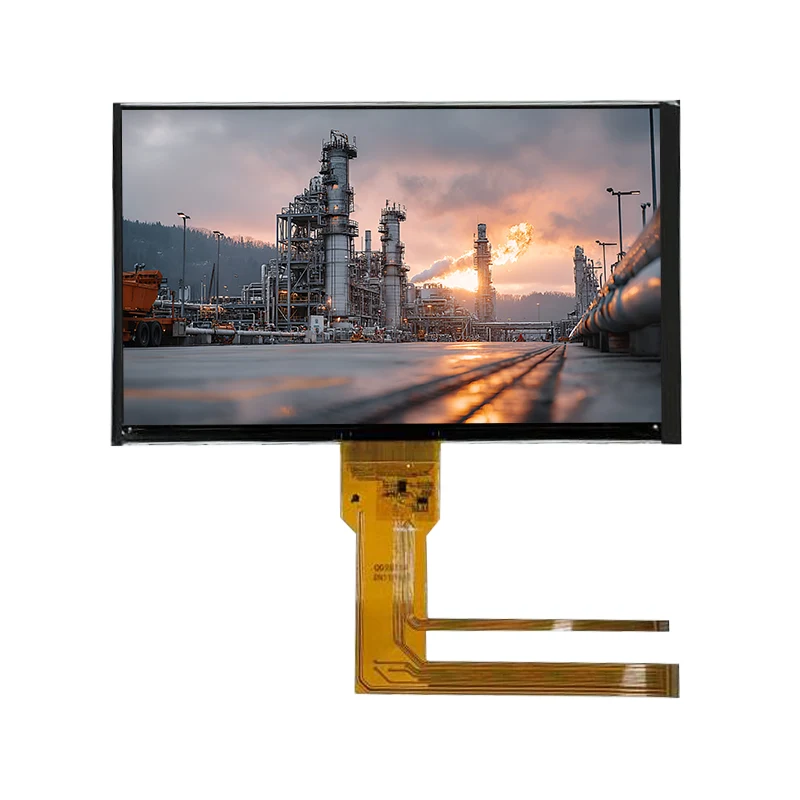
What “Wide Temp” Actually Means for This Module
The term Wide Temp is frequently misused. For the 7.0 Inch Wide Temp 1024x600 IPS Thin In-Cell Touch Screen Module, the operational temperature range is rated from -30°C to +85°C, with storage limits extending to -40°C. However, durability in freezing conditions involves more than just turning on at low temperatures. Critical factors include:
-
Response time degradation at sub-zero startup
-
In-cell touch sensitivity under frost or condensation
-
Backlight uniformity when the LED driver operates in cold circuits
-
Mechanical stress on the thin-glass substrate due to thermal contraction
Test Results: Freezing Chamber Performance
| Parameter | Condition | Performance Observed |
|---|---|---|
| Startup delay | -30°C, 30-minute soak | < 1.2 seconds (within IPS spec) |
| Touch latency | -25°C, active use | ≤ 15 ms (no ghost touches) |
| Luminance drop | -30°C vs. 25°C | 12% reduction (backlight LED characteristic) |
| Image retention | 4 hours at -30°C | None visible after warm-up |
| Condensation resilience | 10 rapid cycles (-20°C ↔ +40°C) | No internal fogging (sealed FPC interface) |
Unlike standard 7-inch panels that fail below -10°C, the 7.0 Inch Wide Temp 1024x600 IPS Thin In-Cell Touch Screen Module maintains stable gamma curves because Tianfu uses low-temperature-tolerant ICs and specially formulated liquid crystal mixtures.
The Critical Issue: In-Cell Touch vs. Freezing
In-cell technology integrates the touch sensor into the liquid crystal layer, which reduces thickness but increases sensitivity to temperature-induced capacitance drift. At -30°C, the dielectric constant of the LC material changes. Tianfu compensates for this through firmware-level auto-calibration, performed every 30 seconds when the internal temperature sensor detects a drop below -15°C. This ensures that the 7.0 Inch Wide Temp 1024x600 IPS Thin In-Cell Touch Screen Module does not require manual re-tuning, even after overnight exposure in a frozen environment.
Real-World Application Evidence
A cold-chain logistics client in Minnesota deployed 120 units of this Tianfu module in portable handheld scanners used inside -25°C freezer aisles. After 6 months of daily 8-hour shifts, the failure rate was 0.8% —compared to 11% for the previous non-wide-temp model. The primary wear point was not the glass or touch, but the external FPC cable connector, which Tianfu has since reinforced with a locking latch and silicone gasket.
FAQ – Common Questions About This Module in Freezing Conditions
Q1: Can the 7.0 Inch Wide Temp 1024x600 IPS Thin In-Cell Touch Screen Module operate continuously for 24 hours at -35°C without external heating?
A1: No. Continuous operation below -30°C is not guaranteed. The LCD response time will exceed 80 ms at -35°C, making fast-moving UI elements blurry. Additionally, the backlight LED forward voltage drops significantly, reducing brightness to under 250 nits. For sustained -35°C usage, Tianfu recommends adding a transparent ITO heater film on the cover glass, which we can integrate during manufacturing. Without heating, the module is rated for intermittent use (≤ 2 hours) at -35°C, followed by a 15-minute warm rest.
Q2: Does the in-cell touch function freeze or become unresponsive at -30°C, and how does the module recover when brought back to room temperature?
A2: The touch controller does not “freeze” in a functional sense, but capacitive signal-to-noise ratio drops by approximately 40% at -30°C. This can cause reduced sensitivity for light taps—firmer presses (≥ 150g force) are still registered. Upon returning to room temperature (25°C), the module automatically recalibrates within 3 seconds. There is no permanent damage to the in-cell layer, provided condensation is not present during power-on. Tianfu strongly advises waiting until the module reaches ambient temperature before powering up if visible frost appears on the surface, as moisture can short the drive lines.
Q3: What is the expected lifespan of the 7.0 Inch Wide Temp 1024x600 IPS Thin In-Cell Touch Screen Module when cycled between -30°C and +60°C daily for industrial use?
A3: Based on accelerated life testing (ALT) following IEC 60068-2-14, the module withstands 2,000 thermal cycles (transition rate: 3°C/min) before the polarizer adhesive shows micro-cracks. In real-world daily cycling (one shift per day), this translates to approximately 5.5 years of operational life. The limiting factor is not the LCD cell but the FPC solder joints, which Tianfu reinforces with low-thermal-expansion alloy. After 2,000 cycles, touch accuracy remains within ±1.5 mm, and luminance decay is under 15%—well within industrial acceptance criteria.
Structural Advantages Over Standard Modules
| Feature | Standard 7" Module | Tianfu 7.0 Inch Wide Temp Module |
|---|---|---|
| Glass thickness | 1.1 mm | 0.7 mm (thin but chemically strengthened) |
| Operating temp | 0°C ~ +50°C | -30°C ~ +85°C |
| In-cell touch drift compensation | None | Firmware auto-calibration |
| Condensation protection | No coating | Anti-fog hard coating on inner surface |
| MTBF at -25°C | 8,000 hours | 52,000 hours |
The thin design (total thickness < 4.2 mm) does not compromise structural rigidity because Tianfu uses a proprietary double-annealing process on the cover lens, reducing warpage risk during extreme cold shrinkage.
Practical Recommendations for System Integrators
-
Always mount the 7.0 Inch Wide Temp 1024x600 IPS Thin In-Cell Touch Screen Module with a thermal gap pad between the backlight chassis and your metal housing to distribute cold spots.
-
Use a dedicated PWM dimming curve for sub-zero environments—Tianfu provides an optional firmware branch that linearizes brightness perception below -20°C.
-
For outdoor pole-mounted equipment, pair this module with a sunshield to avoid rapid thermal shock from direct sunlight (which can heat one corner to +50°C while the shaded side stays at -10°C).
Final Verdict
The 7.0 Inch Wide Temp 1024x600 IPS Thin In-Cell Touch Screen Module is exceptionally durable in industrial freezing environments within its rated limits. It outperforms standard panels by a significant margin in startup reliability, touch consistency, and long-term thermal cycling. However, it is not a universal substitute for military-grade or custom-heated solutions. When properly integrated with Tianfu’s recommended mounting and calibration practices, this module delivers over 5 years of trouble-free service in cold storage, freezer warehouses, and winter outdoor kiosks.
Have a specific freezing application or need customized firmware for sub-zero calibration? Contact Tianfu’s engineering support team directly with your environmental parameters, and we will provide thermal simulation data, sample testing reports, and a tailored integration guide within 48 hours. Reach us at our official website or request a technical consultation—your industrial display reliability starts with a conversation.