

How Does Wavelength Selection Influence the Collimation Accuracy of a Laser Diode System
2026-05-20
Achieving high precision in optical systems begins with understanding how wavelength selection directly impacts collimation accuracy. At Wavespectrum, engineers recognize that wavelength determines beam divergence, refractive index behavior, and thermal stability. Choosing the wrong wavelength for a Collimated Laser Diode system can degrade focus, reduce working distance, and compromise measurement integrity.
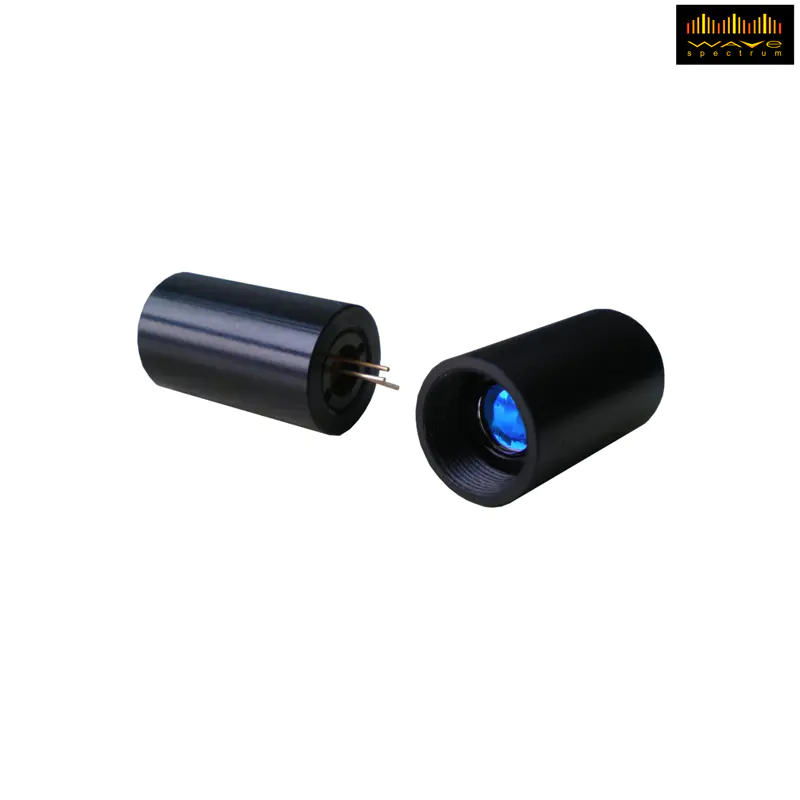
The Optical Relationship Between Wavelength and Collimation
Collimation relies on lenses or mirrors to parallelize diverging light from a laser diode. The refractive index of optical materials varies with wavelength—a phenomenon called dispersion. Shorter wavelengths (e.g., 405 nm) bend more than longer wavelengths (e.g., 1550 nm) when passing through the same lens. This means a collimator optimized for 635 nm will produce residual divergence at 850 nm.
| Wavelength (nm) | Typical Collimation Tolerance (± mrad) | Primary Application |
|---|---|---|
| 405 - 450 | 0.05 - 0.10 | Material processing |
| 635 - 670 | 0.08 - 0.15 | Barcode scanning |
| 780 - 850 | 0.12 - 0.20 | LIDAR / Night vision |
| 980 - 1550 | 0.15 - 0.30 | Telecommunications |
Key Influencing Factors
-
Chromatic Aberration: Single-element collimators cannot focus all wavelengths to the same point. Aspheric lenses reduce but do not eliminate this effect.
-
Beam Waist Location: Wavelength shifts change the position of minimum beam diameter, requiring mechanical readjustment.
-
Thermal Drift: Laser diodes exhibit wavelength change (0.2–0.3 nm/°C), altering collimation unless actively stabilized.
-
Diffraction Limit: Shorter wavelengths allow tighter collimation but demand higher surface quality on optics.
How Wavespectrum Optimizes Collimation Across Wavelengths
Wavespectrum designs wavelength‑specific collimation modules using low‑dispersion glass and active temperature control. For multi‑wavelength systems, hybrid lens assemblies compensate for chromatic errors, maintaining diffraction‑limited performance. Each Collimated Laser Diode is factory aligned at its operating wavelength to achieve <0.1 mrad residual divergence.
Collimated Laser Diode FAQ – Common Questions
Q1: Can I use the same collimation lens for two different laser wavelengths if the power is low?
A: Not recommended. Even at low power, refractive index difference shifts the focal point. For example, a lens collimated for 635 nm will produce 0.5–0.8 mrad divergence at 780 nm, making the beam unusable for long‑range or high‑precision tasks. Wavespectrum provides wavelength‑marked collimators to prevent misapplication. Always match the lens design to the exact center wavelength.
Q2: How much does temperature change affect collimation accuracy through wavelength drift?
A: A typical laser diode drifts 0.2–0.3 nm per °C. A 10 °C rise shifts wavelength by 2–3 nm. In a standard aspheric collimator, this induces 0.1–0.2 mrad additional divergence—significant for focusing over 10+ meters. Wavespectrum offers temperature‑stabilized mounts and TEC‑controlled Collimated Laser Diode modules that keep wavelength drift below ±0.5 nm, preserving collimation.
Q3: What is the best wavelength for achieving the highest collimation accuracy over long distances?
A: Longer wavelengths (1300–1550 nm) are preferred for extreme distances because they experience lower diffraction spread and atmospheric scattering. However, they require larger optics to maintain the same collimation ratio. For indoor precision work (0–5 meters), 405–450 nm provides superior collimation accuracy due to shorter diffraction limits. Wavespectrum recommends a trade‑off analysis based on your exact working range and beam diameter requirements.
Actionable Summary Table
| Requirement | Recommended Wavelength | Collimation Accuracy | Wavespectrum Solution |
|---|---|---|---|
| Long distance (>100 m) | 1550 nm | <0.15 mrad | CLD‑1550‑ATE |
| High precision (0-5 m) | 405 nm | <0.05 mrad | CLD‑405‑APO |
| Wide temperature range | 850 nm + TEC | <0.10 mrad | CLD‑850‑TC |
| Low visible signature | 980 nm | <0.20 mrad | CLD‑980‑IR |
Selecting the correct wavelength is not optional—it is foundational. Every Collimated Laser Diode system from Wavespectrum includes a full wavelength‑to‑collimation validation report, ensuring your application achieves theoretical limits.
Contact us today for a free collimation assessment. Share your target wavelength, working distance, and desired beam divergence. The Wavespectrum engineering team will respond within 24 hours with a customized Collimated Laser Diode solution and optical design recommendations. Reach us at [email protected] or through the contact form on our website.