

How does the short-circuit current rating affect the safety of a DC SPD in off-grid systems
2026-04-15
When designing a safe off-grid solar or battery storage system, the short-circuit current rating (SCCR) of a DC SPD is not just a technical specification—it is a critical safety boundary. At Dongan, we have seen how selecting a DC SPD with an inadequate SCCR can lead to catastrophic failure, fire, or complete system shutdown. Understanding this rating ensures that your off-grid installation remains protected under real fault conditions.
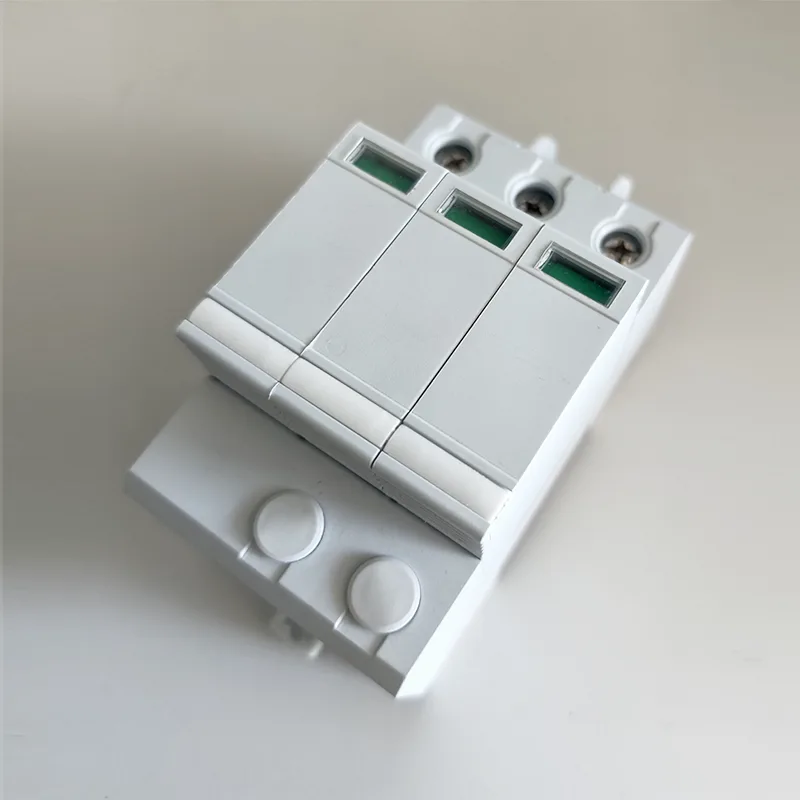
The SCCR of a DC SPD defines the maximum fault current the device can safely withstand without rupturing or catching fire. In off-grid systems, battery banks and high-current charge controllers can deliver thousands of amps during a short circuit. If the DC SPD has a lower SCCR than the available fault current, it may explode or sustain internal arcing, rendering surge protection useless and creating a new hazard.
| Parameter | Low SCCR DC SPD | High SCCR DC SPD |
|---|---|---|
| Fault current handling | <5 kA | ≥10 kA (up to 50 kA) |
| Risk of rupture under short circuit | High | Very low |
| Suitability for battery-based off-grid systems | Not recommended | Required |
| Typical application | Small portable panels | Large off-grid homes or telecom |
Key safety factors influenced by SCCR in off-grid systems
-
Thermal stress management: A higher SCCR means the DC SPD can clear a fault without melting internal components.
-
Coordination with overcurrent devices: Fuses or breakers must have interrupting ratings compatible with the DC SPD SCCR to avoid cascade failure.
-
Fire prevention: A DC SPD with insufficient SCCR can eject molten metal or burn insulation, especially in enclosed off-grid power rooms.
Dongan recommends always calculating the prospective short-circuit current at the point of installation. For off-grid systems with lithium battery banks exceeding 10 kWh, the available fault current often surpasses 15 kA. In such cases, a DC SPD rated at 20 kA SCCR or higher is mandatory.
DC SPD FAQ – Common questions from off-grid installers
What happens if I use a DC SPD with a lower SCCR than my system’s available fault current?
The DC SPD may violently fail during a surge event that coincides with a short circuit. Instead of clamping the surge, the device can rupture, creating an arc flash or fire. The surge protection path is lost, and the resulting arc can damage adjacent wiring and batteries. To avoid this, always match or exceed the DC SPD SCCR to the maximum fault current calculated from your battery bank and inverter.
How do I determine the available short-circuit current at the DC SPD location in an off-grid system
You need to calculate based on the battery type, capacity, and internal resistance. For lead-acid, use the CCA rating or manufacturer’s short-circuit current. For lithium, check the battery management system (BMS) limits but also consider that many BMS units cannot interrupt external short circuits. The worst-case fault current equals battery voltage divided by total circuit resistance (including cables). When in doubt, add a current-limiting fuse ahead of the DC SPD and ensure the DC SPD SCCR is at least as high as the fuse interrupting rating.
Can I rely on an external fuse to protect a low SCCR DC SPD in an off-grid system
No, a fuse protects the circuit but does not raise the DC SPD SCCR. If the fault current exceeds the DC SPD SCCR, the device may rupture before the fuse opens. Proper coordination requires the fuse to have a clearing time fast enough and a current limitation low enough to keep the fault energy below the DC SPD withstand level. However, the safest practice is to select a DC SPD with an SCCR equal to or greater than the maximum prospective fault current. Dongan offers DC SPD models rated from 10 kA to 50 kA SCCR for various off-grid scales.
Final thoughts and safety action
Every off-grid system is unique, but the physics of fault current is not. Choosing a DC SPD with an adequate SCCR is non-negotiable for safety compliance and long-term reliability. Dongan provides fully tested DC SPD devices with clear SCCR markings and application support for off-grid solar, wind, and battery storage.
Contact us today to review your off-grid system’s fault current calculations and select the right DC SPD for safe, code-compliant protection. Our engineering team is ready to help you avoid costly failures and ensure your installation meets international safety standards.