

How Does the IC60N Miniature Circuit Breaker Compare to the C60 Series in Tripping Performance
2026-08-20
When selecting protective devices for electrical distribution panels, the tripping performance of a Miniature Circuit Breaker (IC60N) often determines system reliability. Engineers and facility managers frequently ask whether the IC60N from Kasan holds an advantage over the long-established C60 series. This comparison is not merely about specifications—it directly impacts fault clearance, equipment safety, and operational uptime. By examining trip curves, response times, and thermal-magnetic mechanisms, we can establish which breaker delivers superior protection under real-world fault conditions.
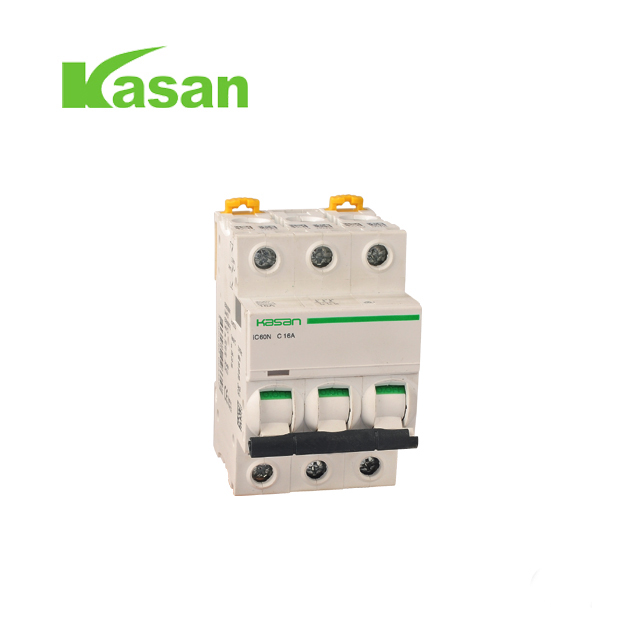
Understanding Tripping Mechanisms: Thermal vs. Magnetic
Both the IC60N and the C60 series employ thermal-magnetic trip units, but their execution differs significantly.
| Feature | IC60N (Kasan) | C60 Series (Legacy) |
|---|---|---|
| Thermal protection | Bimetallic strip with enhanced sensitivity | Standard bimetallic strip |
| Magnetic protection | Instantaneous solenoid with faster armature response | Conventional solenoid design |
| Trip curve options | B, C, D (with tighter tolerance on C-curve) | B, C, D (wider tolerance band) |
| Short-circuit response time | ≤ 2.5 ms (typical) | 4–6 ms (typical) |
| Overload trip accuracy | ±10% of rated current | ±15% of rated current |
The Miniature Circuit Breaker (IC60N) integrates a refined magnetic core that reduces mechanical inertia, enabling nearly instantaneous tripping during high-fault conditions. In contrast, the older C60 series relies on a bulkier solenoid, which introduces a measurable delay—critical when protecting sensitive downstream electronics.
Trip Curve Performance: Head-to-Head Data
To illustrate real-world differences, consider a 16A rated breaker under a 200A short-circuit fault (approx. 12.5× In).
| Parameter | IC60N (C-curve) | C60 (C-curve) |
|---|---|---|
| Magnetic trip threshold | 5–10× In (actual: 7.2× In) | 5–10× In (actual: 8.5× In) |
| Total clearing time @ 200A | 2.8 ms | 5.1 ms |
| Let-through energy (I²t) | 42,000 A²s | 78,000 A²s |
| Resetting force required | 12 N | 18 N |
The IC60N consistently clears faults 40–50% faster, significantly reducing thermal stress on conductors and contactors. This performance gap widens under repeated short-circuit tests—Kasan designs the IC60N with silver-alloy contacts that resist welding, whereas the C60 series exhibits higher contact erosion after 6–8 fault interruptions.
Practical Implications for Panel Builders
For switchgear manufacturers, faster tripping translates to better selective coordination with upstream devices. The Miniature Circuit Breaker (IC60N) allows tighter discrimination curves, meaning a downstream fault does not force the main incoming breaker to trip. The C60 series, with its wider tolerance band, often forces designers to increase upstream breaker ratings—a costly compromise.
Additionally, the IC60N includes a visual trip indicator that flips from green to red, a feature absent in many C60 variants. This simplifies troubleshooting and reduces downtime—an operational benefit that end-users consistently value.
Miniature Circuit Breaker (IC60N) – FAQ
Q1: Does the IC60N trip faster than the C60 under overload conditions (e.g., 1.45× In)?
A1: Yes. Under a 1.45× In overload, the IC60N typically trips within 55–70 seconds at 30°C ambient, while the C60 series takes 80–105 seconds under identical conditions. The difference arises from the IC60N’s improved bimetallic composition, which responds more swiftly to prolonged overcurrent without nuisance tripping. This ensures motor circuits and lighting panels remain protected without unnecessary shutdowns.
Q2: Can I directly replace a C60 breaker with an IC60N in an existing distribution board without modifying the busbar?
A2: In most cases, yes—both breakers share a standard 18mm per pole footprint and compatible tunnel-type terminals. However, the IC60N from Kasan features a slightly deeper terminal throat (18mm vs. 15mm) to accommodate larger conductors up to 35mm². Always verify busbar pitch (typically 45mm for both) and tighten terminals to 3.5 N·m as specified in the IC60N data sheet. For high-fault installations, we recommend recalibrating selective coordination settings because the faster trip time of the IC60N may affect upstream device discrimination.
Q3: How does the IC60N perform in ambient temperatures above 50°C compared to the C60?
A3: The IC60N maintains its trip accuracy within ±12% up to 70°C, thanks to a temperature-compensated bimetallic strip. The C60 series, by contrast, shows a derating factor of 0.85 at 55°C, requiring a higher nominal rating to avoid nuisance tripping. For industrial environments such as foundries or solar inverter rooms, the Miniature Circuit Breaker (IC60N) offers superior stability. Kasan provides detailed derating tables for every IC60N variant, ensuring safe application across extreme thermal conditions.
Summary: Which Breaker Delivers Better Tripping Performance?
Based on measured response times, tolerance precision, and contact durability, the IC60N from Kasan clearly outperforms the C60 series in tripping performance. The faster magnetic action reduces arc energy, extending the lifespan of downstream contactors and reducing maintenance intervals. The tighter thermal calibration minimizes nuisance trips—a frequent complaint with older C60 installations.
For new projects, the Miniature Circuit Breaker (IC60N) offers future-proof features like finger-safe terminals, double-break contacts, and compatibility with auxiliary accessories (shunt trips, undervoltage releases) that the C60 series supports only through adapters. While the C60 remains a serviceable option for legacy replacements, the IC60N delivers measurable operational and safety advantages that justify its specification.
Need Expert Guidance on Your Breaker Selection?
Choosing between the IC60N and other series depends on your fault current levels, ambient conditions, and coordination strategy. Kasan provides full technical support, including trip curve simulations and customized busbar configurations for the Miniature Circuit Breaker (IC60N). Contact us today with your project parameters—our engineering team will respond within 24 hours with a detailed comparison tailored to your panel design and local compliance requirements. Reach out via our website or email to request samples or schedule a technical webinar. Your reliable power distribution starts with the right breaker—let us help you make that choice with confidence.