

How Does the Auto-Extinguishing Mechanism Work in Perfluorohexanone-Based Portable Devices
2026-03-17
In the evolving landscape of fire safety, the Portable Perfluorohexanone Auto-extinguishing Device represents a significant leap forward in protecting critical assets. Unlike traditional water or powder-based extinguishers, these advanced units leverage chemical precision to suppress fires instantly without causing collateral damage. At Wzonpa, we specialize in engineering these compact safety solutions, ensuring that businesses can safeguard server rooms, industrial cabinets, and vehicles with zero residue and maximum efficiency.
Understanding the science behind the auto-extinguishing mechanism is essential for safety managers and procurement officers. Here is a technical breakdown of how a Portable Perfluorohexanone Auto-extinguishing Device operates when a fire threatens your environment.
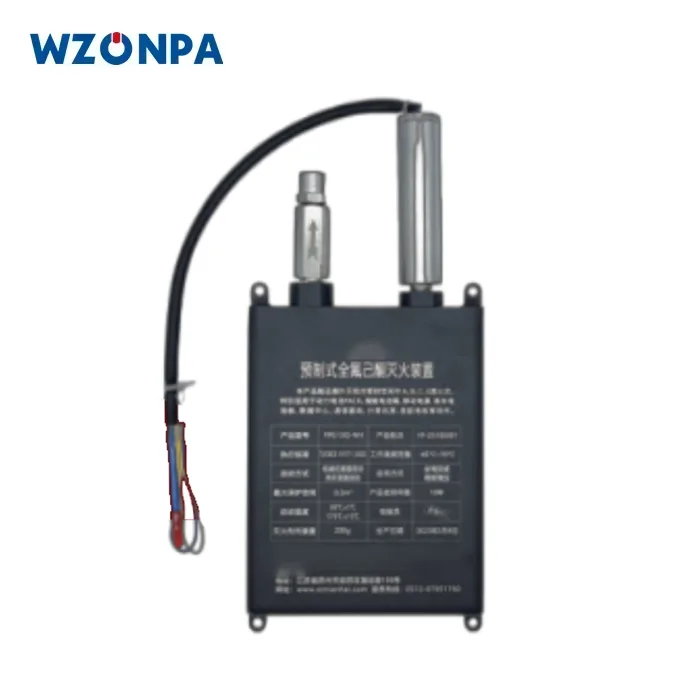
The Core Chemistry of Suppression
Perfluorohexanone (often referred to by its chemical name FK-5-1-12) is a clear, odorless fluorinated ketone. Its auto-extinguishing capability relies on a physical heat absorption mechanism rather than chemical interference. When deployed, it transitions from liquid to gas instantly, absorbing a massive amount of thermal energy from the fire triangle (heat, fuel, oxygen).
Unlike CO2, which displaces oxygen and poses a risk to personnel, or dry chemicals, which corrode electronics, the agent used in a Wzonpa unit is safe for occupied spaces and delicate equipment.
Step-by-Step: The Auto-Extinguishing Sequence
The mechanism of a Portable Perfluorohexanone Auto-extinguishing Device is a marvel of passive safety. It requires no manual activation, making it ideal for unattended areas. The process follows a precise scientific sequence:
| Phase | Component Action | Scientific Outcome |
|---|---|---|
| 1. Detection | A linear heat-sensitive tube or electronic sensor detects a rapid temperature rise (typically >100°C). | The control circuit or physical tube integrity is compromised, triggering the release. |
| 2. Activation | The pressure differential causes the burst disc or valve to open instantly. | The liquid Perfluorohexanone is forced out by the nitrogen propellant. |
| 3. Vaporization | The agent exits the nozzle as a fine mist, vaporizing immediately upon contact with flames. | Endothermic reaction cools the flame below the combustion point (approx. 400°C reduction). |
| 4. Saturation | The gaseous agent disperses throughout the enclosure, seeking the fire source. | Interruption of the combustion chain reaction without oxygen displacement. |
Why Choose Automatic Over Manual?
The primary advantage of a Portable Perfluorohexanone Auto-extinguishing Device is its 24/7 vigilance. Human reaction time, even when trained, cannot compete with the speed of a chemical chain reaction. Wzonpa devices are engineered to detect and suppress a fire within seconds, often before a traditional sprinkler system or handheld extinguisher would even be activated.
"The speed of suppression is critical. By removing heat energy so rapidly, Perfluorohexanone prevents re-ignition and limits thermal damage to surrounding assets." – Wzonpa Engineering Standard
Frequently Asked Questions (FAQ)
To further clarify the application and mechanics of these devices, here are answers to common technical inquiries regarding the Portable Perfluorohexanone Auto-extinguishing Device.
Q1: Is the Perfluorohexanone agent safe for sensitive electronic equipment like servers and PLCs?
A: Yes, it is exceptionally safe. Unlike dry chemical powders that are conductive and corrosive, or water that causes short circuits, Perfluorohexanone is a non-conductive dielectric fluid. It vaporizes completely, leaving zero residue. This ensures that sensitive circuit boards, hard drives, and networking equipment suffer no secondary damage from the suppression process itself. The device can be activated without needing to power down the equipment, ensuring business continuity.
Q2: What triggers the automatic release if no one is present to activate it?
A: The Portable Perfluorohexanone Auto-extinguishing Device utilizes a robust mechanical or electronic activation system. In mechanical variants, a pressurized detection tube runs through the hazard area. If a fire breaches this tube, the heat bursts it, causing a pressure drop that mechanically opens the valve. In electronic variants, smoke or heat sensors send a signal to a control panel, which then fires an electric squib to release the agent. Both methods ensure automatic, reliable deployment without human intervention.
Q3: How does the device ensure the agent reaches the fire source if it is inside a cabinet?
A: The physical properties of Perfluorohexanone are key here. Upon release, the liquid is atomized under high pressure. As it exits the nozzle, it rapidly converts to a gas and expands. This gaseous state allows it to "three-dimensionally" fill the entire protected volume, much like air conditioning cools a room. It will flow around obstacles, seep into crevices, and envelop the fire source completely, ensuring total flooding suppression even in complex geometries.
Technical Specifications at a Glance
When selecting a Portable Perfluorohexanone Auto-extinguishing Device for your facility, consider the technical parameters that define its capabilities. Wzonpa offers a range of models tailored to different volume sizes.
-
Agent Type: FK-5-1-12 (Perfluorohexanone)
-
Ozone Depletion Potential (ODP): 0
-
Global Warming Potential (GWP): 1
-
Atmospheric Lifetime: 5 days (extremely short)
-
Typical Discharge Time: < 10 seconds
-
Storage Pressure: 25 bar @ 20°C
Conclusion and Call to Action
The engineering behind a Portable Perfluorohexanone Auto-extinguishing Device transforms fire safety from reactive damage control to proactive asset preservation. By understanding the endothermic reaction and rapid vaporization mechanics, it is clear why industries ranging from telecommunications to renewable energy are adopting this technology.
At Wzonpa, we are committed to delivering the highest standard of protection. Our devices are rigorously tested to ensure they perform exactly when you need them most. Do not leave your critical infrastructure to chance.
Contact Us today to discuss your specific fire safety requirements with our engineering team. Let Wzonpa help you design a suppression solution that keeps your operations running safely and continuously.