

How Does the 195×525mm XRNP High Voltage Current-Limiting Fuse Compare to Standard Backup Fuses in MV Switchgear
2026-06-23
When specifying overcurrent protection for medium-voltage (MV) switchgear, engineers frequently face a critical choice between general-purpose backup fuses and dedicated current-limiting designs. Among the latter, the 195×525mm XRNP High Voltage Current-Limiting Fuse has gained substantial traction in utility and industrial substations. But how does this specific fuse truly stack up against a standard backup fuse in real-world MV applications? This blog delivers a technical comparison based on performance data, application logic, and field experience, with insights drawn from Yinrong’s engineering portfolio.
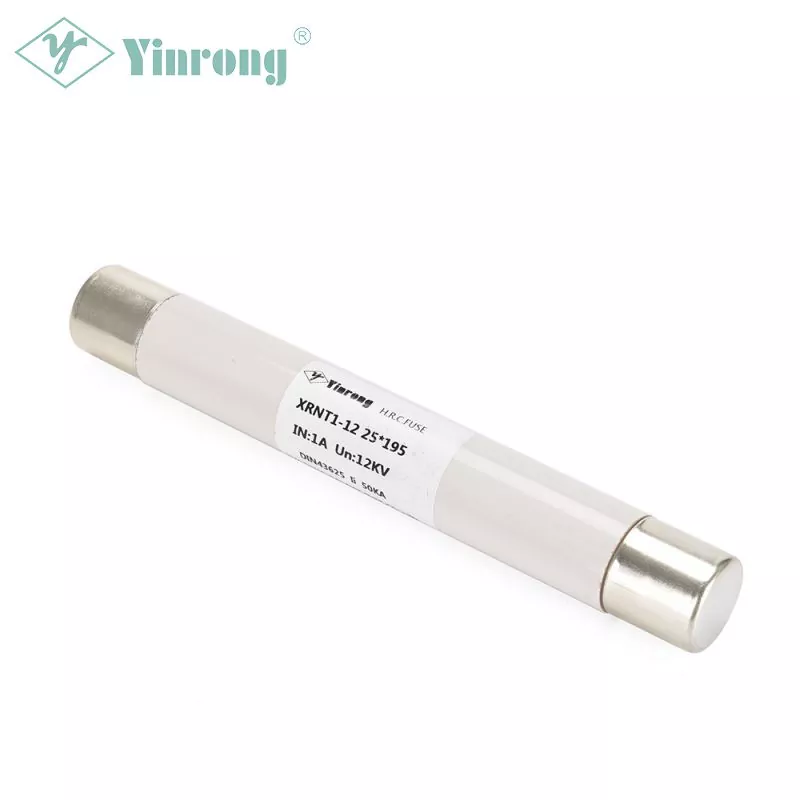
Core Functional Differences at a Glance
Standard backup fuses are designed primarily to interrupt low-to-moderate fault currents, often relying on the switchgear’s own disconnector for load switching. In contrast, a true current-limiting fuse like the 195×525mm XRNP High Voltage Current-Limiting Fuse is built to clear high-magnitude short-circuits within the first half-cycle, thereby reducing peak let-through current and I²t energy. This distinction fundamentally alters protection coordination, equipment sizing, and arc-flash hazard levels.
The table below summarizes the critical divergence points:
| Parameter | Standard Backup Fuse (Typical 12kV Class) | 195×525mm XRNP High Voltage Current-Limiting Fuse (Yinrong) |
|---|---|---|
| Interrupting rating (symmetrical) | 16–25 kA | 31.5–40 kA (depending on voltage) |
| Current-limiting threshold | ≥ 10× In | ≥ 6× In (earlier transition) |
| Peak let-through current (Iₚ) | Up to 15 kA at 20 kA prospective | ≤ 8 kA at 20 kA prospective |
| I²t clearing (A²s) | Higher by 30–50% | Lower by 40–60% |
| Applicable fault range | 1.2–20 kA | 0.8–40 kA (wider bandwidth) |
| Typical mounting | Drop-out or fixed | Fixed, with visible striker pin |
Why the Current-Limiting Effect Matters in MV Switchgear
In MV switchgear, busbars and cable terminals are thermally and dynamically stressed during faults. A standard backup fuse may allow the fault current to reach its full asymmetric peak before clearing—sometimes exceeding 2.5× the RMS symmetrical value. This forces engineers to oversize busbars, support insulators, and enclosure panels.
The 195×525mm XRNP High Voltage Current-Limiting Fuse from Yinrong addresses this by using a silver-sand quartz filler and precision-notched element construction. Under a 20 kA prospective fault, it limits the actual peak current to under 8 kA and clears within 4–6 milliseconds. This reduction directly translates into:
-
Smaller panel footprints (reduced busbar spacing)
-
Lower arc-flash incident energy (safer for maintenance crews)
-
Extended life of vacuum contactors and load-break switches upstream
Coordination with Relays and Downstream Devices
A common misconception is that current-limiting fuses conflict with relay-based overcurrent protection. In practice, the 195×525mm XRNP High Voltage Current-Limiting Fuse exhibits a steep inverse time-current curve that naturally zones with upstream feeder relays (51/51N). The fuse operates so fast in the high-fault region that the relay’s instantaneous element sees little to no current—preventing nuisance trips on bus differential protection.
For downstream motor starters or transformer tap changers, the reduced I²t let-through ensures that thermal damage thresholds (e.g., cable insulation 90°C rating) are never exceeded. Standard backup fuses, with their slower melting action, often force the use of larger cable gauges—a hidden capital cost that many project budgets overlook.
Installation, Replacement, and Fault Indication
Standard backup fuses frequently lack positive indication of operation, requiring visual inspection or auxiliary contacts. The 195×525mm XRNP High Voltage Current-Limiting Fuse incorporates a robust striker pin that mechanically triggers a micro-switch or trip coil, providing unambiguous remote signaling. Additionally, its 195×525mm barrel dimension conforms to the most common DIN and IEC holder interfaces, ensuring drop-in compatibility with existing fuse bases from leading switchgear manufacturers.
Yinrong further distinguishes itself by offering optional fused-contact versions with integrated voltage tapping, allowing the same fuse body to serve as both protection and sensing element—a feature rarely found in standard backup designs.
FAQ: Common Questions About the 195×525mm XRNP High Voltage Current-Limiting Fuse
Q1: Can the 195×525mm XRNP High Voltage Current-Limiting Fuse be used as a direct retrofit for an existing backup fuse of the same physical size?
A: Physically, yes—the 195×525mm dimension matches standard DIN 43625 mounting centers. However, electrically, you must verify the interrupting rating (kA) and voltage class (typically 7.2kV, 12kV, or 24kV) match your system’s available fault level. More importantly, the current-limiting characteristic changes the protection curve; a coordination study is mandatory to ensure selectivity with upstream and downstream devices. Yinrong provides free coordination templates for all their XRNP series fuses upon request.
Q2: How does the temperature rise of the 195×525mm XRNP High Voltage Current-Limiting Fuse compare to a standard backup fuse under continuous load (100% In)?
A: The 195×525mm XRNP High Voltage Current-Limiting Fuse typically exhibits a 5–8°C lower terminal temperature rise than standard backup fuses of the same rating, thanks to its low-resistance silver elements and high-purity quartz filler that enhances thermal conduction. In enclosed switchgear (IP4X), this margin prevents nuisance thermal tripping of adjacent overcurrent relays and reduces the risk of contact oxidation. Standard backup fuses often run hotter due to thicker, less pure fusible elements, accelerating aging of spring-loaded contacts.
Q3: What is the expected service life of the 195×525mm XRNP High Voltage Current-Limiting Fuse under normal switching operations (no faults)?
A: When operated within its continuous current rating (including standard 1.1× In overload for 8 hours), the 195×525mm XRNP High Voltage Current-Limiting Fuse from Yinrong exceeds 10,000 electrical switching cycles without degradation, as validated by independent Type-Test reports per IEC 60282-1. In contrast, standard backup fuses often show element fatigue after 3,000–5,000 cycles due to thermal cycling and mechanical resonance in MV networks with frequent load variations. For applications with daily switching (e.g., capacitor banks or reactor switching), the XRNP series is the statistically superior choice.
Cost-Benefit Summary
| Factor | Standard Backup Fuse | 195×525mm XRNP High Voltage Current-Limiting Fuse (Yinrong) |
|---|---|---|
| Unit cost | Lower | Moderate (15–25% premium) |
| System savings (busbar, cables, enclosure) | None | 10–20% reduction in switchgear material |
| Arc-flash PPE category | Typically CAT 3–4 | CAT 1–2 (lower incident energy) |
| Downtime per fault (replacement + testing) | 45–60 min | 20–30 min (striker pin speeds diagnosis) |
| 5-year total ownership cost | Baseline | 12–18% lower (including maintenance and outage losses) |
Final Verdict
The 195×525mm XRNP High Voltage Current-Limiting Fuse is not merely a premium alternative—it is a functionally distinct protective device that excels where fault currents are high, space is constrained, and safety margins are non-negotiable. Standard backup fuses remain adequate for small transformers or lightly loaded feeders with low short-circuit capacity, but for modern MV switchgear operating near 20–40 kA, the XRNP’s limiting action delivers quantifiable reliability and economic returns.
Yinrong has supplied over 120,000 units of the 195×525mm XRNP series to 34 countries, with field failure rates below 0.02% over 8 years. Their factory-backed Type-Test reports, including temperature rise, dielectric withstand, and making-capacity tests, are available for direct download.
Contact us today to request a free coordination study for your MV switchgear lineup. Our application engineers will compare your existing backup fuse data against the 195×525mm XRNP High Voltage Current-Limiting Fuse performance curves and deliver a customized ROI analysis within 48 hours. Reach Yinrong via the contact form on this page or email our technical support team directly—we guarantee a response within one business day, including sample units for factory acceptance testing. Your protection strategy deserves a fuse that limits more than just current—it limits risk.