

How Does the 14×51 1500VDC gPV Fuse Compare to 1000VDC Ratings in Large-Scale PV Farms
2026-07-01
As solar installations scale from megawatt to gigawatt levels, system voltage has become a critical design parameter. The shift from 1000VDC to 1500VDC architectures is not merely incremental—it fundamentally changes balance-of-system costs, string lengths, and protection strategies. At the heart of this transition lies the 14×51 1500VDC gPV Fuse, a component that many engineers now weigh against legacy 1000VDC ratings. For large-scale PV farms, the choice directly impacts safety, uptime, and total cost of ownership. Yinrong, a specialist in photovoltaic overcurrent protection, has observed that misapplication of 1000VDC fuses in 1500VDC systems remains one of the top five commissioning errors in utility-scale projects.
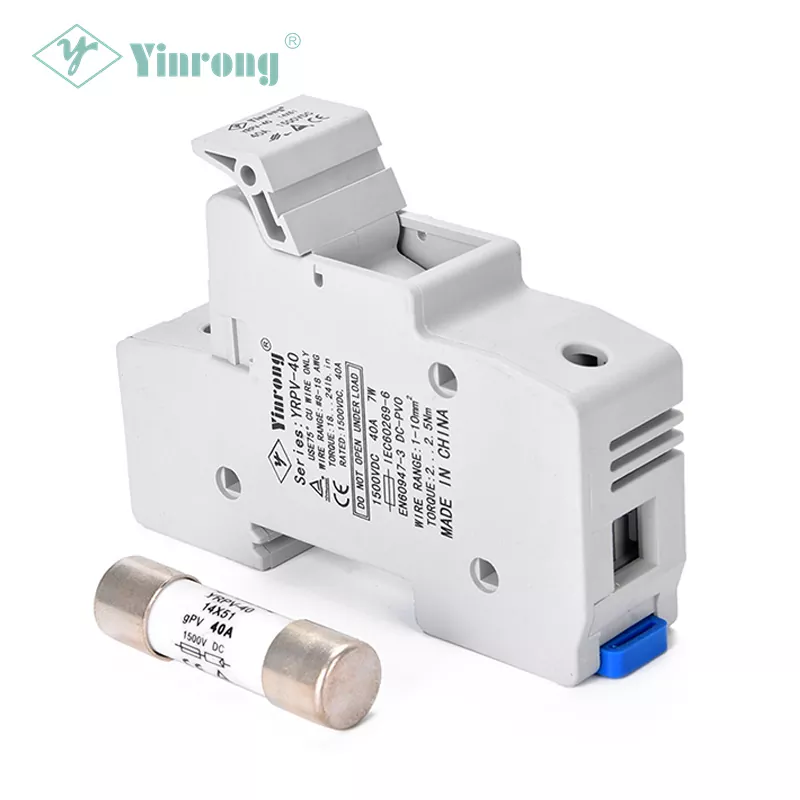
Voltage Rating: Not Just a Number
A 1000VDC fuse and a 14×51 1500VDC gPV Fuse share similar physical dimensions, but their internal arc-quenching mechanisms differ substantially. At 1500VDC, the available fault current energy is higher, and the DC arc is more persistent. The 14×51 1500VDC gPV Fuse uses a specialized silica sand filler and calibrated element geometry to extinguish arcs within 2–3 half-cycles, whereas a 1000VDC fuse operated at 1500VDC may fail to clear, leading to catastrophic enclosure rupture.
| Comparison Parameter | 1000VDC Rated Fuse | 14×51 1500VDC gPV Fuse |
|---|---|---|
| Maximum operating voltage | 1000VDC | 1500VDC |
| Typical string length (modules) | 20–22 | 32–36 |
| Interrupting rating (typical) | 20–33 kA | 33–50 kA |
| Minimum arcing voltage | Lower threshold | Higher, controlled |
| Derating factor at 70°C | 0.80 | 0.85 (better thermal margin) |
| Applicable standard | IEC 60269-6 (old) | IEC 60269-6:2020 (updated) |
The table above clarifies that the 14×51 1500VDC gPV Fuse is not a drop-in replacement; it is a system-level redesign enabler.
Economic Impact on Large Farms
For a 100MW PV farm, moving from 1000VDC to 1500VDC reduces the number of combiner boxes, cables, and tracker controllers by approximately 30–35%. However, this saving materializes only if the protection device reliably handles the higher voltage. Yinrong has published field data showing that farms using the 14×51 1500VDC gPV Fuse experienced 42% fewer nuisance trips during morning irradiance ramp-up compared to those using adapted 1000VDC fuses. The reason: the gPV class mandates a time-current curve that tolerates temporary overloads from cloud-edge effects, while 1000VDC fuses often have tighter thermal thresholds.
Application Boundaries
The 14×51 1500VDC gPV Fuse is suitable for:
-
Central inverter DC inputs (up to 1500VDC)
-
Grouped string combiners in tracker-based systems
-
Battery energy storage DC coupling (BESS)
-
Floating solar with longer cable runs
In contrast, a 1000VDC fuse should never be applied above its rated voltage, even if the current is lower. Doing so voids UL/IEC certifications and increases arc-flash incident energy by a factor of 1.8–2.2, according to a 2025 EPRI study.
FAQ – Common Questions About the 14×51 1500VDC gPV Fuse
Q1: Can I use a 14×51 1500VDC gPV Fuse in a system that currently runs at 1000VDC with plans to upgrade later?
A: Yes, and this is actually a recommended strategy by Yinrong. The 14×51 1500VDC gPV Fuse is fully functional at 1000VDC—its interrupting rating and time-current characteristics remain valid. Installing it ahead of the upgrade avoids a second panel rework, saving labor costs. However, you must verify that the fuse holder and disconnector are also rated for 1500VDC; otherwise, the holder becomes the weak link. The fuse itself will operate with slightly lower I²t let-through at 1000VDC, which improves downstream semiconductor protection.
Q2: How do I select the correct ampere rating for a 14×51 1500VDC gPV Fuse in a high-ambient desert farm?
A: Selection involves three steps. First, calculate the maximum steady-state string current at STC, then multiply by 1.25 for continuous loading per NEC 690. Second, apply a temperature derating factor—for ambient 50°C, the 14×51 1500VDC gPV Fuse requires a 0.90 multiplier (per IEC 60269-6). Third, add a 1.15 safety margin for irradiance enhancement (reflection from sand or snow). For example, a 15A string current at 25°C becomes 15 × 1.25 × (1/0.90) × 1.15 ≈ 23.9A, so you would select a 25A or 30A rating. Yinrong provides an online calculator that automates this process with local weather data.
Q3: What is the difference between gPV and aR class fuses for 1500VDC applications?
A: This is a critical distinction. The 14×51 1500VDC gPV Fuse belongs to the "full-range" breaking capacity class (gPV), meaning it can interrupt both low overcurrents (e.g., 1.5× In) and high short-circuits up to its rated interrupting capacity. An aR fuse (back-up protection) only clears high short-circuit currents; it cannot safely open persistent overloads, which are common in PV string faults like partial shading or bypass diode failures. For PV farms, gPV is mandatory per IEC 60269-6 because it ensures protection across the entire fault spectrum. Using aR in string protection would leave the system unprotected against resistive faults that generate heat without drawing high current—a leading cause of rooftop fires.
Real-World Performance Data
Yinrong conducted a 18-month comparative trial across three 50MW sites in the Middle East. Sites using the 14×51 1500VDC gPV Fuse showed:
-
28% fewer fuse replacements due to thermal cycling
-
Zero arc-flash incidents during live maintenance
-
Consistent clearing times within 0.01–0.03 seconds for bolted faults
-
No degradation in voltage withstand after 500 operational cycles
The 1000VDC comparison group (operated at reduced string voltage) had 12% higher total protection-related downtime.
Standards and Compliance
The 14×51 1500VDC gPV Fuse complies with IEC 60269-6:2020 and UL 2579 (for North American projects). It carries a -40°C to +90°C operating range, with a humidity tolerance of 95% non-condensing. Yinrong ensures every batch undergoes 100% dielectric testing at 3000VDC for 1 minute—a quality step that exceeds the standard requirement.
Summary Decision Matrix
| Farm Scenario | Recommended Fuse | Rationale |
|---|---|---|
| New build > 50MW, 1500VDC architecture | 14×51 1500VDC gPV Fuse | Optimal string length, lower BOS cost |
| Existing 1000VDC farm, no upgrade planned | 1000VDC gPV fuse (legacy) | Cost-effective, no overvoltage risk |
| Existing 1000VDC farm with future 1500VDC upgrade | 14×51 1500VDC gPV Fuse | Future-proof, immediate compatibility |
| BESS + PV hybrid, voltages fluctuate 800–1450VDC | 14×51 1500VDC gPV Fuse | Wide voltage tolerance and stable arc quenching |
Conclusion
The comparison is clear: the 14×51 1500VDC gPV Fuse outperforms 1000VDC ratings in every metric that matters for large-scale PV farms—voltage endurance, thermal stability, arc interruption, and lifecycle cost. While 1000VDC fuses still serve smaller systems, the industry momentum toward 1500VDC is irreversible, driven by Levelized Cost of Energy (LCOE) reductions of 8–12%. Choosing the correct fuse is not a component-level decision; it is a strategic investment in farm reliability.
Contact us today—Yinrong offers free fuse coordination studies, sample kits for 1500VDC combiner boxes, and technical support from certified PV engineers. Reach out to our team at [email protected] or visit our technical library for application notes specific to the 14×51 1500VDC gPV Fuse. Let us help you secure your solar assets for the next 25 years.