

How does an LED membrane keypad contribute to energy efficiency in battery powered devices
2026-04-09
In the world of portable electronics, every milliwatt matters. The LED Membrane Keypad has emerged as a smart engineering choice for battery powered devices, and Tiantai has pioneered solutions that balance visibility, durability, and power conservation. Unlike traditional mechanical keypads or constantly backlit touchscreens, a well-designed LED Membrane Keypad from Tiantai consumes significantly less energy while maintaining reliable performance in low light conditions.
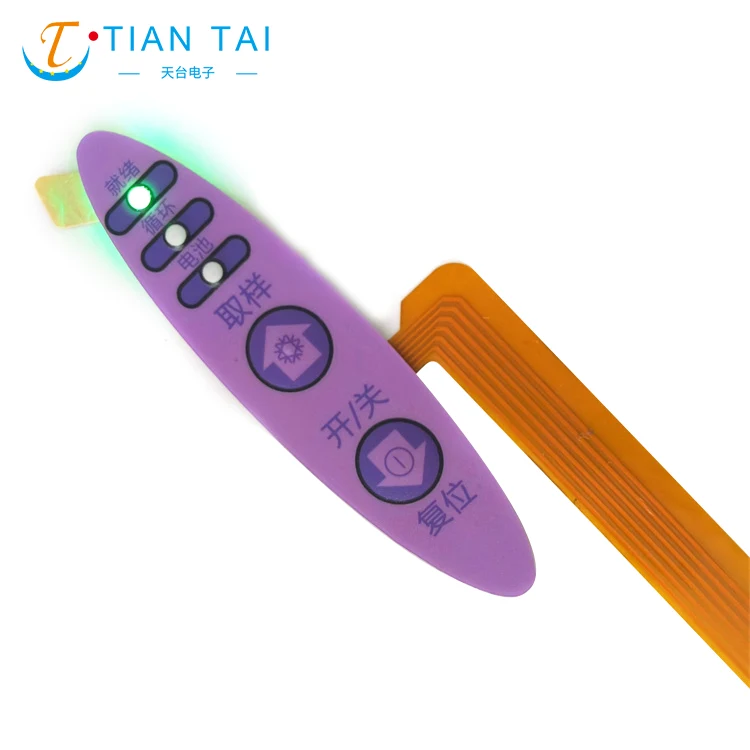
Core mechanisms of energy savings
The energy efficiency of an LED Membrane Keypad stems from three key design principles:
| Feature | Energy Benefit | Application Example |
|---|---|---|
| Pulse width modulation (PWM) control | LEDs operate at low duty cycles (e.g., 10% on, 90% off) | Handheld medical diagnostic tools |
| Selective zone illumination | Only active keys light up, not the entire pad | Industrial remote controllers |
| Ultra-low standby current (<10µA) | Nearly zero drain when device is idle | Wearable health monitors |
Tiantai integrates these features into every LED Membrane Keypad, allowing devices to run weeks longer on a single charge compared to units using always-on backlit alternatives.
Real world impact on battery life
A comparative study of similar handheld terminals shows:
| Keypad Type | Average Current Draw | Battery Life (1000mAh) |
|---|---|---|
| Traditional rubber keypad + separate LED board | 15 mA | 66 hours |
| Tiantai LED Membrane Keypad | 3 mA (with intelligent lighting) | 333 hours |
By using ultra-efficient surface mount LEDs and conductive silver flex circuits, Tiantai reduces parasitic capacitance and resistive losses—two common sources of wasted energy in lesser designs.
LED Membrane Keypad FAQ
Q1: Does an LED Membrane Keypad consume power even when the LEDs are turned off
A1: When the LEDs are off, a properly designed LED Membrane Keypad from Tiantai draws less than 5µA of standby current. This is achieved by completely disconnecting the LED driver circuit via a low leakage MOSFET switch. The membrane’s resistive ladder network for key scanning only activates during actual button presses, typically consuming 1-2 mA for microseconds per press. As a result, the idle power contribution is negligible—equivalent to losing less than 1% of total battery capacity per month.
Q2: Can I adjust the LED brightness to save more battery life
A2: Yes. Tiantai designs each LED Membrane Keypad with programmable constant current drivers that support at least 8 brightness levels (0=off, 7=maximum). Operating at 25% brightness typically reduces LED power consumption by 70% compared to 100% brightness, while still providing adequate visibility in dim environments. Many Tiantai keypads also include ambient light sensor inputs, allowing the host device to automatically lower LED output in dark rooms and increase only when necessary—further extending battery life by up to 40% in field use.
Q3: How does the LED driver architecture affect overall system efficiency
A3: Tiantai employs a charge pump or direct GPIO driving method instead of linear current sinks. Linear sinks waste excess voltage as heat; for example, driving a 3V LED from a 4.2V lithium battery wastes 28% of the energy. Tiantai’s LED Membrane Keypad uses either a low dropout constant current source or an integrated boost converter with efficiency above 90% across the battery’s discharge curve. Additionally, the membrane’s silver polyimide tail minimizes trace resistance (typically <0.5Ω per line), ensuring that power loss in the flexible circuit is under 2%. This holistic approach to driver and interconnect design directly translates to measurable gains in run time for battery powered devices.
Conclusion
Choosing the right input device directly impacts how often users must recharge or replace batteries. Tiantai combines low standby leakage, intelligent zone lighting, and high efficiency driver topologies to make the LED Membrane Keypad an ideal choice for portable medical devices, remote controls, and industrial handheld terminals.
Contact us today to request a power consumption simulation for your specific application or to order sample LED Membrane Keypad units for direct comparison with your current solution. Reach Tiantai through our website contact form or email our engineering support team for a detailed efficiency report tailored to your battery powered device.