

How Does an ACDC Constant Current Chip Shape the Next Generation of Power Electronics?
2025-12-19
Abstract
ACDC Constant Current Chips play a decisive role in modern power management systems by enabling stable current output directly from alternating current sources. This article provides a structured and in-depth examination of how an ACDC Constant Current Chip operates, how its electrical parameters define performance boundaries, and how design logic influences efficiency, safety, and system reliability. By combining engineering fundamentals, application-driven analysis, and market-oriented perspectives, this content delivers a reference-grade overview suitable for engineers, procurement specialists, and technical decision-makers seeking clarity in an increasingly regulated and efficiency-driven electronics landscape.
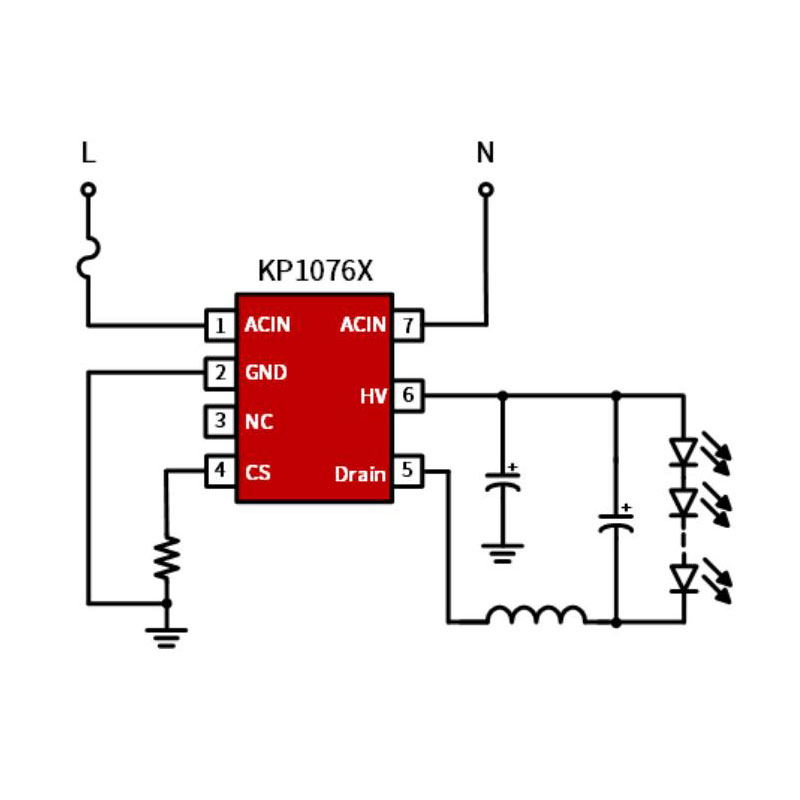
Table of Contents
- 1. Product Overview and Core Operating Logic
- 2. Technical Parameters and Electrical Characteristics
- 3. How an ACDC Constant Current Chip Works in Real Applications
- 4. Common Questions About ACDC Constant Current Chips
1. Product Overview and Core Operating Logic
An ACDC Constant Current Chip is a specialized power management integrated circuit designed to convert alternating current input directly into a regulated constant current output. Unlike traditional multi-stage power solutions that rely on external rectification, bulky transformers, or discrete current regulation components, this category of chip integrates rectification, current sensing, and regulation logic within a compact semiconductor architecture.
The central purpose of an ACDC Constant Current Chip is to maintain a stable output current regardless of input voltage fluctuation, load variation, or environmental changes. This operating principle is especially critical in current-driven loads such as LEDs, semiconductor lighting modules, and certain industrial actuators, where current instability directly translates into performance degradation, thermal stress, or premature failure.
From a system-level perspective, the chip acts as the control core that balances electrical efficiency, safety compliance, and long-term reliability. Its design philosophy emphasizes simplified peripheral circuitry, reduced component count, and predictable electrical behavior across wide input voltage ranges.
In global markets where energy efficiency standards, electromagnetic compatibility requirements, and safety certifications continue to tighten, the ACDC Constant Current Chip has become a foundational component rather than a peripheral option.
2. Technical Parameters and Electrical Characteristics
The technical parameters of an ACDC Constant Current Chip define its application scope, thermal limits, and compliance readiness. Understanding these parameters is essential for accurate component selection and system design optimization.
| Parameter | Typical Range | Technical Significance |
|---|---|---|
| Input Voltage Range | 85–265 VAC | Supports global mains voltage standards without additional conversion stages |
| Output Current Accuracy | ±3% to ±5% | Ensures consistent load performance and minimizes thermal deviation |
| Operating Frequency | Internal fixed or adaptive | Affects electromagnetic interference behavior and efficiency balance |
| Power Factor | Up to 0.9+ | Aligns with regulatory efficiency and harmonic distortion requirements |
| Protection Functions | OVP, OCP, OTP | Prevents damage from abnormal electrical or thermal conditions |
These parameters should not be evaluated in isolation. Instead, they form an interdependent framework where thermal performance, electrical stress margins, and long-term degradation behavior must be assessed together. A well-designed ACDC Constant Current Chip balances these variables to deliver stable operation across extended service lifecycles.
3. How an ACDC Constant Current Chip Works in Real Applications
The functional operation of an ACDC Constant Current Chip can be understood through a structured sequence of internal processes. Each stage contributes to the chip’s ability to regulate current precisely while maintaining safety and efficiency.
How input AC voltage is managed
The chip internally processes alternating current by rectifying the waveform and shaping it into a controllable electrical signal. Advanced designs integrate high-voltage startup circuits that allow stable operation even during low-load or cold-start conditions.
How constant current regulation is achieved
A current sensing mechanism continuously monitors output current and feeds real-time data into an internal control loop. This loop dynamically adjusts switching behavior to compensate for voltage variation, load changes, and temperature drift.
How system protection is implemented
Protection logic is embedded at the silicon level. Overvoltage protection prevents excessive stress on downstream components, overcurrent protection limits fault escalation, and thermal shutdown mechanisms safeguard against overheating under abnormal operating conditions.
In practical applications such as LED lighting systems, industrial signal lamps, and architectural illumination, this integrated control approach reduces external circuitry requirements and simplifies compliance with international safety and efficiency standards.
4. Common Questions About ACDC Constant Current Chips
How does an ACDC Constant Current Chip differ from a traditional AC-DC power supply?
A traditional AC-DC power supply focuses on voltage regulation, while an ACDC Constant Current Chip directly regulates output current. This distinction is critical for current-driven loads, where voltage-based regulation introduces instability and efficiency loss.
How does current accuracy impact system lifespan?
Higher current accuracy reduces thermal stress on connected loads and minimizes material fatigue over time. Consistent current delivery directly correlates with longer operational life and reduced maintenance requirements.
How should thermal performance be evaluated during chip selection?
Thermal performance should be evaluated under worst-case input voltage and ambient temperature conditions. Junction temperature margins, package dissipation capability, and PCB thermal design must be assessed together rather than independently.
How do protection functions influence system reliability?
Integrated protection functions act as preventive mechanisms that limit fault propagation. By addressing abnormal conditions at the chip level, overall system reliability improves and catastrophic failure risks are significantly reduced.
Industry References
International Electrotechnical Commission (IEC) power electronics standards
IEEE publications on power management integrated circuits
Global energy efficiency and harmonic regulation frameworks
As power electronics continue to evolve toward higher integration and stricter compliance requirements, the ACDC Constant Current Chip remains a central enabler of efficient, reliable, and scalable system design. Manufacturers such as Shenzhen Cokintech Co., Ltd. continue to refine chip architectures to address emerging application demands across lighting, industrial control, and smart infrastructure sectors.
For detailed specifications, application guidance, or customized support related to ACDC Constant Current Chip solutions, please contact Shenzhen Cokintech Co., Ltd. to engage with technical specialists and explore appropriate integration pathways.