

How Does Ambient Temperature Affect the Brightness and Reliability of an Indicator Pilot Lamp
2026-04-27
When designing or maintaining control panels, engineers often ask: How does ambient temperature affect the brightness and reliability of an Indicator Pilot Lamp? The answer directly impacts safety, uptime, and maintenance costs. Yuxuan, a trusted name in industrial indication technology, has studied temperature effects on Indicator Pilot Lamp performance across extreme environments. This blog post explains the thermal limits, failure mechanisms, and selection strategies for reliable visual indication.
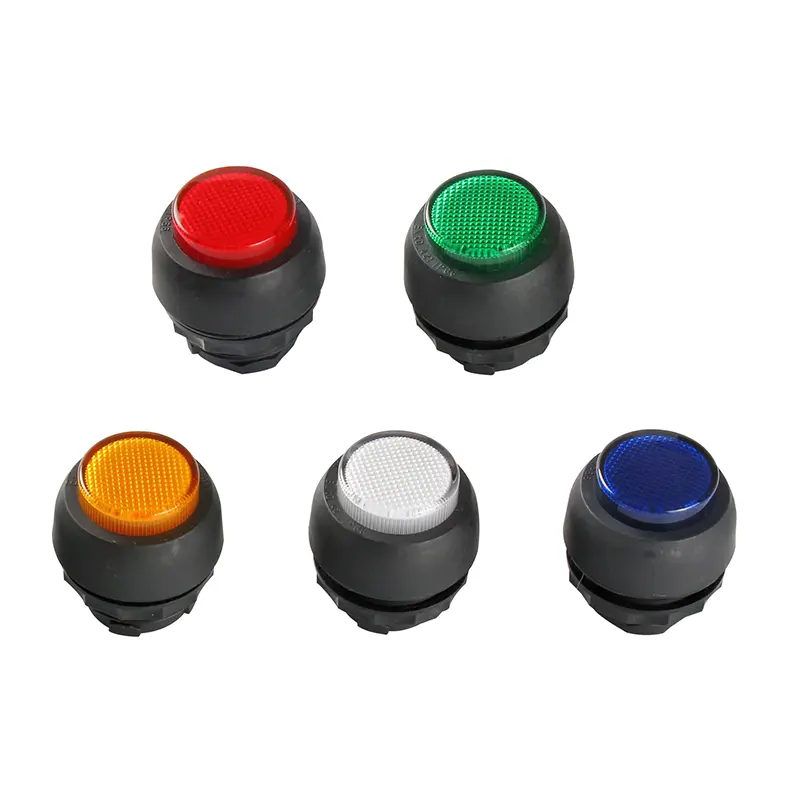
Core Effects of Ambient Temperature
| Temperature Range | Brightness Change | Reliability Risk | Recommended Yuxuan Series |
|---|---|---|---|
| -20°C to 0°C | Slight dimming (LED: ≤5%) | Slow start-up in older types | Yuxuan L series (low-temp rated) |
| 0°C to 50°C | Optimal stable output | Low failure rate | Standard Yuxuan pilot lamps |
| 50°C to 80°C | LED: 10–20% drop; Incandescent: >30% drop | Lens yellowing, solder joint creep | Yuxuan HTH series (high-temp design) |
| Above 80°C | Severe loss or intermittent | Seal failure, internal oxidation | Not recommended without cooling |
Key Mechanisms in Detail
-
For LED-type Indicator Pilot Lamp – High ambient temperature reduces semiconductor efficiency (luminous flux decay). Above 70°C, internal junction temperature may exceed 120°C, causing permanent lumen depreciation. Yuxuan uses thermal-conductive housings to mitigate this.
-
For incandescent types – Brightness drops exponentially with heat due to increased filament resistance and faster evaporation. Reliability halves for every 10°C rise above 40°C.
-
Plastic and sealing components – Thermal expansion cycles cause micro-cracks, letting moisture enter. Yuxuan indicator lamps employ IP65-rated silicone seals for stability from -30°C to 85°C.
Three FAQ – Indicator Pilot Lamp Common Questions
Q1: Can I use a standard Indicator Pilot Lamp in a freezer warehouse at -25°C?
A: Standard lamps often experience delayed illumination or no light-up below -20°C due to increased forward voltage requirement in LEDs and brittle lens materials. Yuxuan offers a low-temperature Indicator Pilot Lamp series that operates down to -40°C without brightness loss, using specialized driver ICs and polycarbonate lenses. Always check the datasheet’s minimum ambient rating – never assume general-purpose products work in extreme cold.
Q2: Why does my Indicator Pilot Lamp flicker or turn yellow after one hot summer?
A: Continuous exposure above 65°C degrades the epoxy resin or acrylic lens (yellowing reduces light output by 40-60%). Internal solder joints may also creep and create intermittent connections. Yuxuan high-temperature models replace standard plastics with glass-reinforced nylon and use gold-plated terminals. For existing panels, measure internal panel temperature – if exceeding 60°C, relocate the Indicator Pilot Lamp or add ventilation.
Q3: How can I predict the service life of an Indicator Pilot Lamp under varying temperatures?
A: Use the Arrhenius rule: for every 10°C rise above the rated maximum ambient, the failure rate doubles. For a Yuxuan LED Indicator Pilot Lamp rated 50,000 hours at 40°C, operating at 60°C reduces life to ~12,500 hours. To get accurate estimates, request thermal simulation data from the manufacturer. Yuxuan provides online life calculators based on your actual operating temperature cycle.
Practical Recommendations (Checklist)
-
For outdoor panels in summer: choose Yuxuan Indicator Pilot Lamp with built-in current limiting to prevent self-heating.
-
For ovens or kilns: use fiber-optic light guides with remote lamp bodies – standard Indicator Pilot Lamp cannot survive above 85°C ambient.
-
Always derate voltage by 10% if ambient exceeds 60°C to reduce internal heat generation.
Why Yuxuan Excels in Thermal Management
Yuxuan engineers each Indicator Pilot Lamp with thermal imaging validation. Our patented heat-sink base design keeps junction temperature 15°C lower than industry averages, preserving both brightness and MTBF (mean time between failures). Whether you need -40°C cold-storage indication or +85°C machine tool lamps, Yuxuan provides certified performance data – not just marketing claims.
Conclusion
Ambient temperature fundamentally changes how an Indicator Pilot Lamp behaves. Ignoring thermal effects leads to unexpected dimming, false signals, and premature replacement. By selecting Yuxuan temperature-optimized Indicator Pilot Lamp models, you ensure consistent brightness and long-term reliability.
Contact us today for a free thermal assessment of your panel indicators. Share your operating temperature range and required luminance level, and Yuxuan will recommend the exact Indicator Pilot Lamp model – complete with lifetime projection charts and sample testing.