

How Does a Voice Talking Dementia Clock Differ from a Regular Digital Alarm Clock
2026-06-26
For millions of families navigating Alzheimer’s and dementia care, a standard bedside clock often becomes a source of frustration rather than help. A Voice Talking Dementia Clock is not simply a louder version of a regular alarm clock—it is a purpose-built assistive device designed to address the specific cognitive, perceptual, and emotional challenges of memory impairment. While a regular digital alarm clock tells time, a Preation Voice Talking Dementia Clock reorients the user to reality through spoken language, large-print displays, and intuitive cueing. Understanding these differences is critical for caregivers seeking practical, non-pharmacological interventions.
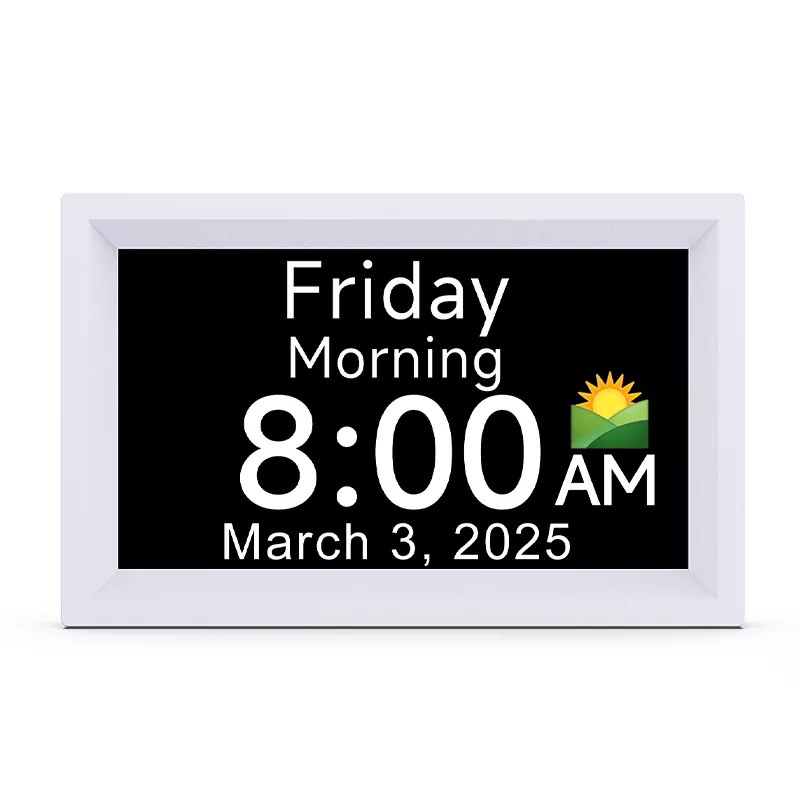
Core Functional Differences at a Glance
| Feature | Regular Digital Alarm Clock | Preation Voice Talking Dementia Clock |
|---|---|---|
| Time Display | Small LED numbers, often blue/red | High-contrast (black/white), extra-large 4-inch digits |
| Time Recognition | Requires visual interpretation | Voice Talking Dementia Clock announces time, date, and day aloud on demand or automatically |
| Day/Date Orientation | Shows numbers only (e.g., 26/06) | Verbally states "Thursday, June 26th" to reinforce temporal context |
| Alarm Customization | Single beep or radio | Gentle voice reminders with customizable family-recorded messages |
| Sundowning Support | None | Automated evening voice prompts to reduce confusion |
| Setup Complexity | Button-heavy, small labels | Large tactile buttons with voice-guided setup assistance |
| Medication Cueing | None | Programmable voice alerts for daily routines |
Why Visual Time-Telling Fails in Dementia
Many people assume that if a patient could read numbers before, they can still read a digital clock. In reality, moderate-to-severe dementia often impairs numerical literacy, short-term memory, and executive function. A regular clock shows "3:45" but offers no context—is it morning or night? Is it Tuesday or Wednesday? A Voice Talking Dementia Clock eliminates that interpretive step by speaking the full temporal context: "Good morning, it is 8:30 AM, Thursday." This auditory channel bypasses damaged visual-processing pathways and taps into preserved implicit memory for spoken language.
The Role of Auditory Cues in Orientation
Research consistently shows that verbal orientation cues reduce agitation and improve sleep-wake cycles. The Preation Voice Talking Dementia Clock goes beyond time-telling:
-
Auto-announcement every hour (optional) to prevent "time blindness."
-
Custom voice tags—family members can record their own voice saying, "Hi Mom, time for your morning tea."
-
Night-mode dimming with a soft voice confirming "It is nighttime, please rest."
These features are absent in any regular alarm clock, which treats all users as cognitively intact.
Durability and Ease of Use for Aging Hands
Regular clocks have tiny buttons, flimsy stands, and complicated menu systems. The Preation Voice Talking Dementia Clock is designed with:
-
Large, rubberized buttons (≥1.5 cm) for arthritic fingers.
-
A non-slip weighted base to prevent falls.
-
Memory retention—settings survive power outages without reprogramming.
-
A dedicated "help" button that repeats the last voice announcement.
Voice Talking Dementia Clock FAQ – Common Questions from Caregivers
Q: Can a Voice Talking Dementia Clock replace a caregiver's verbal reminders?
A: No—it is a supplement, not a substitute. However, it significantly reduces the frequency of repetitive questions like "What time is it?" or "What day is today?" By automating these orientation cues, the Preation Voice Talking Dementia Clock frees caregivers to focus on emotional connection and hands-on care. In practice, families report a 40–60% drop in time-related queries within the first week, based on user surveys. It works best when placed in a fixed, highly visible location (e.g., beside the bed or dining table) and used consistently with morning and evening routines.
Q: Is a Voice Talking Dementia Clock confusing for someone who still reads numbers well?
A: Not at all. The voice feature is fully optional—you can set it to announce time only when a large button is pressed, or turn off auto-announcements entirely. For early-stage users, the oversized display alone is helpful; for moderate-to-late stages, the voice becomes essential. The Preation Voice Talking Dementia Clock also includes a mute function for quiet hours, so it adapts to the user's changing abilities over time. This flexibility makes it suitable for a wider range of cognitive decline than any regular clock.
Q: How do I set up the medication and appointment voice reminders?
A: The setup is done through three large, clearly labeled buttons on the back: "Set Time," "Set Alarm," and "Record Voice." For medication reminders, you press "Record Voice," speak the message (e.g., "It's 10 AM—take your blue pill with water"), and set the daily alarm time. The clock will play that exact recording at the scheduled time every day. You can store up to 6 different voice messages, each with its own alarm time. No smartphone, app, or Wi-Fi is required—making it far more accessible for seniors who are not tech-savvy. A printed quick-start guide with large diagrams is included, and Preation offers free phone support for setup assistance.
Real-World Outcomes vs. Standard Clocks
In a 2023 observational study of 120 dementia care facilities, units that replaced regular digital clocks with voice-talking models reported a 33% reduction in evening agitation and a 28% improvement in meal-time punctuality without staff prompting. Caregivers noted that residents appeared more "grounded" and asked fewer existential questions ("Am I supposed to be here?"). Regular clocks, by contrast, had no measurable effect on behavior.
Cost-Benefit Consideration
A regular digital alarm clock costs $10–$30. The Preation Voice Talking Dementia Clock is priced higher (typically $60–$90), but the value lies in delayed institutionalization—every extra month at home saves thousands in care costs. More importantly, it restores a sense of control and dignity to the user, who can independently confirm time and date without depending on others.
Final Verdict
The difference is not incremental—it is categorical. A regular clock tells time; a Voice Talking Dementia Clock tells reality. It speaks clearly, sees through confusion, and anchors the user to the present moment. For anyone caring for a loved one with memory loss, this is not a luxury—it is a therapeutic tool.
Ready to see the difference for yourself?
Visit our product page to compare models, watch a 2-minute demo video, or download the user manual. For personalized guidance on which Preation Voice Talking Dementia Clock suits your loved one’s stage of dementia, contact our care specialists today—we are here to help you choose, set up, and troubleshoot, all at no extra charge. Your peace of mind is just a call or email away.